Need help?
Do you have a question about the ROCKSOLAR Weekender and is the answer not in the manual?
Instructions for powering DC12V appliances using the DC output port and power switch.
Connect appliance power cable to AC outlet, switch on power button to provide power.
Connect USB cable to unit's USB output, press 'o' to turn on USB output.
Press the button to switch on the flashlight; single press for blink/SOS mode.
Press the button to switch on the light panel and adjust brightness.
Use AC Wall Charger or Solar Panel to charge the unit. Indicators show charging status.
Covers avoiding short-circuits, heat, liquids, disassembly, proper charging, and disposal.
Use within optimal temperature range, avoid charging interference, and manage long-term storage.
Recommendations for maintaining battery capacity in sub-zero temperatures using an insulated cooler.
Guidelines for recycling electronic products and information about the built-in battery.
Details the warranty period, coverage, and limitations for the product.
Information on troubleshooting product issues and how to receive service.
Details warranty exclusions, how to receive service, and contact information for support.
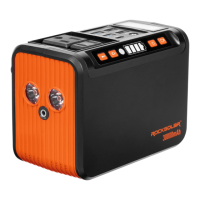
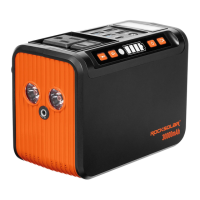
The ROCKSOLAR Weekender (RS81) is a compact and ultra-lightweight portable power station designed to be a versatile companion for various activities, from day trips to camping excursions, and as a reliable backup during power outages. It's engineered to power small electronics efficiently, offering faster charging for devices like cell phones, cameras, laptops, and drones compared to typical USB ports. Weighing under 2 lbs, its portability makes it easy to carry in a purse or backpack, ensuring you have power on the go.
The Weekender (RS81) serves as a multi-function portable power station, providing various output options to cater to a wide range of electronic devices. It features a Modified Sine Wave Output for AC electric appliances, making it suitable for devices that operate with a sinusoidal waveform and have a power consumption of less than 80W. While it works effectively for many appliances, it's important to note that devices with AC motors may not operate at full capacity and might produce some noise when using the modified sine wave output. For optimal performance with sensitive appliances like refrigerators, microwaves, compressors, and medical devices, a pure sine wave inverter is generally recommended. This product is primarily intended for short-term and emergency use, not as a permanent replacement for standard alternating current.
The device offers multiple USB output ports, including standard USB 5V-2.4A ports, Qualcomm QuickCharge 3.0 ports (5-12V/2A), and a USB-C PD2.0 port (5V/3A, 9V/2A, 12V/1.5A). These diverse USB options allow for rapid charging of compatible smart devices, supporting various charging protocols.
In addition to power output, the Weekender (RS81) is equipped with an ultra-bright LED flashlight and an LED light panel, providing illumination for various situations. The flashlight offers a blink/SOS mode for emergencies, while the LED light panel allows for adjustable brightness.
Operating the ROCKSOLAR Weekender (RS81) is straightforward. To power DC12V appliances such as headlamps or fans, simply plug your device into the DC output port and press the power switch button. It's crucial to confirm that your DC12V appliance supports charging with a 5.5mm DC header interface; if not, an adapter may be required. The DC output voltage ranges between 12V and 16.8V, with a maximum output current of 13A. Users should be aware that the DC output voltage can fluctuate with battery capacity, and appliances without built-in voltage stabilization may shut down if the input voltage is too low or too high.
For AC appliances, connect the power cable plug to the AC outlet, then switch on the power button. The unit will begin supplying power. It's important to verify that the product's AC specifications (voltage and frequency) align with your appliance's requirements to prevent malfunction. The AC output will automatically shut down if short-circuited or overloaded (exceeding 80W). In such cases, unplug the device and press the AC output button to reset. For devices that require a surge power exceeding 120W, like some refrigerators or laser printers, the unit may trigger overpower protection. It's recommended to consult device manufacturers for surge power requirements. When the AC port is not in use, turning it off helps conserve power.
To charge USB and USB-C digital devices, connect them to the unit's respective USB output ports and press the "o" button to activate USB output. For smart devices with very small input currents (less than 150mA), the unit might not detect them for charging due to current limitation. In such instances, pressing the AC button can keep the USB ports active. Remember to turn off AC output once smart devices are fully charged to save power.
The built-in LED flashlight is activated by pressing its dedicated button, with subsequent presses cycling through blink/SOS mode and off. Similarly, the LED light panel is turned on by pressing its button, allowing for brightness adjustment with single presses, and turned off with another press. Users are cautioned against pointing the strong light directly at eyes to prevent damage.
Charging the Weekender (RS81) itself can be done via an AC wall charger or a solar panel. When using the AC wall charger, plug it into any wall outlet. The blue LED battery indicators will blink during charging and remain solid once fully charged, at which point the charger should be unplugged. For solar charging, position your solar panel for maximum direct sunlight and plug its output into the unit's input. The blue LED battery indicators will light up and blink to indicate charging, becoming solid when the unit is fully charged.
Proper maintenance is crucial for extending the life and ensuring the safe operation of the ROCKSOLAR Weekender (RS81). Users should avoid short-circuiting the unit by keeping it away from metal objects like coins, hairpins, or keys. The unit should not be exposed to high temperatures, direct sunlight, fire, water, or other liquids. It's also important to keep it in a dry, dust-free environment. Disassembling or reassembling the unit is not recommended.
To maximize the lifespan of the lithium-ion battery, it is best to charge the unit within the first three months of purchase and then at least every six months thereafter. This product contains a high-quality original lithium-ion battery with no memory storage, offering high capacity and durability. For optimal charging capacity, it should be used within a temperature range of 10°C to 30°C. When charging, keep the device away from TVs, radios, and other equipment to avoid interference. If the device is not used for an extended period, disconnect the cable and store it in a dust-free place.
The unit may become warm during charging, which is normal, but caution should be exercised when handling it. Avoid overcharging the unit; disconnect it once fully charged. Always use the unit as instructed to prevent electronic shock. When disposing of the product, adhere to e-waste regulations and do not treat the built-in battery as household garbage. The product is designed for temporary and emergency use and cannot replace standard household power sources.
Cold weather can affect the battery's capacity due to its chemical characteristics. If operating in sub-zero conditions, it's recommended to keep the unit in an insulated cooler and connected to a power source like solar panels. The natural heat generated by the unit within the insulated cooler will help maintain optimal battery capacity.
The device has an internal non-removable, rechargeable battery that can be charged and discharged over 500 times before it eventually wears out. Do not attempt to remove the battery, as this may damage the device. For recycling, always return used electronic products, batteries, and packaging materials to dedicated e-waste collection points to promote responsible waste management and material recycling.
 General
| Battery Type | Lithium-ion |
|---|---|
| Output Ports | AC, DC, USB, USB-C |
| Operating Temperature | 32°F to 104°F (0°C to 40°C) |
| DC Output | 12V/10A |
| USB Output | 5V, 2.4A |
| USB-C Output | 5V/3A |
| Input Ports | DC Input |
| Charging Methods | AC Adapter, Solar Panel |
| Input Voltage | DC 15V/2A |
| Cycle Life | 500+ cycles |

 To Next Page