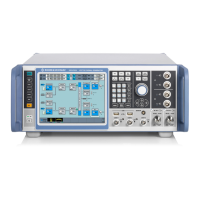
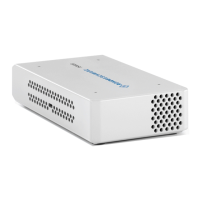
The R&S EZ-17 is an RF current probe designed for measuring RF currents in conductors and, for Model 03, injecting interference currents. It operates like a transformer, where the conductor under test forms the primary winding and the probe's jaws, containing two halves of a ferrite core, form the secondary winding. The probe measures a voltage proportional to the primary current at its RF output, which is then displayed by a connected measuring instrument.
Function Description:
The R&S EZ-17 current probe is used to measure RF currents in a conductor by clamping its jaws around the conductor. It converts the primary current into a proportional voltage at its RF output. This voltage can then be read by a measuring instrument, such as an EMI receiver. Model 03 of the probe also supports electromagnetic susceptibility (EMS) measurements, specifically for bulk current injection tests, by allowing the injection of interference currents onto the conductor.
The probe's design incorporates a metal frame and two halves of a ferrite core, which also provide static shielding. When closed, a spring catch holds the two halves of the current probe together, ensuring a defined air gap and a closed magnetic circuit for accurate measurements.
Important Technical Specifications:
The R&S EZ-17 is available in two models, each optimized for specific applications within a frequency range of 20 Hz to 100 MHz (with an extended range up to 245 MHz):
-
Model 02 (0816.2063.02): This model is an RF current probe with a flat frequency response above 1 MHz and an internal resistance of 50 Ω. It complies with CISPR 16-1-2 and is suitable for:
- Measuring electromagnetic emissions according to standards like CISPR14-1, CISPR25, CISPR32, and MIL-STD-461.
- Measuring the shielding effectiveness of RF cables.
- The permanent permissible current loading for Model 02 is limited by the loading of its internal terminations.
- The transducer factor (k) for Model 02 is -10 dB in the range of the plane frequency response.
-
Model 03 (0816.2063.03): This model functions as both an RF current measurement probe and an RF current injection probe. It features a small transducer factor in the frequency range from 1 MHz to 200 MHz and a high load capacity, making it ideal for:
- Measuring electromagnetic emissions with high sensitivity requirements (e.g., VG 95373-20 and RTCA/DO-160).
- Performing electromagnetic susceptibility (EMS) measurements (bulk current injection tests).
- The permanent permissible current loading for Model 03 is limited by the thermal loading capacity of the ferrite core.
- The transducer factor (k) for Model 03 is -17 dB in the range of the plane frequency response.
For both models, at frequencies lower than 1 MHz, the voltage response decreases by 20 dB per frequency decade. At frequencies higher than 100 MHz, the voltage response is influenced by an intrinsic resonance of the R&S EZ-17. The outer diameter of the conductor (single-wire, multi-wire, or coaxial cables) that can be placed within the probe's jaws must be less than 30 mm.
Usage Features:
- Ease of Use: The probe is designed as a clamp, allowing for easy placement around a conductor.
- Connection: It connects to a measuring instrument (e.g., an EMI receiver) via an N-connector. An appropriate cable is included, with its frequency-dependent cable loss already considered in the calibration data. For other cables, adequate shielding and correction for additional loss are required, and cables must have an impedance of 50 Ω.
- Safety Precautions:
- Users must be electrically skilled persons with relevant education and experience to perceive and avoid electrical hazards.
- Always switch off the test circuit before applying the current probe.
- Only use the current probe on insulated conductors, ensuring the insulation is sufficient for the voltage and meets current standards (e.g., IEC 60664-1:2020).
- Avoid using the probe on uninsulated live lines belonging to measurement category II, III, or IV, as this can cause serious injury.
- Do not connect the probe to devices that can imprint hazardous voltages (above 30 V RMS, 42 V peak, or 60 V DC).
- Observe all voltage and current ratings to prevent electric shock.
- Use the probe only within specified frequency limits to avoid high temperatures and potential burns or fire.
- Measurement Quality: To ensure accurate results, avoid any contamination that could create an additional air gap between the two halves of the probe, as this can invalidate the measurement.
- Current Loading: Be aware of permissible current loading limits specified in the datasheet to prevent saturation of the ferrite core. When measuring bunched wires, ensure the vector sum of the currents does not exceed these limits.
- Transducer Factor: An individual transducer factor is provided with each probe. It is recommended to store this factor in the measuring receiver for automatic correction and display of results in dBµA. The current level in dB(µA) is calculated by adding the transducer factor (k) to the voltage level in dB(µV).
Maintenance Features:
- No Regular Maintenance: The R&S EZ-17 does not require regular maintenance, apart from occasional cleaning.
- Cleaning: The product should be cleaned using a dry, lint-free cloth. Do not use liquid cleaning agents, solvents, acids, or bases, as these can damage the front panel labeling, plastic parts, and display. The casing is not waterproof.
- Storage: Protect the product from dust. Ensure that storage conditions (temperature range, climatic load) comply with the values specified in the data sheet.
- Disposal: Rohde & Schwarz is committed to eco-friendly disposal and recycling. Products labeled with the WEEE symbol (Figure 7-1) cannot be disposed of in normal household waste or municipal collection points for waste electrical and electronic equipment. Contact a local service representative for proper disposal.

 Need help?
 General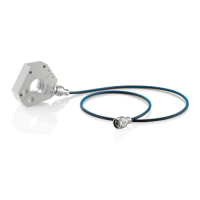

 To Next Page