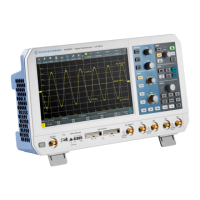
The R&S®RTC1000 is a digital oscilloscope designed for measurements on circuits that are indirectly connected to the mains or not connected at all. It is rated for pollution degree 2, suitable for indoor, dry locations where only non-conductive pollution occurs, though temporary conductivity due to condensation is possible. The instrument must be operated by personnel familiar with the potential risks of measuring electrical quantities, adhering to local and national safety regulations.
Function Description
The R&S RTC1000 is a versatile digital oscilloscope used for analyzing electrical signals. It features two analog input channels and supports various measurement modes and functions. The instrument can be controlled remotely and offers context-sensitive help directly on the device. It also includes a pattern generator (optional R&S RTC-B6) and logic channels (optional R&S RTC-B1) for mixed-signal analysis.
Important Technical Specifications
- Power Supply: The R&S RTC1000 automatically adapts to different AC power voltages.
- Nominal ranges: 100 V to 240 V AC at 50 Hz to 60 Hz, or 100 V to 120 V at 400 Hz.
- Maximum power consumption: 25 W.
- Input Impedance: All BNC inputs have an input impedance of 1 MΩ.
- Maximum Input Voltages:
- Channel inputs: 200 V (peak) and 150 V (RMS).
- External trigger input: 100 V (peak) and 70 V (RMS).
- Transient overvoltages must not exceed 200 V (peak).
- Logic Probe Input (optional R&S RTC-B1):
- Maximum input voltage: 40 V (peak) at 100 kΩ input impedance.
- Maximum input frequency for a signal with minimum input voltage swing and medium hysteresis: 800 mV (Vpp) is 300 MHz.
- Trigger Level: The external trigger input level can be set from -5 V to 5 V.
- Interfaces:
- USB 2.0 (Type A) for connecting USB flash drives for storing and reloading instrument settings and measurement data, and for firmware updates.
- USB 2.0 (Type B) for connecting a printer or for remote control.
- LAN (RJ-45) for connecting to a Local Area Network (LAN), supporting up to 100 Mbit/s.
- EMC: Electromagnetic interference (EMI) can affect measurement results. Use shielded cables and terminate open cable ends to suppress EMI.
Usage Features
- Setup and Operation: The instrument can be used in standalone operation on a benchtop or installed in a 19" rack mount (with an optional rack mount kit). For standalone use, it can be placed horizontally or with its support feet extended.
- User Interface: The front panel features a display, softkeys, an [ON/OFF] key, and functional blocks for Cursor/Menu, Analysis, General, Vertical, Trigger, and Horizontal sections.
- Input Connectors: Two BNC connectors for analog channel inputs (CH1, CH2), one BNC connector for external trigger input, and a multi-purpose BNC connector [Aux Out].
- Logic Channels (optional R&S RTC-B1): A connector for the logic probe, allowing for mixed-signal analysis.
- Pattern Generator (optional R&S RTC-B6): Output for the pattern generator and a probe adjustment output.
- Powering On/Off: The instrument powers on automatically when connected to AC power and the main power switch is in position I. It adapts to different AC voltages. To shut down, press the [ON/OFF] key on the front panel, then switch the main power switch to position 0 and disconnect the AC power cable. Proper shutdown using the [ON/OFF] key is crucial to prevent data loss.
- Warm-up Time: After powering on, the instrument requires approximately 20 minutes for self-alignment and measurements to stabilize.
- Safety: The instrument is not rated for any measurement category. When measuring in circuits with transient overvoltages of category II, III, or IV, use probes that comply with DIN EN 61010-031 and appropriately reduce the voltage to prevent overvoltages higher than 200 V (peak) from being applied to the instrument.
Maintenance Features
- Fuse Replacement: The instrument is protected by a fuse located on the rear panel between the main power switch and AC power supply.
- Fuse type: Size 5x20 mm, 250V~, T2.5H (slow-blow), IEC60127-2/5.
- Always ensure the instrument is switched off and disconnected from all power supplies before replacing the fuse. Use only Rohde & Schwarz supplied fuses or fuses of the same type and rating.
- Firmware Updates: Firmware updates can be performed via the USB Type A interface.
- Cleaning: The instrument should be kept in a dry, indoor environment.
- Airflow: Ensure all fan openings are unobstructed and airflow perforations are unimpeded. Maintain a minimum distance of 10 cm from walls and 20 cm between instruments when placed side by side to prevent overheating.
- Documentation: Comprehensive documentation is available, including a user manual, service manual (for registered users), calibration certificate, and release notes.

 Need help?
 General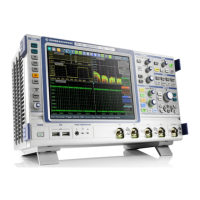



 To Next Page