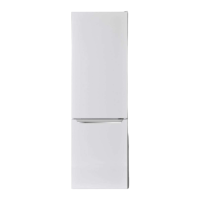
This document serves as a comprehensive manual for the ROMMER Combi Refrigerator - Freezer models CM 316 A++ INOX and CM 315 A++. It provides essential information regarding environmental considerations, safety precautions, installation, operation, maintenance, and troubleshooting.
The appliance is marked according to European Directive 2002/96/CE for Waste Electrical and Electronic Equipment (WEEE). The crossed-out wheeled bin symbol on the appliance indicates that it should not be treated as normal household waste at the end of its life. Instead, it must be taken to a differentiated collection center for electrical and electronic waste or returned to the retailer when purchasing a new equivalent appliance. Proper differentiated collection helps prevent negative environmental and health impacts from incorrect product treatment. Disposal must comply with local environmental regulations. The packaging materials, such as polystyrene, cardboard, and plastic bags, should be sorted for recycling. The appliance is HFC-free, and its refrigerant circuit contains R600a (Isobutane).
R600a (Isobutane)
Isobutane is a natural gas that does not harm the environment but is flammable. Before connecting the appliance to the power supply, ensure that none of the tubes in the refrigerant circuit are damaged. For every 8 grams of refrigerant, the installation site must have a minimum volume of 1 cubic meter. The amount of refrigerant is specified on the technical data card located on the back of the appliance. In case of refrigerant leakage, avoid open flames or ignition sources near the leak point.
Safety Precautions
This section outlines key safety measures for using the appliance. Always read and follow these instructions carefully. Keep the instruction manual for future reference and pass it on to any new owner if the appliance is sold.
- The appliance is intended exclusively for domestic use to store/freeze food.
- It is not intended for commercial use.
- In case of emergency, disconnect the appliance immediately.
- Check that the power cord is not damaged.
- Avoid using extension cords or multiple plugs to connect to the power supply.
- Never touch or handle the appliance with bare feet or wet hands/feet.
- Before any cleaning or maintenance, unplug the appliance or switch off the main power supply.
- To disconnect, pull the plug from the socket; do not pull the power cord.
- Do not place glass bottles or containers in the low-temperature section, as they may crack or break when their contents freeze.
- Any maintenance, including replacing the power cord, must be performed by technical assistance or qualified personnel. Otherwise, serious injury could occur.
- The packaging materials (plastic bags, polystyrene, etc.) can be dangerous for children; keep them out of reach.
- Do not allow children to play with the appliance. Children should not climb into the drawers, as they could get trapped.
- Do not use the appliance as a step or support for heavy objects.
- Ensure proper ventilation to avoid overheating.
- Maintain a minimum distance of 10 cm from the wall for proper air circulation.
- Do not store explosive or flammable substances near the appliance.
- Do not place hot food directly into the appliance.
- Ensure the appliance is placed on a flat, stable surface.
- Avoid direct sunlight or heat sources.
- Do not store electrical appliances inside the refrigerator/freezer.
- Do not use sharp objects to remove ice.
- Do not damage the refrigerant circuit.
Function Description
The ROMMER Combi Refrigerator - Freezer is designed for storing and freezing food in a household setting. It features separate compartments for refrigeration and freezing, allowing for optimal temperature control for different types of food. The appliance includes a thermostat for temperature adjustment and internal lighting.
Important Technical Specifications
- Models: CM 316 A++ INOX, CM 315 A++
- Refrigerant: R600a (Isobutane)
- Energy Efficiency: A++ (as indicated in the model name)
- Freezer Rating: 4 stars (suitable for long-term storage of frozen food)
- Bulb Wattage: 2W (for internal lighting)
- Recommended Ambient Temperature: Between 16°C and 43°C (for optimal performance)
- Minimum Clearance: 9cm (3 1/2") at the back, 2cm (3/4") at the sides.
Usage Features
- Temperature Adjustment: The refrigerator temperature is controlled via a panel in the refrigerator compartment. The recommended setting for normal use is 5. Adjustment cycles are 2→4→5→6→8→2. Higher numbers indicate warmer temperatures. Users can adjust the temperature based on their needs (lower number for colder, higher number for warmer).
- Fast Cool Function: This function allows for rapid cooling or freezing of food. It automatically deactivates after 26 hours or can be manually turned off.
- Error Indication: If indicator lights "2," "5," or "8" flash, it signals a refrigerator malfunction. Contact after-sales service.
- Food Storage Guidelines:
- Uncooked vs. Cooked Food: Do not mix prepared food with uncooked food. Store them on separate shelves, preferably covered with film.
- Air Circulation: Leave space around food to allow cold air to circulate throughout the appliance.
- Wrapping Food: Wrap food in separate, closed compartments to prevent odor transfer and drying.
- Pre-cooked Food: Allow pre-cooked food to cool completely before placing it in the refrigerator or freezer.
- Door Usage: Limit opening the door frequently to prevent cold air from escaping.
- Freezer Storage: Store frozen food according to the "Best Before" date on the packaging.
- Freezing Fresh Food: Freeze food in small quantities for faster freezing and thawing. Avoid metal containers. Use special freezer bags, plastic containers, or aluminum foil. Leave a small "air space" for liquids to expand.
- Salad Bin: This is the most humid part of the fridge, ideal for vegetables, fruits, and fresh salad items. Always wrap produce kept in the salad bin.
- Raw Meat/Poultry/Fish: Store on the lowest shelf to prevent dripping onto other foods.
- Flammable Materials: Do not store flammable gases or liquids.
Maintenance Features
- Defrosting:
- Temporary Measure: Scrape away frost build-up with a plastic scraper. Never use metal or sharp instruments.
- Complete Defrosting: Necessary approximately once a year or when the frost layer exceeds 5mm.
- Procedure:
- Remove frozen food and place it in another freezer/refrigerator or wrap it in newspaper/towels and a blanket in a cool place.
- Turn the thermostat to "0" and disconnect the appliance from the power supply. Leave doors open.
- Scrape away frost with a plastic scraper. Place bowls of hot water inside to accelerate thawing.
- Once defrosted, clean the interior.
- Cleaning the Interior:
- Clean with a weak solution of bicarbonate of soda.
- Rinse with warm water using a damp sponge or cloth and wipe dry.
- Wash drawers in warm soapy water and dry thoroughly before replacing.
- The drain hole has a "cleaning spike" to prevent food particles from entering. Use it to ensure no blockages after cleaning.
- Cleaning the Exterior:
- Use a standard non-abrasive detergent diluted in warm water.
- Vacuum the condenser grille at the back with a soft brush attachment.
- Do not use harsh cleaners, scouring pads, or solvents.
- Changing the Light Bulb:
- Turn the thermostat to "0" and disconnect the appliance.
- Remove the bulb cover.
- Remove the old bulb.
- Insert a new 2W bulb.
- Replace the cover and reconnect the appliance.
- Reversing the Door Swing:
- It is recommended to contact a qualified technician for this procedure.
- Tools Needed: Star-style screwdriver, flat-blade screwdriver, hexagonal wrench.
- Procedure (detailed steps with illustrations are provided in the manual):
- Remove the refrigerator and freezer doors.
- Remove the hinge cover and bolts.
- Remove the top hinge bolts.
- Remove the doors.
- Remove the middle hinge bolts.
- Lift and remove the doors.
- Remove the bottom hinge bolts.
- Reverse the door stop and locking plate.
- Assemble the bottom hinge and its bolts.
- Adjust the height of the feet to level the refrigerator.
- Assemble the freezer door and rotate the middle hinge 180 degrees, fixing its bolts.
- Assemble the refrigerator door and upper hinge, fixing its bolts and covering the hinge.
- Assemble the hole of the roof in the cabinet side, fixing its bolts.
- Important: Save all removed parts. Rest the fridge freezer on a solid surface during the process. Do not lay it flat to avoid damaging the coolant system. Ensure the appliance is unplugged and empty. Two people are recommended for assembly. Double-check door alignment and seal closure, adjusting leveling feet if necessary.
Troubleshooting
- No Power: Check if plugged in, switched on, and if the fuse is blown. Test the socket with another appliance.
- Exceptionally Cold: Thermostat may be set too high.
- Exceptionally Warm: Compressor may not be working. Turn the thermostat to maximum and wait a few minutes. If no humming sound, contact the store.
- Not Working: Check power connection. Ensure ambient temperature is between 16°C and 32°C. Leave the appliance for 30 minutes.
- Condensation on Exterior: May be due to room temperature changes. If persistent, contact a qualified technician.
- Noises (Gurgling, Whooshing, Humming, Pulsating): These are normal sounds from refrigerant circulation and compressor operation.
- Servicing: Repairs should only be performed by authorized engineers. Do not attempt self-repair. Contact the local store for service. If not in use for long periods, disconnect, empty, clean, and leave the door ajar to prevent odors.

 Need help?

 To Next Page
 General