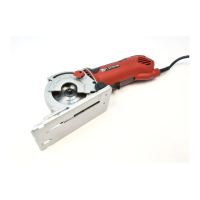
The Rotorazer 3000 Series, RZ120, is a versatile electric circular saw designed for ripping and cross-cutting various materials while resting firmly on the workpiece. This multifunctional mini saw is suitable for cutting wood, laminate flooring, plastics, ceramic tiles, slate, aluminum sheet, and other materials. It comes equipped with a safety guard, an adjustment blade setting, and three interchangeable blades, along with other attachments, to enhance its utility.
Function Description:
The Rotorazer 3000 Series, RZ120, operates by holding the material to be cut between its base plate and a support surface, allowing the blade to penetrate the material for clean, fast, and safe cuts. To switch the tool on, the safety switch (2) must be pushed forward with one finger, followed by pressing and holding the ON/OFF switch (1). The release button for the safety guard (14) is then pressed with the thumb. Releasing the ON/OFF switch (1) turns the tool off.
The cutting depth is adjustable, a crucial feature for precise work. It is recommended to adjust the cutting depth to be at least 2 mm deeper than the material's thickness for a clean cut. This adjustment is made by loosening the adjustment lever (3), moving it until the arrow points to the desired depth on the scale (7), and then tightening the lever again.
For cutting along a straight line, the indicators on the front and rear of the blade guard assist in guiding the saw. Plunge cutting, while sometimes challenging in very hard materials, is also possible. For plunge cuts, the cutting depth (3) is adjusted, the tool is connected to the power source, and the base plate is placed on the workpiece. After turning on the tool and allowing the blade to reach working speed (about two seconds), the blade is slowly allowed to penetrate the workpiece with some pressure, moving the tool forward. It's crucial not to move the tool backward while the blade is in the workpiece. Once the cut is complete, the saw is turned off and removed.
When cutting difficult materials or those that generate a lot of dust, it's advisable to first familiarize oneself with the tool by cutting wood. For hard materials like metal and some plastics, more pressure may be required. The manual specifically warns against cutting materials that generate dust or dangerous fumes, such as certain plastics and asbestos. For sheet metal, the cutting depth should be at least 1 mm greater than the material's thickness, with scrap material placed underneath. Deep scratches and rusty areas should be eliminated from the material surface to facilitate tool movement. After every two minutes of cutting metal, a three-minute break is recommended for cooling. Suitable cutting fluid can also be used. For floor tiles, slate, and similar materials, using the correct cutting blades and connecting a dust extractor is essential to prevent health hazards and blade guard clogging. Adhesive or duct tape on the base plate can prevent scratching. For drywall, the tool can cut sheets, but a dust extraction device must always be used as dust can affect blade guard operation.
An optional laser feature (10) is available, which can be purchased separately. This laser beam-guide simplifies sawing in a straight line, either along a drawn line or by aligning the beam to a marked point. The laser is switched on and off using the laser ON/OFF button (13).
Important Technical Specifications:
- Type/Model: Rotorazer 3000 Series, RZ120
- Power Connection/Frequency: 120 volt / 60 Hz
- Power Consumption: 480 watt
- Rated Speed / No Load Speed: 4200 min
- Cutting Depth: 26 mm
- Saw Blade Diameter: 85 mm
- Protecting Class: II / Double insulated
- Weight: 1.86 kg
- Sound Pressure Level: 93.5 dB (A)
Usage Features:
- Blade Selection: The tool supports specific Rotorazer 3000 Series, RZ120 saw blades. Three types are mentioned:
- Tungsten Carbide cutting blade (Model# RRPTC01): 85 x 10 mm, suitable for soft wood, hard wood, boards of any type, plastics.
- Diamond cutting blade (Model# RRPD01): 85 x 10 mm, suitable for ceramics, tile.
- High-Speed Steel cutting blade (Model# RRPS01): 85 x 10 mm, tooth setting left/right, suitable for soft wood, soft metals such as aluminum, copper, plastics.
- Blade Replacement: To replace the saw blade, the spindle lock (17) is pushed down, and the clamping screw (4) is loosened with the Allen key (19). The clamping screw and flange are then lifted off. The safety guard (14) is pressed back and held firmly to remove the old blade. After cleaning the flange, the new blade is installed, ensuring the direction of motion (arrows on housing and blade) aligns. The spindle lock is pushed down until it clicks, and the clamping screw (4) is tightened with the Allen key.
- Dust Extraction: The tool can be connected to a dust extractor or vacuum cleaner via the vacuum hose adapter (15) and vacuum hose (16) to the dust extraction connection (11). This is highly effective due to the blade being almost completely enclosed, keeping the work area clean and reducing dust-related hazards.
- Personal Safety: Users are advised to wear safety gloves when handling saw blades and to avoid abrasive blades. When working with materials that generate harmful or toxic gases (e.g., certain woods, metals, or lead-containing paint), suitable personal protective gear should be worn, and others should be kept away from the work area.
- Kickback Prevention: Kickback, a sudden reaction to a pinched or misaligned blade, can be avoided by maintaining a firm grip, positioning the body to the side of the blade (not in line), releasing the trigger if the blade binds, and ensuring the blade is centered in the kerf/groove when restarting. Supporting large panels to prevent sagging, using sharp and clean blades, and ensuring locking levers are tight also help prevent kickback. Extra caution is needed for "plunge cuts" into blind areas.
- Blade Guard Safety: The blade guard must close freely and instantly before each use. It should never be clamped or tied open. If the saw is dropped, the guard should be checked for bending. The blade guard spring's operation should also be checked regularly. For special cuts like "plunge cuts," the blade guard can be manually retracted by the sole plate, but it must be released as soon as the blade enters the material. The blade guard should always cover the blade before placing the saw down.
Maintenance Features:
- Cleaning: Before cleaning or maintenance, the tool must be unplugged from the power outlet. Protectors, ventilation holes, and the motor body should be kept free of dust and dirt. The tool should be wiped with a clean cloth or cleaned with low-pressure compressed air immediately after each use. Cleaning products or solvents that could damage plastic parts should not be used, and water should not enter the tool.
- Storage: When not in use, the tool should be stored in its case in a dry, well-ventilated place, out of reach of children (e.g., a high cupboard or closed space).
- Troubleshooting: The manual provides solutions for common issues:
- Tool not starting: Check if the power cord is plugged in or broken. If broken, it should be replaced by a qualified maintenance person. If the carbon brush is worn down, it needs replacement by a qualified maintenance person.
- Cutting depth less than set: Sawdust accumulation blocking the base can be resolved by shaking out the sawdust or connecting a vacuum.
- Blade spins or slips: The blade may not be tightly engaged with the spindle; it should be removed and reassembled as described in the manual.
- Blade not cutting a straight line: The blade might be dull and needs replacement with a new, sharp blade. Ensure the blade is properly mounted. Using an edge guard can also help.
- Warranty: The Rotorazer 3000 Series, RZ120, comes with a one-year warranty against manufacturing defects in materials and workmanship from the original purchase date. For service, customers can call 800.505.1927. The warranty does not cover damage from accident, misuse, or failure to maintain and clean the product as specified.
- Arbitration Agreement: The manual includes an arbitration agreement, which states that disputes between the user and the company will be resolved through binding arbitration, not in court. It also specifies that class action or representative arbitrations are not permitted. Users are encouraged to contact the company to resolve disputes before initiating arbitration.


 To Next Page
 General