Designed in conjunction with the Honda
Motor Company of Japan, the Rover 800
series was launched in the UK in July 1986 as
a replacement for the ageing Rover SD1.
Initially available in four-door Saloon guise, a
Fastback version was added to the range in
mid-1988. Minor styling revisions were
applied to various models in the intervening
years, culminating in a major facelift to all
models for the 1992 model year. This saw the
introduction of the “second generation” Rover
800 series with significant styling and
engineering revisions, together with the
launch of the Coupe model later in the same
year.
Three different engines are used in the
Rover models covered by this manual.
820 models are powered by a 2.0 litre,
4-cylinder, sixteen valve engine with single-
point or multi-point fuel injection. The early
version of this power unit is based on the
proven O-series engine used previously in the
Montego and earlier Austin Rover vehicles,
but with an all new cylinder head and valve
train. For the 1992 model year the T-series
version was announced which shared many of
the O-series components but with significant
revisions in many areas. Both these engines
are available in normally aspirated or
turbocharged versions.
825, 827 and Sterling models are powered
by a 2.5 or 2.7 litre V6 twenty four valve
engine with programmed fuel injection. Both
versions of this engine are virtually identical
apart from an increase in cylinder bore
diameter to provide the larger capacity of the
2.7 litre unit.
On all models, the engine is mounted
transversely at the front of the car and drives
the front wheels through a five-speed manual,
or four speed automatic transmission.
Suspension is independent at the front by
double wishbones and coil springs, and at the
rear by transverse links and coil springs.
Power-assisted steering is standard on all
models.
A comprehensive range of electrical and
interior features are offered as standard
equipment, including electric front windows,
central locking and stereo radio cassette
player. Anti-lock braking, air conditioning,
headlight wash, electric rear windows, driver
and passenger airbags and many other
features and accessories are also available as
optional or standard equipment according to
model.
Acknowledgements
Thanks are due to Champion Spark Plug,
who supplied the illustrations showing spark
plug conditions. Thanks are also due to
Sykes-Pickavant Limited, who provided some
of the workshop tools, and to all those people
at Sparkford who helped in the production of
this manual.
We take great pride in the accuracy of
information given in this manual, but
vehicle manufacturers make alterations
and design changes during the production
run of a particular vehicle of which they do
not inform us. No liability can be accepted
by the authors or publishers for loss,
damage or injury caused by any errors in,
or omissions from, the information given.
Project vehicles
The main project vehicle used in the
preparation of this manual, and appearing in
many of the photographic sequences was a
1986 Rover 820 Se Saloon. Additional work
was carried out and photographed on a 1988
Rover 820 Si Fastback and a 1992 Rover
Sterling.
0•4 Introduction
1380 Rover 800 Series Remake
Introduction to the Rover 800 Series
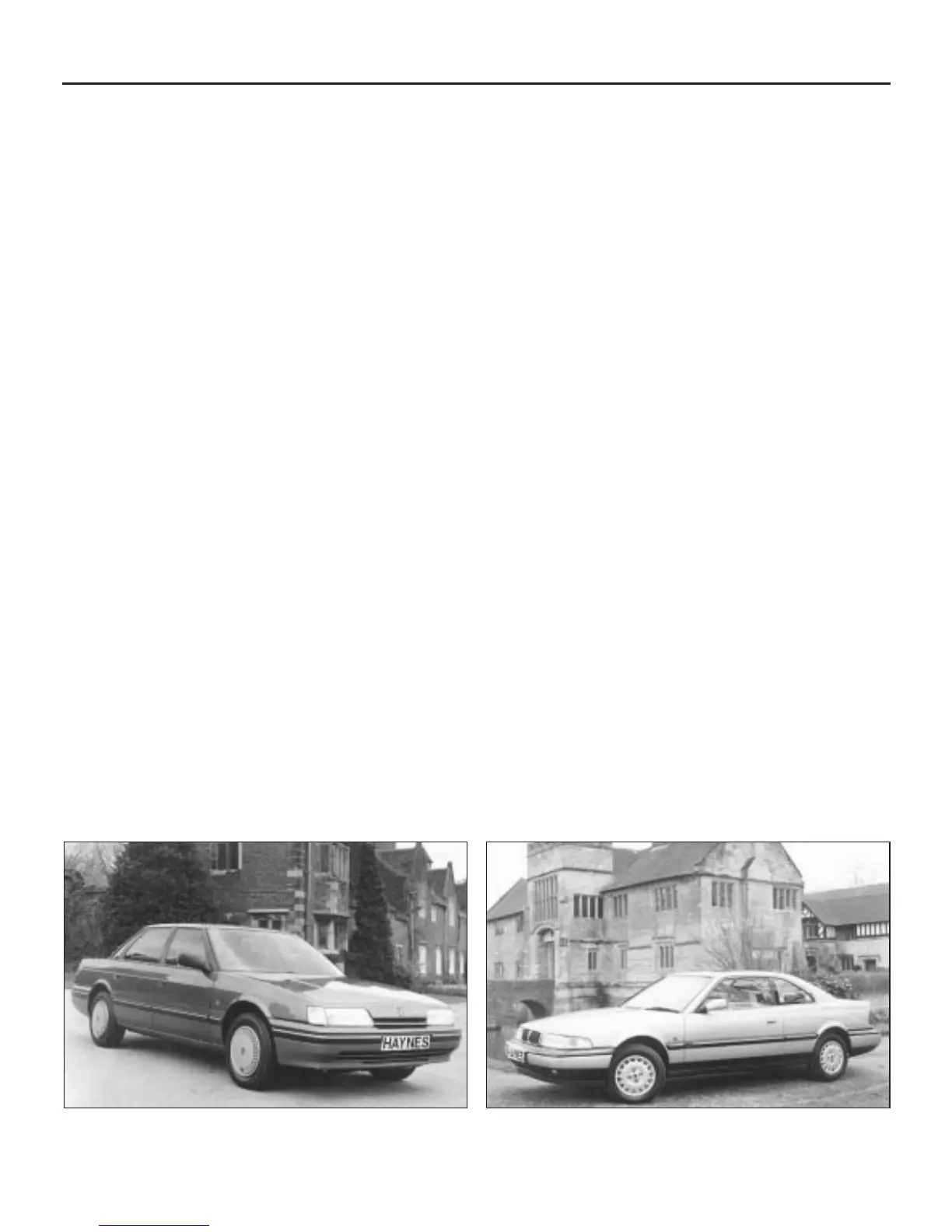
Rover 820i Saloon Rover 800 Coupe


 To Next Page
 Loading...