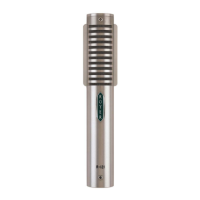
instruments. Its naturally smooth frequency response characteristics are a perfect match for
cymbals, strings and other instruments that commonly exhibit harshness.
Ribbons in the Digital World
Digital recordings benefit greatly from the properties inherent in ribbon microphones. Since A to
D converters cannot distinguish between the sound source being recorded and the complex
distortion components often associated with condenser microphones, they sometimes have
difficulty tracking the signal, resulting in ringing and edgy-sounding tracks. With ribbon
microphones, ringing is almost nonexistent due to the ribbon’s lack of distortion artifacts and
high frequency peaks. A to D converters have less difficulty tracking the ribbon-generated signal,
resulting in very smooth digital recordings free of microphone-related edginess.
User Guide
Using the R-10 Ribbon Microphone
There are a few important facts about ribbon microphones that are key in understanding how to
use them intelligently.
1. The R-10 is a side address, bi-directional microphone and its rejection in the dead areas is
very strong. Due to this directionality, the R-10 should be placed at 1.3 times the distance
normally used with omni-directional microphones, or about the same distance used for
cardioid microphones. This method is used to achieve the same ratio of direct to reflected
sound.
2. In the horizontal plane, the R-10 does not discriminate against the highs off axis; nor does it
boost highs on axis. Therefore, several instruments or vocalists can be placed in front of the
microphone without favoring the performer in the center of the group.
Several performers can be grouped at both the front and back of the microphone, with one
proviso: since the outputs are out of phase at the front and back of the microphone,
cancellation can result if, for example, two tenors are placed at opposite sides at equal
distances and they are singing in unison, so listen to the feed before committing to it.
3. When using the R-10 to record loud signal sources, placing the microphone slightly off axis
to the signal source (either horizontally or vertically) minimizes the effect of high pressure
sound levels displacing and possibly damaging the ribbon element.
4. The R-10 requires no power supply and is safe to use on consoles with phantom microphone
powering, provided that the cabling is wired properly. It should be noted that not all ribbon
microphones are compatible with phantom-powered systems, so check the manufacturer’s
recommendations before using other ribbon microphones. It should also be noted that faulty
or improperly wired cables could cause problems with your R-10. Do not patch an R-10


 To Next Page