3). Attach the spinnaker as follows:
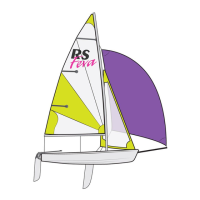
• Tie the tack line that emerges from the forward end of the bowsprit to the tack of the spinnaker.
• Tie halyard to the head of the sail.
• Tie one end of the spinnaker sheet to the clew of the sail. Pass the other end through the block on the side
deck, across the boat behind the mainsheet jammer, under the boom and through the block on the other
side.
• The end of the halyard that emerges from the spinnaker chute forms the downhaul for the sail. Pass the
downhaul outside of the spinnaker sheets, through the ring on the lower downhaul patch on the sail and tie it
onto the upper patch.
4). Pull the spinnaker into the sock using the downhaul from aft of the chute sock.
Rigging the mainsail
1). Tie the main halyard to the head of the sail.
2). Tie the clew around the boom, so that the sail is held close to the boom.
3). Thread the outhaul rope through the clew cringle and back to the bullseye on the end of the boom where it
is tied off.
4). Fit the forward end of the boom onto the gooseneck.
5). Thread the cunningham line through the cringle above the tack and tie the end around the gooseneck
fitting.
6). Hoist the sail when ready to launch and fit the tack strap around the mast. The halyard cleat is found at
the top of the mast. To release the halyard from the cleat pull the line downwards and outwards from the mast.
Once cleated at the top of the mast, the loose halyard should be secured using the inglefield clip to its matching
end on elastic on one side of the mast pot. The excess rope can be coiled up and poked inside the inboard end of
the boom.
Your new sail is supplied with little or no batten tension applied to protect its shape in storage. Before hoisting the
sail it will be necessary to tie in the battens and tension the sail. Finger tension is sufficient to begin with. It is not
necessary to release the tension after every sail, but during winter storage it is worth easing the tension on the
battens.
If you find that the halyard is very stiff upon hoisting the sail, then an application of dry lubricant into the mast
track will reduce the friction between the luff of the sail and the mast. With any fully battened mainsail it is
important that the boat is bow to the wind and that the mainsail battens are all shaped in one direction whilst
raising the sail.
Rudder and daggerboard
1). The rudder drops on to the pintle and gudgeon on the transom. To lower the rudder, wait until you are in
deep water, ensure the pivot wing nut is eased and tension the downhaul rope under the tiller. Finally, tighten the
wing nut on the rudder stock for a positive fit between blade and stock. Ensure that the rudder has clicked past
the retainer fitting. A tight fit of the pintles ensures maximum feel from the rudder blade to the helm, and
eliminates ‘slop’. For this reason the rudder may require some working from side to side to affix and remove.


 To Next Page
 Loading...