Need help?
Do you have a question about the RTS OMNEO Main Station and is the answer not in the manual?
Details copyright ownership and usage rights for the document's content.
Provides important notices regarding product markings and safety symbols.
Lists critical safety instructions for operating the equipment safely.
Lists the OMS products to which this manual applies.
Compares features across different OMS models.
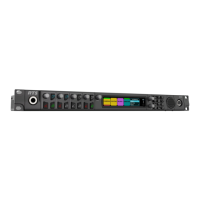
Identifies and describes components of the OMS front panel.
Identifies and describes connectors and ports on the OMS rear panel.
Explains the three modes of operation for the keypanel keypad.
Details the function of each key in Primary, Dial, and Shift modes.
Lists software and hardware interface requirements for the system.
Provides guidance on securely mounting the device in a rack.
Details pin assignments for various connectors on the device.
Describes cable types for TIF, legacy keypanels, and RJ45 Ethernet.
Explains how to connect the OMS device to a network.
Steps to access and configure network settings.
Procedure to configure the network interface for AZedit.
Steps to configure OMNEO network interface settings.
Steps to configure RVON network interface settings.
Guides on configuring various port types for intercom connectivity.
Instructions for connecting different types of devices to OMS ports.
Steps to connect RVON devices to the OMS system.
Adding devices to the catalog and configuring channels.
Configuring devices to accept connections from OMS.
Using IPedit to configure OMNEO and RVON keypanels.
Explains how to navigate through the OMS menu structure.
Describes how to modify data within configuration forms.
Details the icons used on the local keypanel and their meanings.
Provides an overview of port and link statuses.
Explains how to change setup pages on the device.
Describes the Party Line Call and Call Waiting windows.
Details functions like UPG, Mic Kill, Info, All Call, All Talk, Key Assignment.
Information on Rapid Spanning Tree Protocol configuration.
Procedure for resetting the device to factory default settings.
Instructions for using the front panel reset button.
Steps to download firmware to the device using AZedit.
Procedure to download firmware using the Firmware Upload Tool.
Instructions for downloading a custom splash screen image.
Instructions for downloading a custom screen saver image.
Steps to download license files to the device.
Displays current firmware versions and licensed model.
Shows connected AZedit user sessions and network connections.
Shows connected IPedit user sessions and network connections.
Provides a summary of system resources like ports and lines.
Displays network status for the Control Port.
Displays network status for OMNEO SFP fiber ports.
Displays network status for OMNEO RJ45 ports.
Displays network status for the RVON port.
Details status information for OMNEO ports.
Details status information for RVON ports.
Displays status for AIO ports, including keypanel status.
Displays status for 2-Wire ports.
Shows status information for connected devices.
Displays status information for connected TIFs.
Displays communication status for GPIO-16 devices.
Shows status information for General Purpose Inputs and Outputs.
Displays crosspoint status for selected input and output ports.
Displays parameters and status of device power supplies.
Shows temperature readings for device components.
Displays the status of the OMNEO audio synchronization clock.
Procedure to assign a name to the intercom system.
Configures the network connection to AZedit.
Configures the OMNEO network interface settings.
Configures the RVON network interface settings.
Searches for and selects available OMNEO devices to add to the system.
Configures connection parameters for OMNEO channels.
Configures connection parameters for RVON channels.
Configures operating modes for 2-Wire ports.
Configures headset microphone and speaker operation.
Configures panel microphone and speaker operation.
Adds filters and equalization to microphones and speakers.
Configures parametric equalizer for the panel microphone.
Configures equalization for the headset microphone.
Configures frequency response for the speaker.
Applies bandpass filter to the headset speaker.
Configures various microphone settings like mute mode.
Enables and configures the tone generator.
Adjusts crosspoint listen gains using key volume encoder knobs.
Sets the reference level for automatic audio adjustments.
Configures key operation options for Solo, Exclusive, and Auto Dial.
Stores and configures phone numbers for auto dialing.
Allows quick access to different virtual key rows.
Sets the action of setup pages when talk keys are active.
Configures call history display and new call handling.
Enables and configures footswitch operation.
Configures panel volume and listen assignment display.
Adjusts brightness for the LCD panel and key backlights.
Configures the type and behavior of the screen saver.
Sets the size of displayed alpha text on the front panel.
Configures keypad backlight behavior and LED colors.
Configures advanced user interface options.
Enables or disables specific keypad functions.
Configures call beep and mic kill usage.
Manages user authentication for AZedit, IPedit, and keypad access.
Defines authentication requirements for AZedit sessions.
Defines user privileges for IPedit access.
Configures access levels and PIN protection for the front panel.
Grants access to the debug shell via Telnet.
Sets IP addresses for GPIO-16 devices.
Configures OMNEO audio PTP clock synchronization.
Reboots the device without resetting configurations.
Tools for checking device operation.
Checks the operation of physical controls on the front panel.
Configures groups of devices for simultaneous communication.
Assigns party line memberships to device keys.
Configures devices as permanent talkers, listeners, or clears memberships.
Manages setup files locally on the device.
View and verify setup files using AZedit.
Configures key assignments on device keys.
Provides access to more key assignments via setup pages.
Configures selected ports for scroll enable and latch disable.
Configures party line membership and options.
Defines IFB (Interrupted Fold Back) system configurations.
Configures Special List membership and options for group calls.
Configures Relay definitions and options.
Configures ISO (Isolate) settings for private communication.
Configures input and output gain for selected intercom ports.
Configures individual gain levels for crosspoints.
Sets gain levels for ports listening to party lines.
Views and modifies alpha text for resource types.
Lists alarms that have not been acknowledged by the user.
Displays currently active alarms, categorized as clearable or non-clearable.
Provides solutions for common alarm popups and issues.
 General
| Network Protocol | OMNEO |
|---|---|
| Sample Rate | 48 kHz |
| Latency | 1 ms |
| Power Supply | 100-240V AC, 50/60 Hz |
| Dimensions | 1 RU, 19" rack mountable |
| Number of Ports | Varies depending on configuration |
| Redundancy | Network and Power Supply |
| Operating Temperature | +32°F to +104°F (0°C to +40°C) |
| Storage Temperature | -20 to 70°C |
| Communication Protocol | Dante, AES67 |
| Audio Outputs | Varies depending on configuration (Analog, AES, Dante/AES67) |

 To Next Page