Copyright © 2015 Ruckus Wireless, Inc. Page 2 of 4
Published 10 February 2015, Part Number 800-70766-001 Rev B
4 Click OK to save your changes.
Your changes are put into effect immediately. Continue with Step
4: Logging Into the AP.
Step 4: Logging Into the AP
As specified in Step 3: Preparing Your Computer for AP Setup, the
computer should be directly connected to your AP through one of
the Ethernet ports and powered on, ready for setup.
1 On your computer, open a Web browser window.
2 In the browser, type this URL to connect to the AP:
https://192.168.0.1
3 Press <Enter> to initiate the connection. When a security
alert dialog box appears, click OK/Yes to proceed.
4 When the Ruckus Wireless Admin login page appears, enter
the following:
• Username: super
• Password: sp-admin
5 Click Login.
Continue with Step 5: Customizing the Wireless Settings
.
Step 5: Customizing the Wireless Settings
1 On the Web interface menu, click Configuration > Radio
2.4G or Configuration > Radio 5G. The Configure >
Wireless > Common page appears.
2 Verify that the following options are active:
• Channel: SmartSelect
• Country Code: If you are not located in the United States
of America, select your current country.
3 Click Update Settings if you made any changes.
4 Click any of the “Wireless #” (Wireless LAN Number) tabs at
the top of the page.
5 In Wireless Availability, click Enabled.
6 Delete the text in the SSID field, then type a name for your net-
work that will help your users identify this AP in their wireless
network connection application.
7 Click Update Settings to save your changes.
8 Repeat Step 4 through Step 7 for each Wireless # (Wireless
LAN Number) interface that you want to enable.
9 Click Logout to exit the Web interface.
10 When the Ruckus Wireless Admin login page reappears, you
can exit your browser.
11 Disconnect the AP from the computer and from the power
source, and then restore your computer to its original network
connection configuration.
Continue with Step 6: Placing the AP in Your Site
.
Step 6: Placing the AP in Your Site
1 Move the AP to its permanent location (accessible to both
power and network connections). Refer to Mounting Instruc-
tions for physical installation.
2 Use an Ethernet cable to connect the 10/100/1000 port to the
appropriate device:
• The ISP’s or carrier’s network device --or--
• The Ethernet switch that is connected to the ISP’s or
carrier’s network device.
3 Connect the AP power adapter (or PoE power supply) to the
AP, and then to a convenient power source.
4 Verify that the 10/100/1000 port LED is lit.
After a short pause to re-establish the Internet connection, you can
test the AP. Continue with Step 7: Verifying the Installation
.
Step 7: Verifying the Installation
1 Using any wireless-enabled computer or mobile device,
search for and select the wireless network you previously con-
figured.
2 If you can connect, open a browser and link to any public Web
site.
Congratulations! Your wireless network is active and ready for use.
MOUNTING INSTRUCTIONS
The AP can be mounted to a drop-ceiling T-bar, flat surface, or a
pole using Ruckus Wireless AP mounting kits. Refer to the
following sections:
• Mounting on a Drop-Ceiling T-Bar
• Mounting on a Flat Surface
• Mounting on a Flat Surface or Pole Using the Optional Secure
Mounting Bracket
Mounting on a Drop-Ceiling T-Bar
The factory-supplied T-bar mounting assembly kit allows you to
attach the AP to recessed and flush drop-ceiling T-bars.
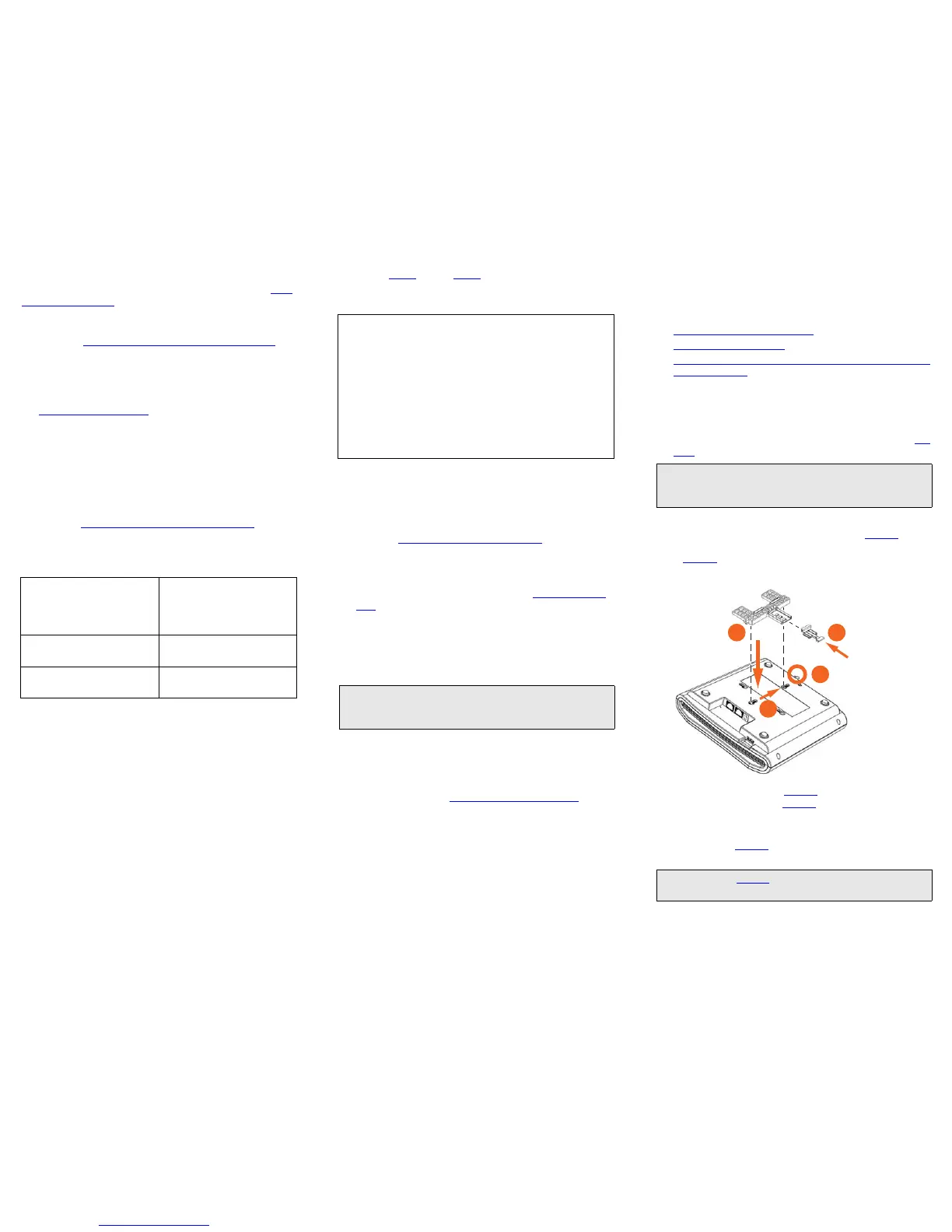
1 Position the studs on the bottom of the T-bar bracket (A in Fig-
ure 3) in the keyholes on the AP enclosure.
2 Slide the T-bar bracket away from the Ethernet ports on the
bottom of the AP until the AP retainer tab (B in Figure 3
) snaps
into place, trapping the T-bar bracket studs in the keyholes (C
in Figure 3
).
Figure 3. Attaching the T-bar bracket to the AP
3 Insert the locking tab (D in Figure 3) so it is in the first position
on the T-bar bracket (A in Figure 3
).
4 Gently push the ceiling tiles, if present, up and out of the way.
5 Position the T-bar bracket so its two clasps grip one edge of
the T-bar (A in Figure 4
). Make sure that both clasps are grip-
ping the T-bar.
Default AP Settings (for your reference)
Network Names (SSIDs) Wireless1—Wireless8 (2.4GHz
radio)
Wireless9—Wireless16 (5GHz
radio)
Security (Encryption method) Disabled for each wireless
interface
Default Management IP
Address
192.168.0.1
Optional: In a default R710 AP configuration, the AP uses a
DHCP-assigned IP address.
If you anticipate logging into the AP regularly to perform
monitoring or maintenance once it is in place, then you may want
to consider switching from DHCP and instead assigning a static
IP address to the AP.
A. On the menu, click Configuration > Internet.
B. Click the Static IP option.
C. Fill in the IP Address and Mask fields.
D. Click Update Settings to save your changes.
Note: If you will be using PoE, then you will need a Cat 5e (or
better) Ethernet cable to connect the AP to the PoE injector or
PoE switch.
Note: There is a second set of keyholes that are for optional
sideways mounting on a drop-ceiling T-bar. Physical security is
not supported when mounting the AP with this set of keyholes.
Note: For clarity, Figure 4 only shows the T-bar bracket and the
T-bar, and does not show the AP.



 To Next Page
 Loading...