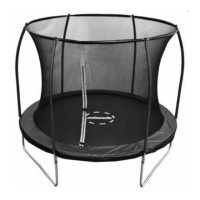
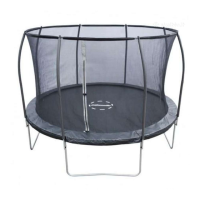
This document provides a manual for an "Inside safety net" for a trampoline, available in sizes 366/426 cm. The manual is presented in English, Swedish, and Norwegian, offering comprehensive safety instructions, parts lists, and assembly guidelines.
Function Description:
The primary function of this product is to provide an internal safety net for a trampoline, designed to prevent users from falling off the trampoline or coming into contact with the frame and springs during use. The net creates a safe jumping enclosure, enhancing the overall safety of the trampoline.
Important Technical Specifications:
- Sizes: 366/426 cm (referring to the trampoline diameter the net is designed for).
- Parts:
- Lower steel poles (8 pcs)
- Upper padded steel poles (8 pcs) - These poles have a padded lining for user protection and should not be removed.
- Attachment kit (16 pcs)
- Screw set (32 pcs)
- Safety net (1 pc)
- Spacer (16 pcs)
- Plastic cap (8 pcs)
- Safety Net Lifespan: The safety net is a consumable item and should be replaced every two years, with a maximum usage period of 3 years before replacement.
Usage Features:
- Safety First: Emphasizes reading all instructions, warnings, and advice on care, maintenance, and use to prevent injuries.
- User Responsibility: The trampoline owner/person in charge is responsible for ensuring all users are aware of the manual's information.
- Clearance Requirements:
- Overhead: A minimum height of 7.3 meters above the ground is recommended for jumping. Ensure no cables, branches, or dangerous objects are present.
- Sides: Maintain at least 2 meters of clear space around the trampoline. Avoid placing it near walls, buildings, fences, or similar structures.
- Placement: The trampoline should be placed on a flat, well-illuminated surface. Do not use it on concrete, stone, wet surfaces, or indoors.
- Supervision: The trampoline should not be used by unauthorized individuals or without supervision.
- Single User: Only one person should jump at a time to prevent serious accidents.
- Jumping Technique:
- Stay in the middle of the mat to reduce the risk of landing on the frame or springs.
- Learn basic jumps and movements before attempting advanced maneuvers.
- Focus on control rather than height, especially when learning.
- Keep eyes on the mat to maintain balance.
- To stop a jump, bend your knees upon landing.
- Age Restriction: Trampolines higher than 51 cm are not suitable for children under 6 years old.
- Prohibited Actions:
- Do not perform somersaults; landing on the head or neck can cause serious injury, paralysis, or death.
- Do not use the trampoline if tired; jump only for short periods.
- Do not use the trampoline under the influence of alcohol or drugs.
- Do not use the trampoline if the mat is wet, damaged, dirty, or worn.
- Do not jump in windy conditions.
- Do not use the trampoline as a springboard for jumping onto other objects.
- Do not jump off or onto the trampoline from the ground or other objects.
- Do not eat immediately before or during use.
- Remove any objects from under the trampoline.
- Ensure the safety net opening is properly closed before jumping.
- Ladder Use: If a ladder is used, it must be removed by the person in charge when they leave the area to prevent children under six from climbing onto the trampoline.
- Storage: Store the trampoline in a safe place when not in use, ensuring only authorized people use it.
Maintenance Features:
- Regular Inspections:
- Before each use, check the trampoline for wear, damage, dirt, or worn parts.
- Regularly check the safety net for wear, loose parts, or missing components.
- Inspect the edge protector to ensure it is correctly placed and not damaged.
- Check for tears, rips, or holes in the safety net, its accessories, or the mat.
- Ensure the safety net is not slack and its seams are not loose or worn.
- Inspect the frame for bent or damaged parts (e.g., legs).
- Check for broken, damaged, or missing springs.
- Verify that the edge protector is being used, is not broken, and is correctly assembled.
- Ensure no parts (especially those with sharp edges) are sticking out on the frame, springs, or trampoline.
- Replacement: The safety net should be replaced every two years (maximum 3 years). Replace any worn, damaged, or missing parts immediately.
- Disassembly/Repair: If any of the above risks are discovered, the trampoline must be dismantled or put away and not used until the problem(s) have been resolved.
- Assembly Check: After assembly, perform a final safety check to ensure all straps, hooks, and screws are securely fastened and correctly positioned. Regularly check and adjust all fasteners as needed. Stop using the safety net if it becomes heavily worn or damaged.
Assembly Instructions:
- Attach Lower Steel Poles: Secure the lower steel poles (1) to the trampoline legs using brackets and spacers. Spacers go between the safety net's lower steel poles and the trampoline's legs. Brackets and spacers are placed at the lower and upper parts of the leg, just below the mat's ring. Tighten with wing nuts and add safety caps.
- Insert Upper Steel Poles: Insert the upper steel poles (2) into the lower steel poles (1) and place plastic caps (7) on top.
- Unfurl and Hang Safety Net:
- Place the net inside the steel poles.
- Start with the opening on the right.
- Attach the straps (C2), ensuring a 10 cm gap between the poles and the net (C3). Center the net and adjust it to the mat's edge. The lower strap should be attached above the mat's edge protector.
- Pass the elastic bands at the net's lower edge between the mat's jumping surface and the edge protector. Wrap the bands around the trampoline frame and secure them with hooks and rings (C4).

 Need help?
 General

 To Next Page