This document is an installation and user guide for Rutland battery-powered electric fence energisers, specifically covering models ESB57, ESB202, ESB145, ESB225, ESB275, ESB325, and ESB375. The guide provides instructions for proper installation, operation, and maintenance to ensure effective performance.
General Function Description
Rutland electric fence energisers are designed to create an electric barrier for livestock control, deterring animals, and training purposes. They operate by sending pulses of electricity through a fence line. The system requires an energiser, a fence line, and an earth system to complete the circuit. When an animal touches the electrified fence, it receives a brief, harmless shock, teaching it to avoid the fence.
Important Technical Specifications
The energisers are built to comply with CE, IPX4, EN60355-2-76, Health & Safety Standards EN55014, and EMC.
Battery life varies by model:
- ESB57: Approximately 144 days.
- ESB202: Approximately 28 days.
- ESB145: 120 days (with 2x 9V 90Ah batteries) or 85 days (with 12V 75Ah battery).
- ESB225: Approximately 35 days.
- ESB275: Approximately 26 days.
- ESB325: Approximately 12 days.
- ESB375: Approximately 7 days.
Optional solar panel battery chargers are available for models ESB145 and ESB225:
- ESB225: 22-212 (3-watt) or 22-213 (6-watt).
- ESB145: 22-213 (6-watt) or 22-219 (10-watt).
Usage Features
Installation:
- Mounting: ESB57 and ESB202 use mounting stand part no. SP57-004. ESB275, ESB325, and ESB375 use mounting stand part no. SP72-010. These models must be kept off the ground. ESB145 and ESB225 feature weatherproof casings and can be placed on the ground. Wood post mounting options are also shown.
- Connections:
- EARTH Terminal: Connect a green/yellow wire to the EARTH terminal and then to an earth stake (part no. 18-179B). Additional earth stakes may be required, spaced 2 meters (6 feet) apart, connected by lead-out cable. The earth stake should be driven 1 meter (3 feet) deep into moist soil.
- FENCE Terminal: Connect a red wire to the FENCE terminal and then to the fence line.
- Battery Connection: Ensure the power switch is in the OFF (0) position before connecting the battery. Connect the RED crocodile clip to the positive (+) terminal and the BLACK crocodile clip to the negative (-) terminal of a 12V leisure battery (part no. 22-107). For ESB145, two 9V dry batteries (part no. 22-101) can also be used.
Operation Modes (Varies by model):
- ESB57: Features an On(1)/Off(0) switch.
- ESB202: Includes a Fast/Economy/Slow switch to change pulse mode.
- Fast Pulse: For training stock.
- Night Econ Pulse: Automatically changes pulse speed (slower at night, faster during daylight) to conserve battery.
- Slow Pulse: To conserve battery power once stock are accustomed to the fence.
- ESB145/ESB225: Features an On(1)/Off(0) switch, a High/Low power switch, and a Fast/Economy/Slow switch.
- High Setting: Normal use.
- Low Setting: Drops output by approximately 30%.
- Fast Pulse: For training stock.
- Night Econ Pulse: Automatically changes pulse speed (slower at night, faster during daylight) to conserve battery.
- Slow Pulse: To conserve battery power once stock are accustomed to the fence.
- ESB275/ESB325/ESB375: Includes an On(1)/Off(0) switch and a Fast/Economy/Slow switch.
- Fast Pulse: For training stock.
- Night Econ Pulse: Automatically changes pulse speed (slower at night, faster during daylight) to conserve battery.
- Slow Pulse: To conserve battery power once stock are accustomed to the fence.
Indicators:
- Pulse Indicator: Flashes to indicate voltage output (all models). For ESB275/ESB325/ESB375, a "Pulse indicator—high output" flashes if over 5,000 volts, and a "Pulse indicator—medium output" flashes if over 3,000 volts.
- Battery Low Indicator: Flashes if the battery needs recharging (all models).
- Light Sensor: (ESB202, ESB145, ESB225, ESB275, ESB325, ESB375) Should be kept clear at all times.
- Warning Low Output: (ESB275, ESB325, ESB375) Flashes and an alarm sounds if output drops below 3,000 volts.
Safety Guidelines:
- Electric fences should be installed to prevent danger to persons, animals, or surroundings and be out of reach of children.
- Never connect more than one energiser to the same fence system. Other fence systems powered by a different energiser should be at least 2.5 meters apart.
- Warning signs (yellow background, 100x200mm, "Caution Electric Fence" in black, 25mm height) should be placed at regular intervals along public roads or pathways.
- Barbed wire must not be electrified.
- Maintain a minimum distance of 2 meters from overhead power lines and communication lines.
- Earth for the electric fence should be more than 10 meters away from domestic electricity board or telecommunications system earths.
- Use insulated cable for connecting leads inside buildings or underground, protecting them from damage.
- Do not install connecting leads in the same conduit as mains supply wiring, communication, or data cables.
- For deterring birds from roosting on buildings, do not connect the fence wire to the earth terminal. Use warning signs where people may access the fence wire.
- Keep combustible materials away from energiser connections.
- Damaged supply cords must be replaced by the manufacturer or qualified personnel.
- Avoid touching electric fence wires with the head, neck, or torso. Use gates or specially designed crossing points. Incorporate non-electrified gates or stiles where fences cross public pathways, with warning signs.
Maintenance Features
Fence Line Maintenance:
- Voltage Testing: Regularly test voltage at the furthest point on the fence line using a Rutland Digital Tester (14-172) or 8-Light Tester (14-173).
- Connection Checks: Routinely check all fence and earth connections for soundness and security.
- Vegetation Control: Keep the fence line free of vegetation for best performance.
- Insulator Cleaning: Keep insulators free from dirt, dust, and cobwebs.
Testing the Fence:
- Push the earth probe into the ground.
- Touch the fence contacts to the fence wire (for poly tape, insert between contacts and rotate 1/4 turn).
- Voltage will be displayed while maintaining contact.
Testing Earthing:
- Short the fence using a metal bar or wire approximately 100 meters along the fence or until the voltage reading is below 3,000 volts.
- Push the tester probe into the ground near the earth stake.
- Touch the earth stake with the tester. If the reading is over 400 volts, earthing is inadequate. Add additional earth stakes 2 meters apart, connected by lead-out cable.
Troubleshooting Guide:
The guide includes a flowchart for troubleshooting common issues:
- Less than 3,000 volts: Check power supply (flat battery or off electric supply). Renew battery or contact an electrician.
- Energiser Fault: If output across live & earth terminals is less than 3,000 volts after disconnecting the fence line, the energiser is faulty. Contact Rutland for assistance.
- Fence Line Issues: If energiser output is normal (over 6,000 volts) but fence line voltage is low, reconnect the fence wire and check for:
- Poor connection of lead-out cable to fence line.
- Poor links between lines.
- Poor fence line joint or conductors.
- Fence line short or leak to ground.
- Leaking under gate cable.
- Very heavy vegetation against the fence line.
- Metal object touching fence line.
- Bad or incorrect insulator.
- Fence line touching a metal or soft wood post.
- Faulty underground cable at gateways.
- Earth System Issues: If earthing is not OK (reading over 400 volts at earth stake), add more earth stakes or drive existing ones deeper. If earthing is OK but voltage is low, check the lead-out cable for leaks to ground.
Warranty and Disposal:
- Warranty: Two-year warranty against manufacturing defects, requiring proof of purchase. Excludes defects from improper installation, misuse, tampering, neglect, moisture, or non-material/workmanship defects. Warranty is limited to repair or replacement.
- Disposal (WEEE Directive): Electrical products displaying the bin symbol should not be disposed of with normal household waste. Return to the retailer or an authorised recycling centre.

 Need help?
 General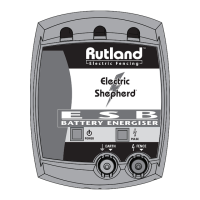

 To Next Page