EasyManua.ls Logo

Ryobi P3200 - User Manual

Ryobi P3200
16 pages
Print Icon
To Next Page IconTo Next Page
Loading...
OPERATOR’S MANUAL
CANISTER VAC
P3200
BATTERIES AND
CHARGERS SOLD
SEPERATELY
SAVE THIS MANUAL FOR FUTURE REFERENCE
Your canister vac has been engineered and manufactured to our high standard for dependability, ease of operation, and
operator safety. When properly cared for, it will give you years of rugged, trouble-free performance.
WARNING: To reduce the risk of injury, the user must read and understand the operator's manual before using
this product.
Thank you for your purchase.

Other manuals for Ryobi P3200

Question and Answer IconNeed help?

Do you have a question about the Ryobi P3200 and is the answer not in the manual?

Summary

General Safety Instructions

Read and Understand All Instructions

Crucial for safe operation and preventing injury.

Proper Handling and Usage

Covers attire, balance, and correct operation.

Electrical and Battery Safety

Addresses risks related to electricity and battery handling.

Charger Safety Rules

General Charger Precautions

Essential guidelines for safe charger use.

Damaged Equipment and Extension Cords

Warnings about using damaged parts and proper extension cord use.

Battery Charging Specifics

Rules for charging batteries, including type and environment.

Symbols and Meanings

Electrical and Operational Symbols

Explains standard electrical and operational symbols used in the manual.

Safety Alert Symbols

Details symbols indicating safety warnings and required protective measures.

Signal Words and Service Safety

Signal Word Definitions

Defines signal words (DANGER, WARNING, CAUTION) indicating risk levels.

Service and Eye Protection Safety

Covers service precautions and the importance of eye protection.

Product Features

Product Specifications

Lists technical specifications of the canister vac.

Vacuum Hose and Attachments

Describes the hose assembly and available attachments.

Tool Belt and Filters

Mentions the tool belt for storage and the filters for different usage modes.

Product Overview, Assembly, and Safety

Understanding Operation and Safety

Stresses understanding the manual and tool before use.

Key Features and Attachments

Highlights features like blower function and attachments.

Unpacking and Assembly Instructions

Guides users through unpacking and assembly.

Assembly Safety Precautions

Critical warnings regarding assembly and handling damaged parts.

Operation and Charging

General Operation Warnings

Essential warnings for safe and proper operation.

Applications of the Canister Vac

Lists primary uses: vacuuming and blowing.

Battery Charging Process and Indicators

Details charging process and LED status meanings.

Operation: Charging and Starting

Battery Charging Time and Conditions

Information on charging time and optimal conditions.

Charging a Hot Battery Pack

Procedure for recharging a hot battery pack.

Starting and Stopping the Vacuum

How to turn the canister vac on and off.

Operation: Battery and Attachments

Battery Pack Installation and Removal

Steps for installing and removing the battery.

Hose and Attachment Procedures

How to attach the hose and use vacuum accessories.

Operation: Vacuuming and Blower

Tool Belt Usage

How to use the tool belt for attachment storage.

Dry and Wet Vacuuming

Procedures for vacuuming dry and wet materials.

Using the Canister Vac as a Blower

How to convert the vac into a blower.

Maintenance

Maintenance Safety Precautions

Crucial safety measures for performing maintenance.

Cleaning Procedures and Filters

Guides on cleaning the unit and maintaining filters.

Maintenance: Waste Removal and Fuses

Removing Liquid Waste

Methods for safely removing liquid waste.

Fuse Replacement and Storage

Instructions for replacing fuses and storing the unit.

Maintenance: Batteries and Recycling

Battery Information and Lifespan

Details about battery type, life, and care.

Battery Storage and Recycling

Guidelines for battery storage and proper recycling.

Service and Parts Information

Service Center Contact and Parts Ordering

Information on contacting service centers and ordering parts.

Model and Serial Number Recording

Importance of recording unit identification numbers.

Overview

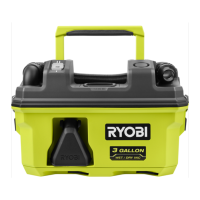
The Ryobi P3200 Canister Vac is a versatile and portable cleaning tool designed for both wet and dry vacuuming, and it can also function as a blower. It is engineered for dependability, ease of operation, and user safety, promising years of rugged, trouble-free performance when properly cared for.

Function Description:

The Ryobi P3200 Canister Vac serves multiple purposes:

  • Vacuuming: It can vacuum light-duty wet or dry surfaces. This includes picking up small amounts of liquid, though caution is advised for larger quantities. It is equipped with a safety ball inside the filter unit housing that shuts off suction when the collection container reaches full capacity during wet vacuuming.
  • Blowing: The canister vac can be used as a blower to clear hard surfaces such as driveways and walkways, and to keep decks and driveways free from leaves and pine needles. Air is blown through the blower port as part of the exhaust system, and a wand can be attached to the blower port for more directed air flow.

Important Technical Specifications:

  • Motor: 18 Volt DC
  • Collection Capacity: 2 Gallons
  • Hose Length: 5 ft.
  • Hose Diameter: 1 1/4 in.
  • Charger Input: 120 V, 60 Hz, AC only
  • Charge Rate: 1 hour (for a fully discharged battery pack)
  • Battery Type: Nickel-cadmium rechargeable batteries (P100 model: 130255004 or 130224028)
  • Charger Type: P110 (1423701, 140237021 or 140237023)
  • Fuse: 30 amp JAT blade type automotive fuse

Usage Features:

  • Cordless Operation: The canister vac is battery-powered, making it portable and not reliant on an electrical outlet during operation.
  • Detachable Tool Belt: This belt stores various attachments when not in use and can be secured in different places for easy access.
  • Large Capacity Collection Container: The container can hold up to 2 gallons of waste, reducing the frequency of emptying.
  • Drain Plug: Located on the back of the canister vac, the drain plug allows for quick and easy draining of liquids from the collection container.
  • Attachments: The vacuum comes with several attachments for different tasks:
    • Vacuum Hose Assembly: Flexible and compatible with various attachments.
    • Wide Nozzle with Squeegee: Ideal for vacuuming large, flat, dry, or wet surfaces.
    • Floor Brush: Designed for vacuuming carpeted surfaces.
    • Narrow Crevice Tool: Used for vacuuming narrow, hard-to-reach places.
    • Car Nozzle: Suitable for car interiors or small surface areas, and can be used with the wand for widened air flow in blower mode.
    • Wand: Functions as a handle in vacuum mode, a blower tube in blower mode, and an extension for other attachments.
  • Battery Charging:
    • Battery packs are shipped in a low charge condition and should be charged until the green LED on the charger illuminates.
    • The charger has LED indicators for different statuses: Red LED (fast charging), Green LED (fully charged/maintenance charge, hot battery pack, or out of normal temperature range), Yellow and Green LEDs (deeply discharged or defective battery pack), and No LED (defective charger or battery pack).
    • A hot battery pack requires approximately 30 minutes to cool down before recharging.
    • The product should be charged in a location where the temperature is between 50°F and 100°F.
  • Starting/Stopping: The canister vac is operated by a power switch with ON (I) and OFF (O) positions.
  • Safety Precautions:
    • Always wear safety goggles or glasses with side shields, and a full face shield if necessary, especially in dusty conditions.
    • Do not operate the tool if any parts are damaged or missing.
    • Remove the battery pack when assembling parts, not in use, or before servicing.
    • Avoid exposing the charger to wet or damp conditions.
    • Do not vacuum hot coals, cigarette butts, flammable liquids, or hard objects like nails and screws.
    • Do not use without the dust bowl or filter in place.
    • Do not submerge the canister vac in liquid when vacuuming liquids.

Maintenance Features:

  • Filter System:
    • Dry Use Filter: Used for dry vacuuming. Two are included.
    • Wet Use Foam Filter: Used for wet vacuuming. One is included.
    • Filters should be checked and replaced or cleaned periodically to maintain efficiency.
    • To clean, remove the filter from the filter unit, shake or lightly brush off dust/dirt, and reattach.
  • Collection Container Cleaning: The collection container should be emptied and cleaned periodically. For wet vacuuming, it's crucial to empty the container when suction shuts off due to full capacity.
  • Liquid Waste Removal: Liquid waste can be drained quickly using the drain plug or by removing the collection container. It's important not to leave liquid in the container for extended periods to prevent moisture damage to the motor.
  • Fuse Replacement: If the canister vac blows its fuse, it can be replaced with a 30 amp JAT blade type automotive fuse.
  • General Cleaning: Avoid using solvents on plastic parts; use clean cloths to remove dirt, dust, oil, and grease.
  • Battery Storage: For storage longer than 30 days, store battery packs below 80°F and in a "discharged" condition.
  • Battery Recycling: Nickel-cadmium batteries should be recycled or disposed of properly, not in ordinary trash. Terminals should be covered with heavy-duty adhesive tape upon removal.
  • Service: For repairs or replacement parts, contact an Authorized Service Center. Only identical replacement parts should be used.

Ryobi P3200 Specifications

General IconGeneral
BrandRyobi
ModelP3200
CategoryVacuum Cleaner
LanguageEnglish

Related product manuals