Need help?
Do you have a question about the Ryobi R18NL16 and is the answer not in the manual?
Specifies the intended applications and limitations of the nailer.
General safety precautions for operating power tools.
Covers safety measures related to the work environment.
Details electrical safety precautions for power tool usage.
Outlines personal safety measures for the operator.
Guidelines for proper usage and maintenance of power tools.
Instructions for charging and using battery packs.
Recommendations for servicing the power tool.
Specific safety warnings for nailer operation.
Further safety advice beyond general guidelines.
Reinforces safety practices like proper footing and attire.
Emphasizes eye and hearing protection requirements.
General safety advice including handling and maintenance.
Safety precautions related to adjusting the depth of drive.
Warning about product use by inexperienced persons.
Warnings regarding battery safety and immersion in fluids.
Guidelines for transporting batteries safely.
Advice on cleaning and maintaining the tool with specific materials.
Instructions for handling and preparing battery packs for recycling.
Information regarding lubrication requirements for the tool.
Guidance on environmentally friendly recycling practices.
Explanation of various symbols used in the manual.
Instructions for cleaning the air filter component.
Visual guide for loading nails and clearing jams.
Detailed steps for removing jammed nails.
Illustrates various maintenance tasks for the tool.
Identifies and labels the various parts of the 18V Nailer.
Illustrates the process of inserting the battery pack.
Shows how to load nails into the magazine.
Explains how to adjust the depth of drive for fasteners.
Demonstrates safety checks and testing tool operation.
Covers initial setup steps including loading and safety checks.
Detailed steps for loading nails into the tool.
Illustrates battery insertion and depth adjustment process.
Visual guide for loading nails into the magazine.
Shows how to adjust the depth of fastener drive.
Lists common problems and their corresponding solutions.
Technical specifications of the 18V Nailer.
Information on compatible batteries and chargers.
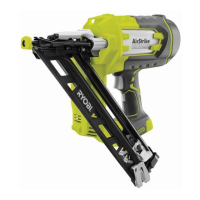
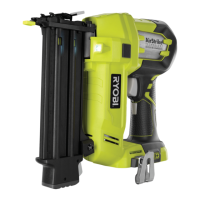
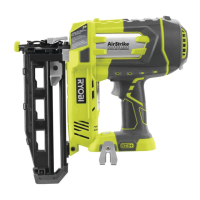
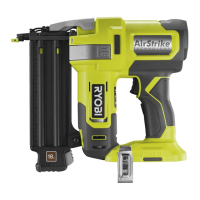
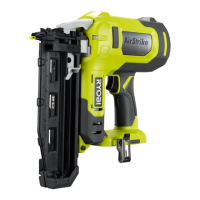
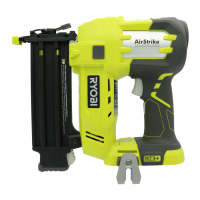
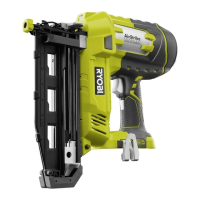
The Ryobi 18V Nailer (16G), model R18NL16, is a cordless power tool designed for driving nails into soft materials such as wood. It is particularly suited for various finishing and trim applications, both interior and exterior. This includes tasks like installing door and window casing, door jambs, baseboards, crown molding, cabinetry, cap and shoe molding, general molding, wooden staircases, door and window trim, chair rails, brickmold, hardwood flooring, and paneling, as well as furniture assembly. The nailer operates using Ryobi's AirStrike Technology, which incorporates in-tool air compression, eliminating the need for external compressors, hoses, or gas cartridges.
The nailer functions in a full sequential actuation mode, meaning a nail is fired each time the trigger switch is squeezed after the safety contact tip has been firmly pressed into the workpiece. For a second nail to be fired, both the safety contact tip and the trigger switch must be released and then activated again in the same sequence. This design ensures controlled and safe operation, preventing accidental firing. The tool is designed for single-hand use, and users are advised against holding it by the front of the magazine or placing hands, head, or other body parts near the nail exit point to prevent serious personal injury.
The depth of drive is adjustable, allowing users to control how deep the nail is driven into the material. This adjustment is made via a depth of drive adjustment wheel. An air pressure dial is also present, which likely influences the driving force of the nailer. LED work lights illuminate the workpiece, improving visibility in dimly lit areas. The tool features a jam release mechanism, allowing users to clear jammed fasteners. A no-mar pad is included to protect the workpiece surface from marring or damage during operation, and replacements are available. The magazine holds up to 100 nails and includes a scale to indicate nail length. A pusher mechanism feeds the nails into the driving mechanism. For convenience, the tool also includes a belt clip, which can be attached with a screw. The handle features an insulated gripping surface for user comfort and safety.
Before operation, it is crucial to read the entire manual, as proper assembly, operation, and maintenance are essential. The tool is not suitable for fixing electric cables. Users should always assume the tool contains fasteners and avoid pointing it towards themselves or others. The tool should only be actuated when placed firmly against the workpiece to prevent deflected fasteners.
When loading nails, ensure the correct type and size (16G brad nails, 19-65 mm in length, 1.6 mm diameter, 0° collation angle) are used, as incorrect fasteners can lead to jamming or malfunctions. The magazine capacity is 100 nails. The battery pack must be inserted correctly, and users should ensure it is fully charged. The tool is always in an operating condition when the battery is installed, so caution is advised.
Adjusting the depth of drive or air pressure should be done with the battery removed to prevent accidental firing. Users should test the depth on a scrap workpiece to achieve the desired depth for the application. If the tool operates but fasteners are not driven fully, it may indicate low air pressure, insufficient depth of drive, or nails that are too long for the wood hardness. Conversely, if fasteners are driven too deep, the air pressure may be too high, or the depth of drive too deep.
Frequent jamming can be caused by incorrect or damaged nails, a loose magazine, or a dirty magazine. If the tool stops and LED work lights flash rapidly, the battery is low or hot. If the LED work lights flash slowly with a charged battery, the tool may have malfunctioned. If the tool is too cold (below 5°C), it may not operate properly and needs to be warmed up. If the nail magazine is empty or very low, the tool will not operate. If the nailing process is interrupted by releasing the trigger mid-way, the system needs to be reset by removing and replacing the battery. If the trigger or workpiece contact has been held for too long without activating the nail firing process, releasing the trigger and activating again will resolve the issue.
Regular maintenance is vital for the tool's safety and performance. Always remove the battery pack from the product before cleaning or performing any maintenance to prevent serious personal injury. Only original manufacturer's replacement parts should be used for servicing to avoid hazards or product damage.
The tool should be kept clean and free from dirt, dust, oil, and grease. Use clean cloths for cleaning. Avoid using brake fluids, gasoline, petroleum-based products, penetrating oils, or strong solvents on plastic parts, as these chemicals can damage, weaken, or destroy the plastic, potentially leading to personal injury.
The bearings in the product are lubricated for the product's lifespan under normal operating conditions, so no further lubrication is required. Users should not apply lubricants to nails, the nail magazine, or the driving mechanism.
The workpiece contact mechanism should be checked frequently for proper operation. If it is not working correctly, the tool should not be used, as accidental nail driving could occur. If fasteners jam, the battery should be disconnected before attempting to clear the jam. Exercise caution when clearing jams, as the mechanism may be under compression, and the fastener could be forcefully discharged.
When the battery pack is removed for recycling, its terminals should be covered with heavy-duty adhesive tape. Do not attempt to destroy or disassemble the battery pack or remove any of its components. Lithium-ion and nickel-cadmium batteries must be recycled or disposed of properly. Avoid touching both terminals with metal objects or body parts to prevent short circuits, which can cause fire or serious injury. Keep batteries away from children.
 General
| Battery Voltage | 18V |
|---|---|
| Nail Size | 16 gauge |
| Power Source | Battery |
| Nail Type | Brad nails |
| Firing Mode | Single sequential firing or contact firing |

 To Next Page