exhaust
manifold
monitors
the oxygen con-
tent
ofthe
exhaust
and
sends
a
proportional
signal to
an
electronic control
unit
(under
the
rear
seat). This signal is
compared
to a
predeterminded
value
and
an
output
signal
is
sent
to a fuel pressure
modulating
valve
to
make
the
necessary fine
adjustment
of
the
air/fuel ratio. Until the sensor
warms
up
after
the
engine is
started,
the
modulating
valve will
operate
at
a
constant
predetermi-
ned
value
and
in the event
of
sensor failure.
A
maintenance
reminder
lamp,
labeled
"EXH",
on
the
instrument
panel illumina-
tes every
30,000 miles to indicate
that
the
oxygen sensor is scheduled for replacement.
(After this service is
performed
your
dealer
will reset the
lamp
actuating
mechanism).
Note: 16 valve engines also have
an
oxygen
sensor
but
it
is a different type
which
is
to
be
replaced
at
60,000 miles. These models
do
not
have the
reminder
lamp.
F.
Three-way
catalyst
The
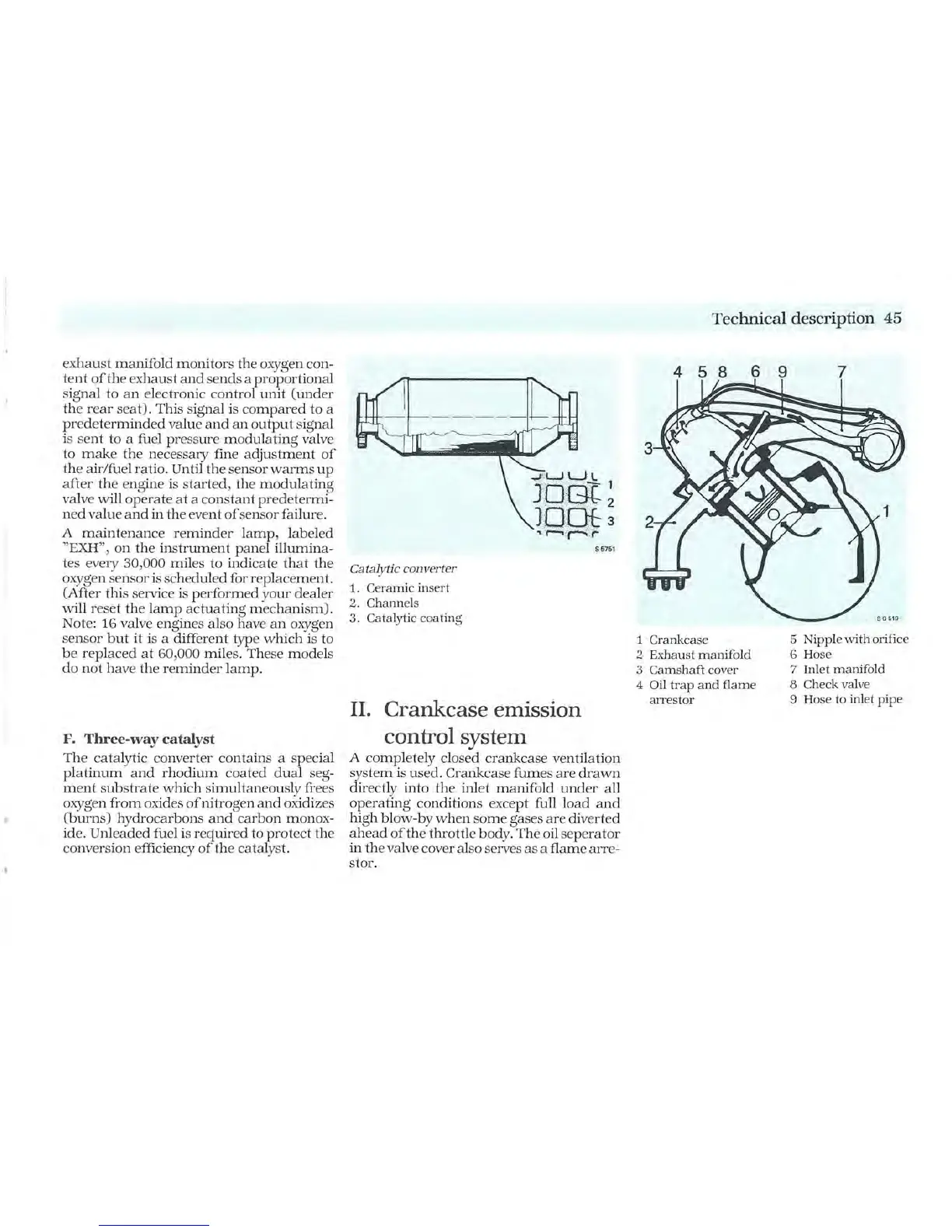
catalytic converter contains a special
platinum
and
rhodium
coated
dual
seg-
ment
substrate
which
simultaneously frees
oxygen
from
oxides
of
nitrogen
and
oxidizes
(burns)
hydrocarbons
and
carbon
monox-
ide. Unleaded fuel is
required
to
protect
the
conversion efficiency
of
the
catalyst.
S 5751
Catalytic converter
1.
Ceramic
insert
2.
Channels
3. Catalytic
coating
II.
Crankcase emission
control system
A completely closed crankcase ventilation
system is used. Crankcase
fumes
are
drawn
directly
into
the
inlet
manifold
under
all
operating
conditions except full
load
and
high
blow
-
by
when
some
gases
are
diverted
ahead
ofthe
throttle body. The oil
seperator
in
the valve cover also serves
as
a flame
arre-
stor.
Technical description
45
4 5 8 6
1 Crankcase
2
Exhaust
manifold
3
Camshaft
cover
4
Oil
trap
and
flame
arrestor
9 7
5
Nipple
with
orifice
6 Hose
7 Inlet
manifold
8
Check
valve
9 Hose
to
inlet
pipe



 To Next Page