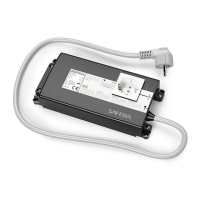
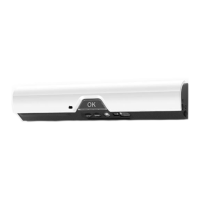
The Safera Aurora Stove Guard is a safety device designed to prevent cooking-related hazards by monitoring the cooktop and automatically cutting off power if a dangerous situation is detected. It is compatible with most electrical cookers, hobs, and ovens intended for household use, including traditional cast-iron, ceramic, and induction cookers, as well as those equipped with timers, afterheat indicators, child-proof locks, or integrated switch-off systems. The system is suitable for cookers up to 90 cm wide.
Function Description:
The Stove Guard system consists of a sensor unit (A), a power control unit (C), and a remote control (D). The sensor unit is typically mounted on the ceiling above the cooktop and continuously monitors the cooking area for signs of overheating or unattended cooking. If a dangerous situation is detected, the sensor unit communicates wirelessly with the power control unit, which then cuts off the power supply to the cooker. The remote control, which has identical button configurations to the sensor unit, allows users to operate all functions of the stove guard.
The system features an "Alarm limit settings" mode (Mode 1) where users can adjust the sensitivity of the alarm based on the installation height of the sensor unit. The default alarm limit is 8, recommended for installation heights between 1.6 and 1.7 meters. The system also includes a "Manual setup of the wireless connection" mode (Mode 2) for re-establishing communication between the sensor and power control units, for example, when replacing either unit. A "Manual calibration of the cooker type" mode (Mode 3) allows users to specify whether the power control unit is connected to both the cooker and oven or only the cooktop, optimizing the system's performance. Finally, a "Testing and adjusting AUX-connection" mode (Mode 4) is available for configuring and testing auxiliary output signals.
The sensor unit employs an auto-recognition feature to identify the cooker type during initial cooking use, which helps minimize false alarms. If the sensor unit is removed from its original mounting position after auto-recognition, the stove guard will prevent the use of the cooker and oven until it is reinstalled correctly.
Important Technical Specifications:
- Power Control Unit Compatibility: Various models available, including PCU6.3-F (fixed 3-phase), PCU6.1-F (fixed 1-phase), PCU6.3-P (3-phase, Perilex-connectors), PCU6.1-P (1-phase, 3-pin plug), and PCU6.1-S (1-phase, Schuko-connectors).
- Sensor Unit Power: Powered by 4 x AA/LR6 batteries.
- Remote Control Power: Powered by 1 x CR 2032 battery.
- Cooker Width Compatibility: Up to 90 cm.
- Installation Height (Leveled Ceiling): Recommended range 1.4 - 2.6 m.
- Installation Height (Sloped Ceiling): Recommended range 5-18° (1:3) slope, max. 2.6 m vertical height.
- Power Control Unit Dimensions (PCU6.3-F, PCU6.1-F): 225.5 mm (length) x 95 mm (width) x 60 mm (height).
- Power Control Unit Dimensions (PCU6.3-P, PCU6.1-P, PCU6.1-S): 225.5 mm (length) x 95 mm (width) x 99 mm (height).
- AUX-connection (Optional):
- Optoisolated and potential-free AUX-outputs (AUX1 and AUX2).
- Maximum IN-OUT voltage: 24 VDC.
- Maximum IN-OUT current: 10 mA.
- Only DC voltage is permitted between IN-OUT.
- Output signals indicate "Nothing to report," "Normal cooking detected," "Alarm," and "Service needed."
- Inversed AUX-mode available.
- Water Leakage Sensor (Optional): Supports up to four sensors.
Usage Features:
- Indicator Light: Provides visual feedback on the system's status and problem types.
- Blinking orange: Test in progress.
- Blinking green: Test successful, cooker power switched off.
- Blinking red: Test failed (sensor unit view blocked or power control unit issue).
- Lit white: Alarm limit settings mode.
- Blinking purple-blue: Manual setup of wireless connection mode.
- Blinking yellow-green: Manual calibration of cooker type mode.
- Blinking white (normal AUX-mode): Testing and adjusting AUX-connection mode.
- Blinking red (inversed AUX-mode): Testing and adjusting AUX-connection mode.
- Blinking blue: Water leakage detected.
- Buttons:
- Adjustment Button 1 (①): Used to lower the alarm limit, toggle AUX1 output, or turn on the oven for calibration.
- Adjustment Button 2 (②): Used to raise the alarm limit, toggle AUX2 output, or turn on the biggest cooker plate for calibration.
- OK-button (③): Used to confirm settings, finish tests, or move to the next manual adjustment mode.
- Alarm Limit Adjustment: Users can easily adjust the alarm limit in Mode 1 to suit their cooking habits and kitchen environment.
- Cooker Type Calibration: Mode 3 allows for manual calibration to optimize detection for cookers with or without an oven connected to the power control unit.
- AUX-connection: Provides real-time status information to automation and security systems, indicating cooking activity, alarms, and service needs.
- Water Leakage Sensor: An optional feature that detects water leaks and triggers an alarm, with the sensor unit's indicator light blinking blue.
Maintenance Features:
- Troubleshooting Guide: The manual provides detailed steps for troubleshooting common issues such as the cooker not shutting down, the cooker not turning on, faulty sensor unit installation, and wireless connection problems.
- Battery Replacement: Instructions for checking and replacing batteries in the sensor unit are implied by the troubleshooting section.
- Wireless Connection Setup: If the wireless connection is lost or a unit is replaced, users can manually set up the connection in Mode 2.
- Sensor Unit Reinstallation: If the sensor unit's installation position is faulty, the system guides the user to reinstall it correctly.
- Water Leakage Sensor Reset: After a water leak is detected and resolved, the alarm can be reset by pressing the OK button, and the sensor should be cleaned and dried.
- Software Updates: The manual specifies compatibility for PCU software versions x.x.18 and onwards, suggesting that software updates may be available.

 Need help?
 General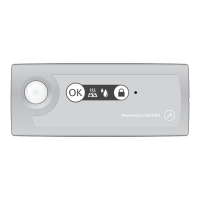

 To Next Page