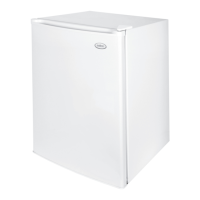
This document provides an instruction booklet for the Salton compact freezer, Model CF2060, detailing its function, usage, and maintenance.
Function Description
The Salton compact freezer is designed for the long-term storage of frozen food. It operates as a freestanding unit, not intended for recessed or enclosed area installation. The appliance features an adjustable temperature control dial, slide-out drawers for organized storage, leveling legs for stability, and a reversible door for flexible placement. Its primary function is to maintain a cold internal temperature to preserve food, with a temperature range from "1" (warmest) to "6" (coldest). The unit is equipped with a cooling system that requires proper ventilation and should be located away from direct sunlight and heat sources to ensure efficient operation.
Usage Features
Before initial use, the freezer requires proper positioning and installation. It must be plugged into a grounded 3-prong outlet, and the use of adapters or extension cords is explicitly prohibited. A separate circuit is recommended for the appliance. The freezer should stand upright for approximately 2 hours before being plugged in to allow the cooling system to stabilize after transportation. For optimal performance, the freezer should be placed on a floor strong enough to support its weight when fully loaded. Adequate clearance is necessary around the unit: a minimum of 20 cm (8") on both sides, 10 cm (4") at the back, and 30 cm (12") above for proper air circulation. If installed next to a fixed wall, sufficient space on the hinge side is needed for the door to swing open.
Leveling the freezer is crucial for proper operation. This is achieved by adjusting the leveling legs; turning them clockwise raises that side, while turning counterclockwise lowers it. It is recommended to position the legs with a slight 1/8" (3 mm) tilt to the back to aid door closure. The freezer is not designed for outdoor use or in uninsulated/unheated locations, particularly where temperatures fall below 12.8°C (55°F), as this can impair performance and lead to excessive frost formation.
Once plugged in and after the initial 2-hour waiting period, the freezer's interior should be allowed to cool for 2-3 hours before food is placed inside. The temperature control dial, located at the back of the unit, should initially be set to the maximum position for 24-48 hours. After this period, it can be adjusted to suit individual needs, with "4" being appropriate for most. To turn off the cooling cycle, the dial should be set to "OFF"; however, this does not cut off the power. If the freezer is unplugged or loses power, a minimum 5-minute waiting period is required before restarting to prevent damage to the circuits. The internal temperature can fluctuate based on door opening frequency and the amount of food stored.
The door is reversible, allowing it to open from either the right or left side. The process involves unplugging the freezer, emptying its contents, removing hinge covers and screws, tilting the unit backward onto protective padding, transferring the hinges to the opposite side, and reattaching the door and covers. Care should be taken to avoid scratching surfaces during this process.
For freezing fresh foods, it is important to select high-quality food suitable for freezing and to use correct, airtight packaging to prevent vitamin loss and dehydration. Foils and bags should wrap tightly around the food. Sanitary precautions should be observed during food preparation. Packages should be marked with the food type, amount, and loading date. Rapid freezing is essential for maintaining food quality; overloading the freezer can reduce freezing quality. Pre-packed commercially frozen food should be stored according to the manufacturer's instructions.
Helpful hints for efficient use include locating the freezer in the coolest part of the room, allowing hot foods to cool before freezing, avoiding overloading, and not lining freezer storage baskets with materials like aluminum foil or wax paper, as these interfere with cold air circulation. Reducing door openings and quickly retrieving items helps maintain internal temperature. In case of a short power interruption, keeping the door closed helps food stay frozen. If power is out for an extended period, food should be checked before consumption, and thawed food should not be refrozen.
Maintenance Features
Regular cleaning is essential for the freezer's longevity and hygiene. Before cleaning, the freezer must be unplugged, and all food and shelves/drawers removed. The interior and door gasket should be wiped with a cloth or sponge dampened in a warm water and baking soda solution (30 ml baking soda to 1 liter/quart of water). The shelves should be washed with mild detergent. The exterior can be cleaned with a soft cloth dampened in mild detergent and warm water. Excess water should be wrung out of the cloth before cleaning areas with controls or electrical parts. Abrasive cleansers should not be used as they can damage the finish. Door gaskets should be cleaned every three months to ensure they remain pliable and maintain a proper seal.
Defrosting is necessary when the freezer frost exceeds 1 cm (1/4") thick. To defrost, all frozen food should be removed and kept frozen. The thermostat dial should be turned to "OFF," and the freezer unplugged. Boiling water should not be used, as it can damage plastic parts. Sharp or metallic instruments are also prohibited for frost removal, as they can damage cooling coils and void the warranty; only the plastic scraper included with the freezer should be used. The defrosting process can take several hours. After defrosting, the melted water should be discarded, the interior dried, and the thermostat dial returned to the previous temperature.
For ice cube production, the recommended thermostat setting is position 6. The ice cube tray should be filled 2/3 full with cold water or a suitable liquid and placed on the bottom of the freezer. Drying the bottom of the tray prevents it from sticking. To release ice cubes, the tray can be held under cold tap water for a second, then twisted slightly over an ice bucket.
During short vacations (less than 3-4 weeks), the appliance can be left operating. For long vacations (over one month), all items should be removed, the power cord unplugged, and the interior thoroughly cleaned and dried. To prevent odor and mold growth, the door should be left slightly open, blocked if necessary.
When moving the freezer, all contents should be removed and stored properly. Loose items inside should be securely taped down. The leveling screws should be turned up to the base to prevent damage. The door should be taped shut. During transportation, the appliance must remain secure in an upright position, and its exterior should be protected with a blanket or similar item.


 To Next Page
 General