This document describes the installation and features of a Samsung air conditioner, specifically models AC**TXQLC.
Function Description
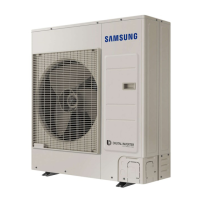
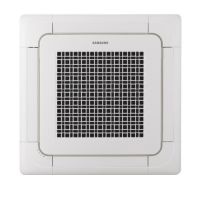
The Samsung air conditioner is designed to provide cooling and heating for indoor environments. It operates as a split system, with an indoor unit and an outdoor unit connected by refrigerant pipes and electrical wiring. The system uses R-410A refrigerant and is available in various capacities to suit different room sizes and climate conditions. The air conditioner is equipped with features for precise temperature control, air distribution, and energy efficiency.
Important Technical Specifications
The manual covers several models with varying capacities and electrical specifications. Here's a summary of key technical data:
Power Supply:
- Rated Voltage & Frequency: 220 - 240 V ~ 50 Hz (single phase) or 380 - 415 V 3N ~ 50 Hz (three phase), depending on the model.
- Rated Current (Cooling/Heating): Varies by model, e.g., 6.6 A to 19.4 A for single-phase cooling, and 6.8 A to 10.5 A for three-phase cooling.
- Rated Power Input (Cooling/Heating): Varies by model, e.g., 1450 W to 4500 W for single-phase cooling, and 1500 W to 5880 W for three-phase cooling.
- EER / COP (Btu/h)/W: Varies by model, e.g., 12.40 to 12.60 for cooling, and 8.50 to 9.20 for heating.
- Power Factor: Typically 0.95 to 0.97.
Refrigerant:
- Type: R-410A.
- Quantity: Varies by model, e.g., 1.45 kg to 3.80 kg.
Capacity:
- Rated Capacity (Cooling/Heating): Expressed in Btu/h, e.g., 18,000 Btu/h to 60,000 Btu/h for cooling, and 16,200 Btu/h to 54,000 Btu/h for heating.
- Annual Energy Consumption (for 2,700 Hr): Varies by model, e.g., 3720 kWh to 15,876 kWh.
Dimensions of the Unit (W×H×D):
- Indoor Unit: Varies by model, e.g., 880 x 638 x 310 mm to 940 x 1420 x 330 mm.
- Outdoor Unit: Varies by model, e.g., 880 x 638 x 310 mm to 940 x 1420 x 330 mm.
Piping:
- Outer Diameter (Gas/Liquid): Common sizes include ø6.35 mm (1/4 inch), ø9.52 mm (3/8 inch), ø12.70 mm (1/2 inch), ø15.88 mm (5/8 inch), and ø19.05 mm (3/4 inch).
- Maximum Allowable Length: Up to 75 m, with a maximum height difference of 30 m between indoor and outdoor units.
- Minimum Thickness of Refrigerant Pipe: Typically 0.7 mm to 0.9 mm, with specific requirements for different pipe diameters and temper grades (O, 1/2H, H).
Electrical Connections:
- Main Power Cable: Connects to the outdoor unit.
- Auxiliary Circuit Breaker (MCCB/ELCB): Required for safety.
- Communication Cable: Connects indoor and outdoor units.
- Grounding: Essential for safety.
Safety Information:
- WARNING: Indicates hazards that may result in severe personal injury or death. This includes warnings about electrical shock, refrigerant leaks, and improper installation.
- CAUTION: Indicates hazards that may result in minor personal injury or property damage. This includes warnings about sharp edges, proper handling of components, and ensuring adequate ventilation.
- The air conditioner should be used only for the applications for which it has been designed.
- Installation, maintenance, and repair should be performed by qualified personnel.
- Do not attempt to repair, move, alter, or reinstall the unit yourself.
- Always ensure proper grounding and use of specified cables and circuit breakers.
- Do not use the unit if damaged or if there are unusual noises or smells.
- Wear protective equipment during installation and maintenance.
Usage Features
The manual primarily focuses on installation, but some usage-related features can be inferred:
- Temperature Control: The system allows users to set desired temperatures for cooling and heating.
- Mode Selection: Users can switch between cooling and heating modes.
- Fan Speed Control: The indoor unit likely offers adjustable fan speeds.
- Error Display: The indoor unit's display provides error codes for troubleshooting.
- Eco Mode: A feature to optimize energy consumption.
- Quiet Mode: A setting for reduced noise operation.
- Automatic Address Setting: The system can automatically assign addresses to connected indoor units in multi-unit installations.
- Monitoring: The K4 switch on the indoor unit allows for monitoring various operational parameters like order frequency, current frequency, ambient temperature, compressor discharge sensor, condenser sensor, current, outdoor fan RPM, target discharge temperature, EEPROM, and protective control status.
Maintenance Features
The manual outlines several procedures that are part of installation and can be considered initial maintenance or setup for future maintenance:
- Refrigerant Pumping Down: A procedure to recover refrigerant from the system, essential before relocating or servicing the unit.
- Relocating Indoor and Outdoor Units: Instructions for safely moving the units, which involves pumping down refrigerant and disconnecting pipes and cables.
- Stopping the Stop Valve: Procedure for closing the service valve during refrigerant recovery or system isolation.
- Adding Refrigerant (R-410A): Instructions for charging the system with the correct amount of refrigerant, including checking for leaks and using a manifold gauge.
- Performing Gas Leak Test: A critical step after connecting refrigerant pipes to ensure no leaks using nitrogen gas.
- Connecting the Drain Hose: Ensures proper drainage of condensate from the indoor unit to prevent water damage.
- Insulating Refrigerant Pipes: Essential for preventing condensation and improving efficiency.
- Checking the Earthing: Verifying proper grounding of the unit for safety.
- Performing Final Check and Trial Operation: A comprehensive check of electrical connections, pipe connections, and a test run of the unit to ensure correct operation and display of parameters.
- Troubleshooting: An appendix provides a list of error codes and their meanings, along with remarks for diagnosis. This is a key feature for maintenance and repair.
- Packing and Unpacking Guide: Instructions for safely unpacking and packing the outdoor unit, useful for installation and potential relocation.
The manual emphasizes that installation and maintenance should be performed by qualified personnel to ensure safety and proper operation of the air conditioner. It also highlights the importance of using genuine Samsung parts and following all local and national regulations.

 Need help?
 General





 To Next Page