Need help?
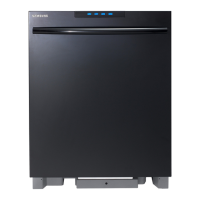
Do you have a question about the Samsung D148S and is the answer not in the manual?
Provides essential safety guidelines for installation and operation.
Details measures to ensure the appliance is safe for use around children.
Guidelines for safe and correct operation, including warnings.
Information on recycling packaging and disposing of used appliances.
Tips for efficient washing, saving water, energy, and detergent.
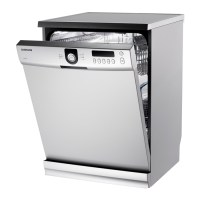
An overview of the dishwasher's main components and parts.
Details the functions and indicators on the appliance's control panel.
Explains water hardness, its effects, and choosing appropriate detergents.
Guides on testing water hardness and choosing traditional or multi-purpose products.
Correlates water hardness levels with salt usage and product recommendations.
Instructions for setting the water softener and loading detergent for traditional products.
Guidance on using multi-purpose tablets and adjusting settings for 'Extra Dry' or 'Sparkling Clean'.
Instructions on how and where to place multi-purpose tablets in the dispenser.
Step-by-step guide on filling the salt tank for water softening.
Explains the salt indicator light and when to refill the salt tank.
Instructions for filling the rinsing product tank and adjusting the dispenser.
Information on the rinsing liquid indicator and its deactivation.
Lists items that should not be washed in the dishwasher due to material or construction.
Guidance on arranging items in the lower basket for optimal washing.
Advice on arranging glasses, cups, and bowls in the upper basket.
Instructions on how to adjust the upper basket's height for different load configurations.
Guidance on placing and arranging cutlery in the basket for flexible loading.
Indicates how the appliance signals a door that is not closed correctly.
Explains that the program selector is locked during operation.
Describes the system that activates the drain pump for excess water.
Details the system that interrupts water supply upon detecting a leak.
A table outlining various wash cycles, their purpose, and typical settings.
How to select and start a wash cycle immediately.
Instructions for setting a delayed start time for wash cycles.
Procedure to cancel a running wash cycle.
How to turn off the appliance after a programme has finished.
Detailed steps for removing and cleaning the filtration system components.
Recommendations for regular maintenance cleaning of the appliance.
Instructions for preparing the dishwasher for long-term storage.
Lists common error codes and their potential causes.
Guides on identifying and resolving common operational problems.
Explains the meaning of various indicator lights and potential issues.
Troubleshooting for problems related to cycle duration or appliance not starting.
Troubleshooting steps for when the appliance fails to restart or drain.
Addresses issues like food traces, deposits, and grease on dishes.
Solutions for white marks, cloudy glass, and colored stains on dishes.
Troubleshooting for streaks, droplets, and dried-on marks on glassware.
Addresses problems like constant filling, rust traces, and waste on filters.
Solutions for issues like droplets on dishes, poor drying on rapid cycles, and condensation.
Guidelines for authorized service and obtaining repair work.
Emphasizes the importance of using certified original spare parts for maintenance.
Specifies common parameters like capacity, item arrangement, and settings for testing.
Details recommended programme and detergent dosage for standardized tests.
 General
| Type | Freestanding |
|---|---|
| Control Type | Electronic |
| Color | White |
| Energy efficiency class | A |
| Delay start | Yes |
| Dimensions (H x W x D) | 85 x 60 x 60 cm |


 To Next Page