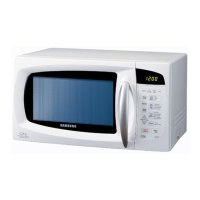
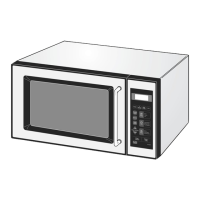
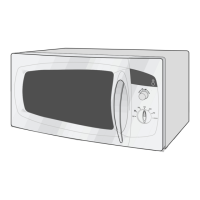
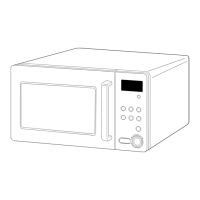
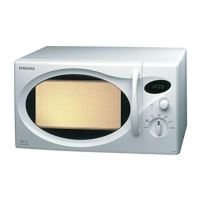
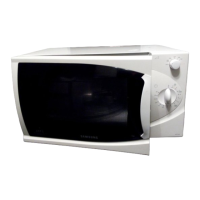
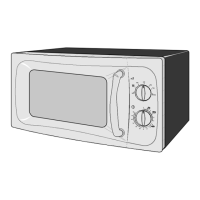
This document is a service manual for the Samsung M1833NR Microwave Oven, providing comprehensive information for technicians on its operation, maintenance, and repair.
Function Description
The Samsung M1833NR is a microwave oven designed for cooking and heating food. It utilizes microwave energy to rapidly prepare meals, offering various operating instructions and safety features for user convenience and protection. The oven's control panel allows users to set cooking times and power levels, while internal components like the magnetron generate the microwaves. The manual details the process of disassembly and reassembly of various parts, alignment and adjustments, and troubleshooting steps to ensure optimal performance and safety. It also includes exploded views and parts lists for easy identification and replacement of components, along with P.C.B and schematic diagrams for in-depth electrical understanding.
Important Technical Specifications
The microwave oven operates with a timer that can be set for up to 99 minutes and 90 seconds. Its power source is 220V, 50Hz, AC, with a power consumption of 1,150W. The output power ranges from 100 to 800W, conforming to IEC-705 test procedures. The operating frequency is 2,450MHz. The magnetron model used is OM75S(31)ESS, and cooling is achieved via a cooling fan motor.
The physical dimensions of the oven are as follows:
- Outside Dimensions: 489mm (W) x 275mm (H) x 361mm (D)
- Oven Dimensions: 306mm (W) x 211mm (H) x 320mm (D)
- Shipping Dimensions: 557mm (W) x 329mm (H) x 434mm (D)
The oven's net weight is 12.5kg, and its gross weight is 14.0kg.
Key electrical specifications for the high voltage transformer include:
- Secondary: Approx. 139Ω
- Filament: Approx. 0Ω
- Primary: Approx. 1.94Ω (at room temperature = 20°C)
For the low voltage transformer, the terminals and their resistances are:
- 1~2 (Input): 1,201Ω
- 3~4 (Output 7V): 4,384Ω
- 5~6 (Output 17V): 21.72Ω
The magnetron's output power is measured using a water temperature rise test, with a formula: Output Power = 4.187 x 1000 x ΔT+0.55xMcx(T2-T1) / 52. The heating time (Sec) is 55, counting time (Sec) is 52, and the coefficient for water is 4.187. The water temperature (T2-T1) is 10°C, room temperature is 10°C, and cylindrical borosilicate glass weight (Mc) is used.
Microwave energy leakage is a critical safety specification. The maximum allowable leakage is 5mW/cm², with 4mW/cm² used for measurement and meter accuracy.
Usage Features
The manual outlines operating instructions, including the control panel layout and features. The control panel includes buttons for various functions such as "Подогрев" (Reheat), "Разморозка" (Defrost), "Мощность" (Power), "Часы" (Clock), "Стоп" (Stop), and "Старт" (Start). It also has buttons for setting time in minutes and seconds. The oven features a door with latches, a door seal, and a viewing window. Inside, there's a turntable, roller ring, and coupler for even cooking. Ventilation holes and a light are also present. Safety interlocks are integrated into the door mechanism to prevent microwave emission when the door is open.
Maintenance Features
The service manual provides extensive details on maintenance and repair procedures.
Safety Precautions:
- Microwave Energy Exposure: Strict precautions are outlined to prevent exposure to excessive microwave energy. This includes not operating the oven with the door open, performing safety checks on all ovens, and ensuring proper door closing, seal, and latch integrity. Any defective or misadjusted components related to the interlock, monitor, door seal, and microwave generation/transmission systems must be repaired or replaced.
- High Voltage Warning: Technicians are warned about the presence of high voltage in the magnetron and transformer circuits. It is crucial to unplug the oven and discharge the high voltage capacitor before touching any components. The capacitor remains charged for about 30 seconds after disconnection. Servicemen are advised to remove watches when working near or replacing the magnetron.
- Component Replacement: Only replacement components with the same ratings, especially for flame resistance and dielectric strength, should be used to avoid shock, fire, or other hazards. Critical safety components are indicated in circuit diagrams by shading.
Disassembly and Reassembly:
- Magnetron, Motor Assembly, and Lamp: Instructions include disconnecting lead wires, removing the air cover, screws, and the magnetron carefully. It emphasizes ensuring the magnetron gasket is in good condition upon reassembly.
- High Voltage Transformer: Steps involve discharging the high voltage capacitor, disconnecting leads, and removing mounting bolts.
- Door Assembly: Detailed steps for removing and reassembling the door, including the door "C" and "E" components, and the key door spring. A reassembly test is required to ensure proper installation and adjustment to prevent excessive microwave leakage.
- Fuse Replacement: Disconnecting power, identifying the blown fuse, and replacing it if primary interlock switch, door sensing switch, monitor switch, and power relay are functioning correctly.
- Drive Motor: Steps to remove the glass tray, guide roller, and turn table motor from the oven bottom.
- Control Circuit Board: Disconnecting connectors, removing screws, and knobs.
- P.C.B Assembly: Pulling the lever end of the plastic fastener and removing the Flexible Printed Circuit (FPC) of the membrane panel.
- Window Display & Membrane Panel: Instructions for handling and replacing the window display and membrane panel, emphasizing careful removal and cleaning of the escutcheon base.
Alignment and Adjustments:
- High Voltage Transformer: Checking continuity of transformer terminals.
- Low Voltage Transformer: Checking continuity and normal resistor readings.
- Magnetron: Checking continuity for open filament or shorted magnetron, isolating the magnetron from the circuit, and checking continuity across filament terminals.
- High Voltage Capacitor: Checking continuity with a meter set at the highest resistance scale.
- High Voltage Diode: Isolating the diode from the circuit and measuring resistance.
- Main Relay and Power Control Relay: Locating relays on the P.C.B Assy, isolating them, and operating the microwave oven with a water load.
- Primary, Door Sensing, and Monitor Switch Adjustment: Detailed procedure for adjusting interlock switches, including visual inspection and continuity checks.
Troubleshooting:
A comprehensive troubleshooting guide is provided for various electrical malfunctions, including:
- Oven dead/No display: Causes include open or loose lead wire harness, open thermal cutout, defective magnetron, defective P.C.B, shorted lead wire harness, defective primary latch switch, defective monitor switch, shorted H.V.Capacitor, and shorted H.V.Transformer.
- Oven does not accept key input: Causes include key input not in sequence, open or loose connection of membrane key pad, and defective P.C.B.
- Timer starts countdown but no microwave oscillation: Causes include off-alignment of latch switches, open or loose connection of high voltage circuit, defective high voltage components, and open or loose wiring of power relay.
- Oven lamp and fan motor turn on: Misadjustment or loose wiring of primary latch switch, defective primary latch switch.
- Oven can program but timer does not start: Open or loose wiring of secondary interlock switch, off-alignment of primary interlock, and defective secondary interlock S/W.
- Microwave output is low: Decrease in power source voltage, open or loose wiring of magnetron filament circuit, and aging of magnetron.
- Fan motor turns on when plugged in: Loose wiring of door sensing switch.
- Oven does not operate and return to the plugged in mode: Defective Ass'y PCB.
- Loud buzzing noise: Loose fan and fan motor, loose screws on H.V.Transformer, shorted H.V.Diode.
- Turntable motor does not rotate: Open or loose wiring of turntable motor, defective turntable motor.
- Oven stops operation during cooking: Open or loose wiring of primary interlock switch, operation of thermal cutout (Magnetron).
- Sparks: Metallic ware or cooking dishes touching the oven wall, scratches or trimmed metallic parts.
- Uneven cooking: Uneven intensity of microwave due to its characteristics.
- Noise from the turntable motor when it starts to operate: Noise may result from the motor.
Exploded Views and Parts List:
Detailed diagrams and lists of all components with their respective part numbers, descriptions, specifications, and quantities. This includes parts for the door assembly, control panel, magnetron, transformer, and various electrical components.
P.C.B and Schematic Diagrams:
Illustrations of the Printed Circuit Board layout and electrical schematics to aid in diagnosing and repairing electrical issues. These diagrams are intended for authorized Samsung personnel only.

 Need help?
 General

 To Next Page