The Sanhua SD2 Series Drive is a variable speed drive designed for controlling brushless permanent magnet (BLDC) or synchronous permanent magnet motors, specifically for compressors. It incorporates advanced control schemes and protection functions to ensure stable, efficient, and reliable operation.
Function Description
The SD2 drive utilizes sensor-less SVPWM sine wave control, which effectively minimizes high-order harmonics, motor vibration, torque fluctuation, and noise. It features weak magnetic control and MTPA (Maximum Torque Per Ampere) control to extend the compressor's operating frequency range. The control strategy employs a double closed-loop feedback system: an outer loop (speed) for stable operating frequency and an inner loop (current) for accurate real-time torque output.
The drive includes a Power Factor Correction (PFC) function, which reduces the impact on the power grid and increases the DC bus voltage to improve the operating frequency range. This allows the drive to operate across an ultra-wide input voltage range, particularly in 1-Phase models.
The SD2 drive also offers USB programming functionality, facilitated by an external USB Off-line Programmer. This requires disconnecting the drive and external control circuits from the power supply and setting the main system switch to "off" before programming.
For communication, the drive supports Reinforced Isolation MODBUS communications, providing robust data exchange. It also features reinforced isolation interfaces for high-pressure switches (HPS) and discharge temperature sensors (DLT), as well as a 0-10V Analog Input interface. The design adheres to Pollution Degree 3 standards for distances between components.
The drive is suitable for various refrigerant systems, including A1 refrigerants (R410A, R448A, R744, R134a, R22, R417C, R404A, R407C), A2L refrigerants (R32, R454A, R454B, R454C, R1234yf, R1234e with hot surface ignition temperature > 350°C), and A3 refrigerants (R290, R600, R600a, R1270 with hot surface ignition temperature > 350°C).
The main function of this drive module is compressor drive and control. It does not include outdoor fan or electronic expansion valve control, nor does it supply power to a host computer or other controllers. These functions are typically handled by a separate master board or user-provided upper controller.
Important Technical Specifications
Models and Power Supply:
The SD2 series includes several models categorized by phase and output current:
- 1-PH Drive:
- SD2011A2: AC 220-240V 50/60Hz, 13A MAX Input, 11A MAX Output.
- SD2015A2: AC 220-240V 50/60Hz, 20A MAX Input, 14.5A MAX Output.
- SD2020A2: AC 220-240V 50/60Hz, 25A MAX Input, 20A MAX Output.
- 3-PH Drive:
- SD2015B4: AC 380-415V 50/60Hz, 8A MAX Input, 15A MAX Output.
- SD2020B4: AC 380-415V 50/60Hz, 11A MAX Input, 20A MAX Output.
- SD2025B4: AC 380-415V 50/60Hz, 18A MAX Input, 25A MAX Output.
- SD2032B4: AC 380-415V 50/60Hz, 25A MAX Input, 32A MAX Output.
Operating Conditions:
- Operating environment: -25°C to 65°C, 0-95% relative humidity (no frost & condensation). The drive should not be installed in direct sunlight, and contaminants like metal powder, dust, oil, and water must be prevented from entering.
- Storage environment: -40°C to 85°C, 0-95% relative humidity (no condensation).
Cooling:
- For horizontal & vertical heatsink models (SD20H**& SD20**********), an airflow speed of at least 1m/s at the heatsink outlet is required for SD2011A2, SD2015A2, SD2020A2, SD2015B4, SD2020B4, and SD2025B4. For SD2032B4, an airflow speed of at least 2m/s is required.
- For flat plate heatsink models (SD20F**), the drive must be liquid cooled. Additional liquid tubes and a cover plate, designed by the user, should be mounted. The reference point temperature of the flat plate must be kept below the specified value, and condensation should be avoided by ensuring the liquid temperature in the tube is not too low.
- Minimum clearances to other components near the drive are crucial for effective cooling. It is recommended to mount the drive in the lower or middle part of the cabinet to facilitate good natural convection.
Electrical Connections:
- Power Terminals: Max tightening torque is 1.5 Nm.
- Control Terminals: Max tightening torque is 0.5 Nm.
- Communication Interface (CN21): Includes 12Vdc output (100mA Max), COM_GND, RS485/ModBus (A, B), 5Vdc, High Pressure Switch input (HPS), Input of Discharge Temperature Sensor (DLT), 0-10Vdc detecting input (AI), and COM_GND.
- If the HPS input (No.5&6) is not used, a short circuit must be implemented between No.5&6 for the drive to function.
- The communication terminal type is EC381V-10P, which is not included in accessories.
- O terminals should be used with heat shrink tubing for bare wires.
- For 3-phase models, chokes are supplied and must be externally connected to the drives. For SD2025B4 and SD2032B4, the grid must provide an RSCE ≥ 120, with a system input current of ≥ 16A on each phase to comply with EN 61000-3-12.
Safety Standards and Certifications:
The drives are designed and manufactured according to CE-LVD and CB reports, adhering to:
- EN 60335-1: Household and similar electrical appliances Safety - Part 1: General requirements.
- EN 60335-2-34: Household and similar electrical appliances Safety - Part 2-34: Particular requirements for motor-compressors.
- EN 60335-2-40: Household and similar electrical appliances Safety - Part 2-40: Particular requirements for electrical heat pumps, air-conditioners and dehumidifier.
- The drive software's DSP is divided into security-related and function-related parts. Security-related parts are authenticated by CLASS B and have independent checksums.
- Compressor model selection and output current protection values are stored in EEPROM as function-related parts without review, to avoid duplicate authentication due to matching different compressors.
EMC Standards:
- EN 55014-1: Electromagnetic compatibility (EMC) – requirements for household appliances, electric tools and similar apparatus - Part 1: Emission CE conducted margin (Conducted Emission): 3db; RE Radiations margin (radiations emissions): 3db.
- EN 55014-2: Electromagnetic compatibility (EMC) – Requirements for household appliances, electric tools and similar apparatus - Part 2: Immunity – Product family standard.
- EN 61000-3-2: Electromagnetic compatibility (EMC) - Part 3-2: Limits – Limits for harmonic currents produced by equipment connected to public low - voltage systems (equipment input current ≤ 16A per phase).
- EN 61000-3-12: Electromagnetic compatibility (EMC) - Part 3-12: Limits – Limits for harmonic currents produced by equipment connected to public low – voltage systems (equipment input current > 16A and ≤ 75A per phase).
- EN 61000-3-3: Electromagnetic compatibility (EMC) - Part 3-3: Limits - Limitation of voltage changes, voltage fluctuations and flicker in public low – voltage systems, for equipment with rated current ≤ 16A per phase and not subject to conditional connection.
- EN 61000-4-2: Electromagnetic compatibility (EMC) – Part 4-2: Testing and measurement techniques – Electrostatic discharge immunity test (8KV Contact discharge, 15KV Air discharge; Criterion B Breakpoint test (all ports of client used) and 4KV Contact discharge, 8KV Air discharge; Criterion B Charged test (all ports of client used)).
- EN 61000-4-3: Electromagnetic compatibility (EMC) – Part 4-3: Testing and measurement techniques – Radiated, radio-frequency, electromagnetic field immunity test (10V/m, 80-1000MHz; Criterion A).
- EN 61000-4-4: Electromagnetic compatibility (EMC) - Part 4-4: Testing and measurement techniques - Electrical fast transient / burst immunity test (2KV / 5KHz (signal Line), 4KV / 5KHz (Power Line); Criterion B).
- EN 61000-4-5: Electromagnetic compatibility (EMC) - Part 4-5: Testing and measurement techniques - Surge immunity test (2KV (Difference module), 4KV (Common module); Criterion B).
- EN 61000-4-8: Electromagnetic compatibility (EMC) – Part 4-5: Testing and measurement techniques – Power frequency magnetic field immunity test (3A/M @ 50Hz; Criterion A).
- EN 61000-4-11: Electromagnetic compatibility (EMC) - Part 4-5: Testing and measurement techniques - Voltage dips, short interruptions and voltage variations immunity tests (0% for 0.5 cycle; Criterion C, 40% for 10 cycles; Criterion C, 70% for 50 cycles; Criterion C).
Usage Features
Start-up and Configuration:
Before starting, the drive requires configuration settings for communication and compressor parameters.
- Communication Parameters: Default settings are address 247, baud rate 19200bps, even parity, and 1 stop bit. If communication data is received from the host within 5 seconds of power-up, these settings are used; otherwise, user-defined parameters apply. Modbus RTU slave, half-duplex communication is supported with functions for holding register reading, input register reading, single register writing, and multiple register writing.
- Compressor Parameters Selection: During standby, users can select different compressor parameters by changing Register 2 code. If Register 2=0, the user-defined compressor parameter is used. If Register 2 is not 0, the value corresponds to a selected compressor number in EEPROM. An EE abnormal fault alarm will occur if the selected number does not exist.
- Compressor Start Control: The drive can be controlled via Modbus protocol or a 0-10V interface voltage. If [0~10V I/F Enable] Registe0.bit15=0, Modbus control is active. Otherwise, the 0-10V interface voltage dictates functions such as stop/restore, stator heater (10% or 100%), and compressor running at target frequencies.
- Fault Handling: If a shutdown fault occurs, register 10.bit7 is set to 1. Faults must be cleared by setting register0.bit7 to 1 before enabling the drive. The compressor can start if no fault alarm is present, register0.bit1-0=1, and register3 is not 0. The compressor will shut down immediately upon a fault or if register0.bit1-0 is set to 0, and decelerate to shut down if register3 is set to 0.
Status Indication:
- Running/Stop Indication (Green/Yellow LED): Green indicates running, Yellow indicates stop. If flashing, it means host computer communication is received (fastest flashing interval 0.5s).
- Fault Indicator (Red LED): Always off means no fault. Flashing indicates a fault. Fast flashing represents ten digits, slow flashing represents ones digit, corresponding to specific fault codes.
Maintenance Features
Protection Functions: The drive incorporates a variety of protection functions implemented via a DSP chip, ensuring quick response to potential issues:
- Frequency-skip frequency
- Current limitation (compressor, AC, IPM temperature, PFC temperature, low DC voltage for 3-phase models)
- Compressor current protection (SW and HW)
- AC current protection
- IPM over-temperature protection
- PFC over-temperature protection
- DLT protection
- HPS protection
- AD-offset abnormal fault
- Compressor/VAC lost-phase protection
- Compressor frequency abnormal fault
- VDC over/under-voltage protection
- VAC over/under-voltage protection
- Charge circuit fault
- EEPROM data abnormal fault
- Communication fault
- MCU self-check fault
- IPM temperature sensor abnormal fault
- PFC temperature sensor abnormal fault
Troubleshooting:
A comprehensive fault code table is provided, detailing fault names (e.g., Lost Communication, EEPROM Data Abnormal, AC Lost-Phase, Over/Under Voltage, Over/Under Current, Temperature Sensor Faults, MCU self-check Fault) and corresponding fault codes. Each fault is associated with possible causes, such as hardware damage, poor cable connections, unbalanced power supply, high/low voltage, high/low temperature, or compressor damage (stalling, wear, demagnetization, winding open/short circuit).
USB Programming:
For maintenance or updates, the USB programming function allows for easy firmware management. The process involves:
- Disconnecting all electrical wires from the power input of the SD2 drive and waiting 10 minutes for electrostatic discharge.
- Removing the cover of the programming terminal, then connecting the drive and USB programmer.
- Turning on the USB programmer (green light steady on), which enters USB program mode and automatically reads the main program file and/or EEPROM data file from the U disk.
- Observing indicator status and fault indicator on the drive to judge the programming result. Indicator lights on the programmer (Light on/off for Green, Yellow, Red) indicate programmer status, U disk connection, and programming success/failure.
- The main program file in the U disk needs to be named as
firmware.hex, and the EEPROM data file as ezdata.hex. The U disk must use FAT32 format. The programmer is not included in accessories.

 Need help?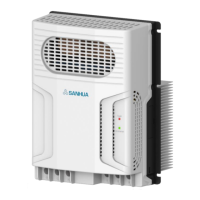

 To Next Page
 General