The provided document is a Safety, Operation & Maintenance Manual for the Sany Paver SAP60C-8. This manual serves as a comprehensive guide for users to safely operate, maintain, and troubleshoot the Sany SAP Series Paver, emphasizing the importance of adhering to safety precautions and instructions to prevent injury, death, or property damage.
Function Description
The Sany Paver SAP60C-8 is a SANY-built equipment designed for construction applications, specifically for paving asphalt mixture, RCC base material, stabilized soil material, and road material (like graded broken stone). Its primary function is to lay and level these materials to create a road base or surface. The machine is designed for high-quality performance and is widely used throughout the engineering construction technology for various types of applications.
Important Technical Specifications
While the full technical specifications are not detailed on the provided pages, the manual structure indicates that a dedicated "Specifications" section (1.2.3.7 and 7 Specifications) exists, which would cover:
- Dimension Parameter (7.1): Likely includes overall dimensions, paving width, and other relevant size specifications.
- Performance Parameter (7.2): Would detail operational capabilities such as paving speed, paving thickness, engine power, and other performance metrics.
- Machine Type: SAP60C-8, indicating a specific model within the SAP Series Paver line.
- Engine: The manual mentions "Engine" in various maintenance and operation sections (e.3.1, 5.1.3, 5.3.4.1, 5.3.4.2, 5.3.4.3, 5.3.4.4, 5.3.4.9, 5.3.8.1, 5.3.8.2, 4.6, 4.6.1, 4.6.2), suggesting a robust power system.
- Hydraulic System: Extensive sections are dedicated to the hydraulic system (3.4, 3.4.1, 3.4.1.1, 3.4.1.2, 3.4.1.3, 3.4.2, 3.4.3, 3.4.4, 3.4.5, 3.4.6, 3.4.7, 3.4.8, 3.4.12, 5.1.4, 5.3.5, 5.3.5.1, 5.3.5.2, 5.3.11, 6.4, 6.4.1, 6.4.2, 6.4.3, 6.4.4, 6.4.5, 6.4.6, 6.4.7, 6.4.8), indicating that it is a critical component for various machine functions, including screed control, conveyor, auger, and travel.
- Electrical System: Also a significant part of the machine, with sections on general electrical system (3.3, 3.3.1, 3.3.2, 3.3.3, 3.3.4, 3.3.5, 3.3.6, 3.12, 5.3.6, 5.3.6.1, 5.3.6.2, 5.3.6.3, 5.3.12, 6.3, 6.3.1, 6.3.2, 6.3.3, 6.3.4, 6.3.5), covering controls, display, and various electrical components.
- Screed System: The manual details various screed components and functions (3.3.4.2, 3.6, 3.6.1, 3.6.2, 3.6.3, 3.6.4, 3.6.5, 3.6.6, 3.6.6.1, 3.6.6.2, 3.6.7, 3.6.8, 3.6.9, 3.6.10, 3.6.11, 3.6.12, 4.4, 4.4.1, 4.4.1.1, 4.4.1.2, 4.4.1.3, 4.4.1.4, 4.4.1.5, 4.7.6, 4.7.6.1, 4.7.6.2, 4.8.4, 4.8.5, 4.8.6, 5.3.14, 5.4.12, 5.4.19, 6.2, 6.3.1), including hydraulic telescopic screed units, tamper, vibrator, and heating, which are crucial for achieving desired paving quality.
- Conveyor System: Covered in sections like 3.5.2, 3.5.2.1, 3.5.2.2, 3.5.2.3, 3.5.2.4, 3.5.2.5, 3.5.2.6, 3.5.2.7, 3.5.2.8, 4.7.3, 4.8.7, 4.8.8, 5.4.2, 5.4.2.1, 5.4.2.2, 5.4.3, 5.4.3.1, 5.4.3.2, 5.4.3.3, 5.4.3.4, 5.4.4, 5.4.4.1, 5.4.4.2, 5.4.5, 5.4.5.1, 5.4.5.2, 5.4.6, 5.4.6.1, 5.4.6.2, 5.4.15, 6.1.3, 6.4.6, 5.3.10, 5.4.18, 5.4.19, 5.4.20, 5.4.20.1, 5.4.20.2, 5.4.20.3, 5.4.20.4, 5.4.20.5, 5.4.21, 5.4.21.1, 5.4.21.2, 5.4.21.3, 5.4.21.4, 5.4.21.5, 5.4.21.6, 5.4.21.7, 5.4.21.8, 5.4.21.9, 5.4.21.10, 6.4.7, 6.4.8, 6.5, 6.5.1, 6.5.2, 6.5.3, 7.1, 7.2), indicating a system for material transport within the paver.
- Auger System: Referenced in sections like 3.5.3, 3.5.3.1, 3.5.3.2, 3.5.3.3, 3.5.3.4, 4.4.2, 4.4.2.1, 4.4.2.2, 4.7.4, 4.8.9, 5.3.10, 5.4.7, 5.4.7.1, 5.4.7.2, 5.4.7.3, 5.4.7.4, 5.4.18, 6.4.6, 6.4.7, 6.4.8, 6.5, 6.5.1, 6.5.2, 6.5.3, 7.1, 7.2), responsible for distributing material across the paving width.
- Travel System: Discussed in sections such as 3.5.1, 3.5.1.1, 3.5.1.2, 3.5.1.3, 3.5.1.4, 3.5.1.5, 3.5.1.6, 4.7.1, 4.7.1.1, 4.7.1.2, 4.7.1.3, 4.8.10, 4.8.11, 5.3.13, 5.4.13, 5.4.14, 5.4.16, 5.4.17, 6.1.2, 6.4.1, 6.4.2, 6.4.3, 6.4.4, 6.4.5, 6.4.6, 6.4.7, 6.4.8, 6.5, 6.5.1, 6.5.2, 6.5.3, 7.1, 7.2), indicating the machine's mobility, likely track-based given the image.
- Centralized Lubrication System: Mentioned in 3.5.4, 4.7.8, 6.1.4, suggesting an automated system for lubrication, enhancing machine longevity.
Usage Features
- Comprehensive Documentation: The paver comes with a "Safety, Operation and Maintenance Manual" and a "Spare Parts Drawing Volume," ensuring users have all necessary information for operation and parts ordering.
- Safety First: The manual strongly emphasizes reading and following all safety precautions and instructions, including those on machine decals, to prevent serious injury, death, or property damage.
- Operator Training: The manual outlines "Qualifications of Operators" (2.1.4) and "Responsibilities of the Operators" (2.1.5), highlighting the need for trained personnel.
- Pre-operational Checks: Detailed procedures for "Preoperational Check" (2.3.1), "Check on Machine" (2.3.1.2), and "Before Operation" (2.3.1.3) are provided to ensure the machine is ready for work.
- Starting Procedures: Includes instructions for "Starting the Engine" (4.6), "Starting the Engine in Cold Weather" (4.6.1), and "Jump-start the Engine" (4.6.2).
- Operational Adjustments: The manual covers extensive adjustments during operation, such as "Adjusting the Travel System" (4.7.1), "Adjusting the Hopper" (4.7.2), "Adjusting the Conveyor System" (4.7.3), "Adjusting the Auger System" (4.7.4), "Adjusting the Leveling System" (4.7.5), "Adjusting the Screed System" (4.7.6), "Adjusting the Towed Arm" (4.7.7), "Adjusting the Centralized Lubrication System" (4.7.8), "Adjusting the Indicator Pole" (4.8.2), "Spraying Diesel Oil" (4.8.3), "Screed Warm-up" (4.8.4), "Placing the Screed" (4.8.5), "Butting the Truck" (4.8.6), "Feeding the Hopper" (4.8.7), "Operating the Scraper" (4.8.8), "Operating the Auger" (4.8.9), "Moving the Paver" (4.8.10), "Moving the Truck Away" (4.8.11), "Receiving the Mixture" (4.8.12), "Distributing the Material" (4.9), "Adjusting during Paving" (4.10), "Adjusting the Evenness" (4.10.1), "Adjusting the Thickness" (4.10.2), "Adjusting the Material Level" (4.10.3), and "Adjusting and Operating the Auto-leveling System" (4.11).
- Control and Display: The machine features a "Console" (3.3.2), "Control Panel" (3.3.3), and a "Display" (3.3.4) with various information pages (Home Page, Screed Control System Setting, Conveyor Setting, Auger Setting, Fault Alarm, Maintenance & Diagnosis Setting, Digital Input/Output Diagnosis, Analog Diagnosis, Language Selection, Leveling Data Diagnosis, System Setting, Potentiometer & Throttle Calibration, Running Current Calibration, Running Parameter Calibration, Model Setting, Working Current Calibration, Hourmeter Setting, GPS Status Indication, Reserved Page, Historical Fault Check Page), providing comprehensive control and diagnostic capabilities.
- Transportation: Includes detailed instructions for "Loading and Unloading" (4.14.1), "Before Loading the Machine" (4.14.1.1), "Starting the Machine" (4.14.1.2), "Parking the Machine" (4.14.1.3), "Securing the Machine" (4.14.1.4), "Packing" (4.14.2), "Precautions for Transporting the Machine" (4.14.3), "Transferring the Machine" (4.14.4), "Storing the Machine" (4.14.5), and "Lifting the Machine" (4.14.6).
- Troubleshooting: A dedicated section (6 Troubleshooting) covers issues related to the tractor, power system, travel system, conveyor, centralized lubrication system, cleaning device, operating system, screed, electrical system, circuit, sensor, switch, controller, and hydraulic system, along with general fault diagnosis.
Maintenance Features
- Regular Maintenance Schedule: The manual provides a detailed "Routine Maintenance" (5.3.1) and "Regular Maintenance" (5.3.2) schedule, including technical maintenance after running for specific hours (50h, 100h, 200h, 500h, 1000h) and for long-time storage.
- Fluid Checks and Changes: Instructions for "Engine Oil-Check/refill/change" (5.3.4.1), "Change the Engine Oil Filter" (5.3.4.2), "Fuel-Check/refill/change" (5.3.4.3), "Oil Water Separator - Check/water draining/exhaust" (5.3.4.4), "Change the Oil Water Separator" (5.3.4.5), "Change the Duplex Fuel Filter" (5.3.4.6), "Hydraulic Oil - Check/refill/change" (5.3.5.1), and "Change the Hydraulic Oil Filter" (5.3.5.2).
- Cooling System Maintenance: Includes "Clean the Radiator" (5.3.4.7) and "Change the Coolant" (5.3.4.8).
- Belt and Filter Maintenance: "Drive Belt of Engine - Check/tension/replace" (5.3.4.9) and "Maintain and Change the Air Filter" (5.3.4.10).
- Electrical System Maintenance: Covers "Maintaining the Batteries" (5.3.6.1), "Maintaining the Electric Control Cabinet" (5.3.6.2), and "Replacing the Fuse" (5.3.6.3).
- Gear Oil Maintenance: "Replacing the Gear Oil in Transfer Case" (5.3.7).
- Lubrication: "Lubricating Points" (5.3.9) and "Grease Points" (5.3.15).
- Component Inspection and Replacement: "Routine Inspection of Tamper Blade, Base Plate, Auger Blade and Conveyor" (5.3.10), "Check the Bolts" (5.3.17), and detailed procedures for "Replacing the Conveyor Chain" (5.4.2), "Adjusting the Tension of Conveyor Chain" (5.4.3), "Replacing and Tensioning the Conveyor Drive Chain" (5.4.4), "Removing and Installing the Conveyor" (5.4.5), "Replacing and Tensioning the Conveyor Chain" (5.4.6), "Adjusting the Tension of Auger Chain" (5.4.7), "Replacing the Travel Reducer" (5.4.8), "Installing and Removing the Hopper" (5.4.9), "Replacing the rubber crawler shoe" (5.4.10), "Replacing the bearing wheel" (5.4.11), "Replacing the Travel Pump" (5.4.13), "Replacing the Travel Motor" (5.4.14), "Replacing the Conveyor Auger Pump" (5.4.15), "Replacing the Front Drive Vibration Pump, Auxiliary Steering Pump, Tamper Pump and Generation Pump" (5.4.16), "Replacing the Front Drive Motor" (5.4.17), "Replacing the Conveyor Motor and the Auger Motor" (5.4.18), "Replacing the Tamper/vibrator/generator Motor" (5.4.19), and "Replacing the Cylinders" (5.4.20).
- Relief Valve Adjustments: Comprehensive instructions for "Adjusting Auxiliary System Pressure" (5.4.21), including various relief valves for different hydraulic circuits.
- Warning Labels: Emphasizes the "Usage of Warning Labels" (2.5.1) and "Repair Precautions" (2.5.1) for safety during maintenance.

 Need help?
 General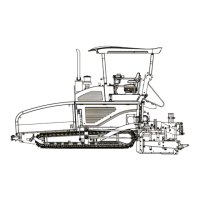

 To Next Page