EasyManua.ls Logo

Sanyo MR-939 - Page 3

Sanyo MR-939
19 pages
Print Icon
To Next Page IconTo Next Page
To Previous Page IconTo Previous Page
Loading...
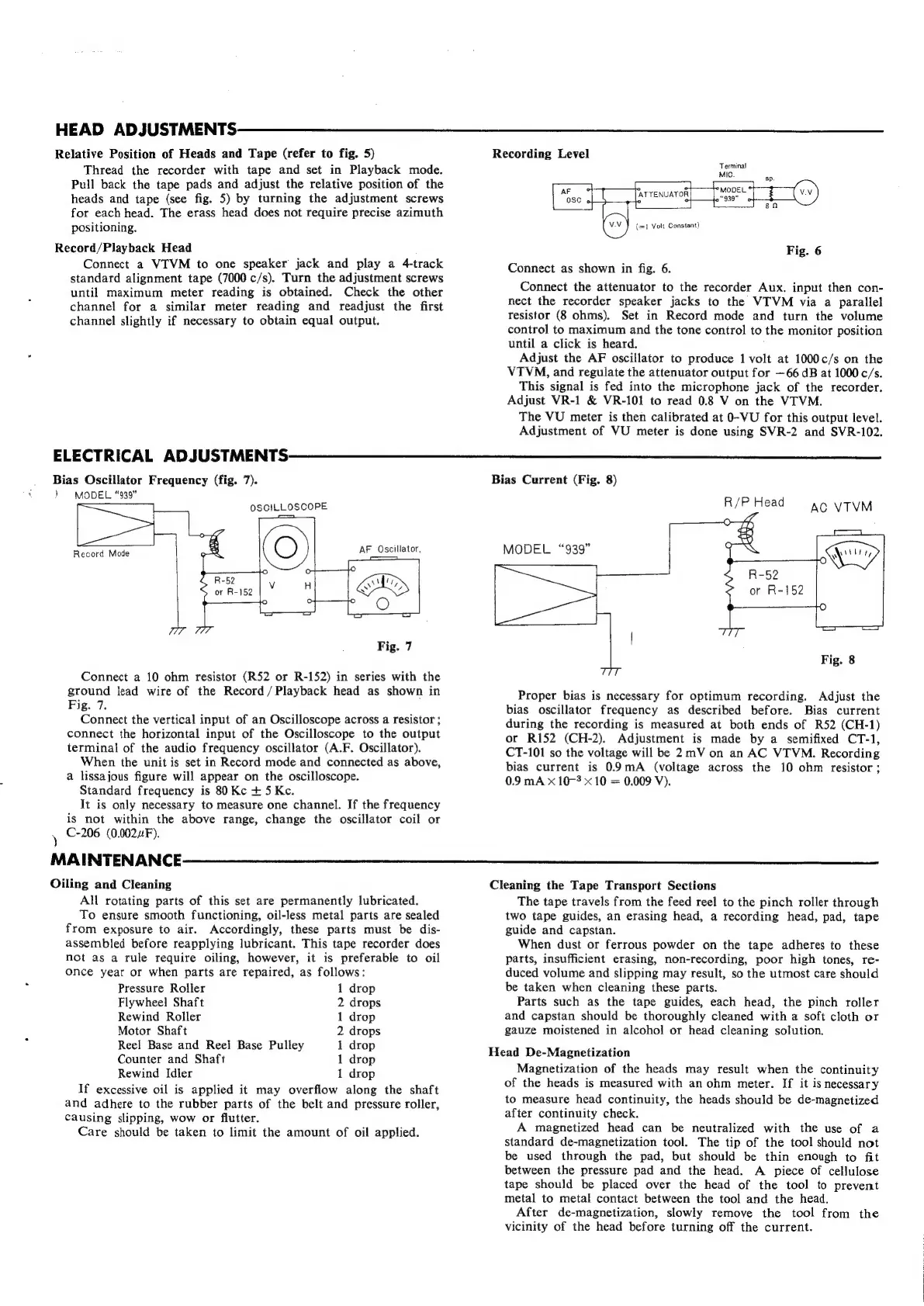
HEAD
ADJUSTMENTS
Relative
Position
of
Heads
and
Tape
(refer
to
fig.
5)
Thread
the
recorder
with
tape
and
set
in
Playback
mode.
Pull
back
the
tape
pads
and
adjust
the
relative
position
of
the
heads
and
tape
(see
fig.
5)
by
turning
the
adjustment
screws
for
each
head.
The
erass
head
does
not
require
precise
azimuth
positioning.
Record/Playback
Head
Connect
a
VTVM
to
one
speaker
jack
and
play
a
4-track
standard
alignment
tape
(7000
c/s).
Turn
the
adjustment
screws
until
maximum
meter
reading
is
obtained.
Check
the
other
channel
for
a
similar
meter
reading
and
readjust
the
first
channel
slightly
if
necessary
to
obtain
equal
output.
ELECTRICAL
ADJUSTMENTS
Bias
Oscillator
Frequency
(fig.
7).
)
MODEL
ā€œ939ā€
OSCILLOSCOPE
Record
Mode
AF
Oscillator.
R-52
or
R-152
Fig.
7
Connect
a
10
ohm
resistor
(R52
or
R-152)
in
series
with
the
ground
lead
wire
of
the
Record/Playback
head
as
shown
in
Fig.
7.
Connect
the
vertical
input
of
an
Oscilloscope
across
a
resistor;
connect
the
horizontal
input
of
the
Oscilloscope
to
the
output
terminal
of
the
audio
frequency
oscillator
(A.F.
Oscillator).
When
the
unit
is
set
in
Record
mode
and
connected
as
above,
a
lissajous
figure
will
appear
on
the
oscilloscope.
Standard
frequency
is
80Kc
+5
Ke.
It
is
only
necessary
to
measure
one
channel.
If
the
frequency
is
not
within
the
above
range,
change
the
oscillator
coil
or
)
C-206
(0.002ā€œF).
MAINTENANCE
Oiling
and
Cleaning
All
rotating
parts
of
this
set
are
permanently
lubricated.
To
ensure
smooth
functioning,
oil-less
metal
parts
are
sealed
from
exposure
to
air.
Accordingly,
these
parts
must
be
dis-
assembled
before
reapplying
lubricant.
This
tape
recorder
does
not
as
a
rule
require
oiling,
however,
it
is
preferable
to
oil
once
year
or
when
parts
are
repaired,
as
follows:
Pressure
Roller
1
drop
Flywheel
Shaft
2
drops
Rewind
Roller
1
drop
Motor
Shaft
2
drops
Reel
Base
and
Reel
Base
Pulley
1
drop
Counter
and
Shaft
1
drop
Rewind
Idler
1
drop
If
excessive
oil
is
applied
it
may
overfiow
along
the
shaft
and
adhere
to
the
rubber
parts
of
the
belt
and
pressure
roller,
causing
slipping,
wow
or
flutter.
Care
should
be
taken
to
limit
the
amount
of
oil
applied.
Recording
Level
Terminal
MIC.
MODEL
ATTENUATOR
|
ā€œ939ā€
gn
(=1]
Volt
Constant)
Fig.
6
Connect
as
shown
in
fig.
6.
Connect
the
attenuator
to
the
recorder
Aux.
input
then
con-
nect
the
recorder
speaker
jacks
to
the
VIT'VM
via
a
parallel
resistor
(8
ohms).
Set
in
Record
mode
and
turn
the
volume
control
to
maximum
and
the
tone
control
to
the
monitor
position
until
a
click
is
heard.
Adjust
the
AF
oscillator
to
produce
1
volt
at
1000c/s
on
the
VTVM,
and
regulate
the
attenuator
output
for
—66
dB
at
1000c/s.
This
signal
is
fed
into
the
microphone
jack
of
the
recorder.
Adjust
VR-1
&
VR-101
to
read
0.8
V
on
the
VITVM.
The
VU
meter
is
then
calibrated
at
0-VU
for
this
output
level.
Adjustment
of
VU
meter
is
done
using
SVR-2
and
SVR-102.
Bias
Current
(Fig.
8)
R/P
Head
AC
VTVM
MODEL
ā€œ939ā€
Proper
bias
is
necessary
for
optimum
recording.
Adjust
the
bias
oscillator
frequency
as
described
before.
Bias
current
during
the
recording
is
measured
at
both
ends
of
R52
(CH-1)
or
R152
(CH-2).
Adjustment
is
made
by
a
semifixed
CT-1,
CT-101
so
the
voltage
will
be
2mV
on
an
AC
VTVM.
Recording
bias
current
is
0.9mA
(voltage
across
the
10
ohm
resistor
;
0.9
mA
x
10-3
x
10
=
0.009
V).
Cleaning
the
Tape
Transport
Sections
The
tape
travels
from
the
feed
reel
to
the
pinch
roller
through
two
tape
guides,
an
erasing
head,
a
recording
head,
pad,
tape
guide
and
capstan.
When
dust
or
ferrous
powder
on
the
tape
adheres
to
these
parts,
insufficient
erasing,
non-recording,
poor
high
tones,
re-
duced
volume
and
slipping
may
result,
so
the
utmost
care
should
be
taken
when
cleaning
these
parts.
Parts
such
as
the
tape
guides,
each
head,
the
pinch
roller
and
capstan
should
be
thoroughly
cleaned
with
a
soft
cloth
or
gauze
moistened
in
alcohol
or
head
cleaning
solution.
Head
De-Magnetization
Magnetization
of
the
heads
may
result
when
the
continuity
of
the
heads
is
measured
with
an
ohm
meter.
If
it
is
necessary
to
measure
head
continuity,
the
heads
should
be
de-magnetized
after
continuity
check.
A
magnetized
head
can
be
neutralized
with
the
use
of
a
standard
de-magnetization
tool.
The
tip
of
the
tool
should
not
be
used
through
the
pad,
but
should
be
thin
enough
to
fit
between
the
pressure
pad
and
the
head.
A
piece
of
cellulose
tape
should
be
placed
over
the
head
of
the
tool
to
prevent
metal
to
metal
contact
between
the
tool
and
the
head.
After
de-magnetization,
slowly
remove
the
tool
from
the
vicinity
of
the
head
before
turning
off
the
current.