The Sapphire Scientific Apex 570 is a mobile cleaning unit designed for professional cleaning and restoration operations. This comprehensive manual provides detailed information on its operation, service, and maintenance, ensuring optimal performance and longevity.
Function Description
The Apex 570 is a truck-mounted cleaning system that utilizes a combination of water heating, vacuum, and chemical pumping systems to deliver powerful and efficient cleaning. It is designed to be installed in a vehicle, providing mobility for various cleaning jobs.
The Water Heating System is a pressurized vessel where cold water enters through an inlet connection. The water first passes through an Inlet Pressure Regulator, which reduces the pressure to 15-18 psi, and then into the water box through a heat exchanger. A bypass valve allows for cooler water delivery by bypassing the heat exchanger. The incoming water is pre-heated by cooling the engine through the heat exchanger. Further heating occurs in the water box, where radiant heat from the vacuum pump and engine exhaust is utilized. The water is then pressurized by the water pump and flows through finned tubing in the heat exchanger, where it is further heated by the vacuum blower and engine exhaust. Hot water then passes through a check valve manifold (containing a strainer and check valve) where chemical injection takes place. The hot solution mixture then flows through the solution outlet manifold to the cleaning tool, with pressure controlled by the Outlet Pressure Regulator. The system maintains a desired water temperature through a Thermalogic control system that triggers a diverter cylinder to either direct hot exhaust across coils for heating or divert it to the exterior exhaust port for cooling.
The Vacuum System is powered by an engine-driven vacuum pump. Air is channeled into the pump, compressed, and discharged, creating airflow for extraction. This airflow removes moisture, dirt, and spent chemicals from surfaces, conveying them to a recovery tank. In the recovery tank, moisture and dirt particles are separated through changes in direction and velocity, and the air is then filtered before entering the vacuum pump. The vacuum pump also heats incoming air during compression, and this hot discharged air is directed through a silencer for noise abatement and then through the heat exchanger. A level shut-off sensor in the waste tank prevents water damage to the vacuum pump by shutting down the unit before the tank is full.
The Chemical Pumping System draws chemicals from a container through a strainer into a flow meter on the control panel, which indicates the chemical flow rate. The chemicals then pass through a stainless steel chemical pump and are injected into a three-way selector valve on the front panel. This valve allows for ON, OFF, or PRIME chemical flow. The chemicals then flow through a chemical metering valve to the solution outlet, controlling the rate of chemical injection into the cleaning solution, as indicated on the flow meter.
Important Technical Specifications
- Engine Speed: 3000 RPM (High Speed/No Load), 1500 RPM (Idle/No Load)
- Water Pump: 1500 RPM (High Speed)
- Water Pump Flow Rate: 5.5 GPM (Maximum)
- Water Pump Pressure: 1500 PSI (Maximum)
- Vacuum Pump: 3000 RPM (High Speed)
- Vacuum Relief Valve: 13 in. Hg
- Waste Tank Capacity at Shut-Off: 75 gallons
- Waste Tank Gross Capacity: 100 gallons
- Console Weight: 1022 lbs. (dry)
- Standard Install Package Weight: 1420 lbs. (dry)
- Operating Weight: 2166 lbs. (includes water weight, not accessories)
- Engine Oil Capacity: 3.4 L (3.59 US qts)
- Drain Plug Tightening Torque: 33 – 37 N·m (3 – 4 kgf·m, 24 – 27 lbf·ft)
- Pressure Pump Oil Capacity: 40 oz.
- Engine Lower Front Pulley Bolt Torque: 69 lbf·ft
- Engine Crankshaft Hub Torque: 40 lbf·ft
- Engine Fan Mounting Bolts Torque: 7 – 8 lbf·ft
- Vacuum Pump Hub Torque: 13 lbf·ft
- Recommended Floor Tool Tip Size: #6
- Fuel Consumption: Approximately 1.5 US gallons per hour (depending on speed setting)
- Recommended Fuel: Unleaded gasoline with a minimum octane rating of 87 (up to 10% ethanol acceptable). E20 and E85 are not recommended and will void the warranty.
- Recommended Oil: High-quality API service class SG or higher 30W oil (no additives).
- Vacuum Pump Oil: AEON PD-XD Synthetic Blower Lubricant (Sapphire Scientific Part # 13-004) for both sides of the vacuum pump.
- High-Pressure Hoses: Must be rated at 250° F and 3000 PSI.
Usage Features
- Instrument Panel Controls and Gauges: The unit features a comprehensive control panel with a chemical flow meter, chemical selection valve (ON, OFF, PRIME), water pressure gauge, water temperature gauge, chemical metering valve, temperature control switch (OFF, LOW, MEDIUM, HIGH), vacuum pressure gauge, hour meter, pressure pump/engine override switch, automatic waste pump control, ignition switch, auxiliary control, circuit breakers, throttle control knob, and choke control knob.
- Solution Outlets: The Apex 570 has two solution outlets for connecting up to two separate solution hoses, allowing for dual wand operation with minimal pressure loss.
- Vacuum Inlet Hose Ports: The unit has one 2-inch and one 2-1/2-inch vacuum inlet ports. Unused ports should be capped to maintain proper vacuum levels.
- Automatic Waste Pump (Optional): If installed, the pump-out switch on the control panel allows for automatic waste water disposal during cleaning.
- Temperature Control: The temperature control switch allows operators to select desired water temperatures (OFF, LOW, MEDIUM, HIGH). The diverter system automatically adjusts to maintain the set temperature.
- Chemical Injection: The chemical pumping system allows for precise control of chemical flow into the cleaning solution, with the flow rate indicated on the chemical flow meter.
- Safety Features: Warning labels are prominently displayed on the unit, highlighting potential hazards such as hot surfaces, rotating machinery, electrical shock, and carbon monoxide. The manual emphasizes operating in well-ventilated areas, not exceeding vehicle payload capacity, and using approved parts.
Maintenance Features
- Daily Maintenance: Includes checking engine oil and vacuum pump oil levels, spraying lubricant into the blower lubrication cup, checking water pump oil, inspecting vacuum inlet filters and strainer baskets, rinsing vacuum hoses, and inspecting/removing debris from the waste pump-out (if equipped).
- Weekly Maintenance: Involves cleaning and inspecting float switches in the waste tank and checking for leaks, worn wires, and hoses.
- Monthly Maintenance: Requires checking the engine air cleaner for damage, inspecting drive belts, checking battery fluid levels and terminals, lubricating the diverter shaft with anti-seize, cleaning the check valve strainer, and checking fastener tightness.
- Quarterly Maintenance: Focuses on cleaning and removing debris from the inlet pressure regulator.
- Yearly Maintenance: Includes checking the check-valve seat for abnormal wear or debris.
- Scheduled Oil Changes: Engine oil and filter changes are recommended after the first 50 hours, then every 200 hours. Water pump crankcase oil should be changed after the first 50 hours, then every 500 hours. Vacuum pump oil should be drained, flushed, and replaced every 1000 hours or yearly.
- Filter Replacement: Engine air filter elements should be replaced every 1000 hours or yearly. Inline fuel filters should be replaced every 500 hours or yearly.
- Spark Plug Maintenance: Spark plugs should be checked every 500 hours and replaced every 1000 hours.
- Valve Adjustments: Engine valves require adjustment every 1000 hours.
- Belt Maintenance: Belts should be re-tensioned after the first 25 hours, then every 100 hours. All belts should be replaced every 2000 hours.
- Chemical Pump Rebuild: The chemical pump should be rebuilt every 500 hours, involving diaphragm, check valve, and disk inspection, and replacement of all o-rings.
- Pressure Regulator Lubrication: O-rings in the pressure regulator should be lubricated every 100 hours.
- Freeze Protection/Descaling: The manual provides detailed instructions for winterizing the unit with anti-freeze and descaling the system to prevent hard water deposits.
- Troubleshooting Guides: Dedicated sections for engine, vacuum pump, pressure pump, chemical system, heat exchanger/temperature, and waste pump troubleshooting are included, offering probable causes and solutions for common malfunctions.

 Need help?
 General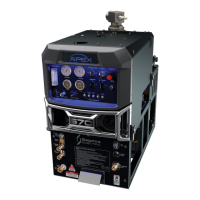

 To Next Page