EasyManua.ls Logo

schmersal AES 1235 - User Manual

schmersal AES 1235
6 pages
Print Icon
To Next Page IconTo Next Page
Loading...
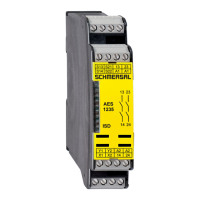
AES 1235
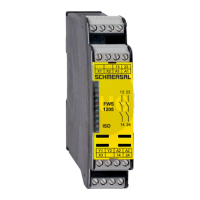
AES 1236
Operating instructions
Safety-monitoring module
EN
1
1. About this document
1.1 Function
This operating instructions manual provides all the information you
need for the mounting, set-up and commissioning for the safe operation
and disassembly of the safety-monitoring module. The operating inst-
ructions must be available in a legible condition and a complete version
in the vicinity of the device.
1.2 Target group: authorised qualified personnel
All operations described in this operating instructions manual must
be carried out by trained specialist personnel, authorised by the plant
operator only.
Please make sure that you have read and understood these operating
instructions and that you know all applicable legislations regarding
occupational safety and accident prevention prior to installation and
putting the component into operation.
The machine builder must carefully select the harmonised standards to
be complied with as well as other technical specifications for the selec-
tion, mounting and integration of the components.
1.3 Explanation of the symbols used
Information, hint, note:
This symbol is used for identifying useful additional information.
Caution: Failure to comply with this warning notice could
lead to failures or malfunctions.
Warning: Failure to comply with this warning notice could
lead to physical injury and/or damage to the machine.
1.4 Appropriate use
The products described in these operating instructions are developed to
execute safety-related functions as part of an entire plant or machine. It
is the responsibility of the manufacturer of a machine or plant to ensure
the correct functionality of the entire machinery or plant.
The safety-monitoring module must be exclusively used in accordance
with the versions listed below or for the applications authorised by the
manufacturer. Detailed information regarding the range of applications
can be found in the chapter "Product description".
1.5 General safety instructions
The user must observe the safety instructions in this operating instruc-
tions manual, the country-specific installation standards as well as all
prevailing safety regulations and accident prevention rules.
Further technical information can be found in the Schmersal
catalogues or in the online catalogue on the Internet:
www.schmersal.net.
The information contained in this operating instructions manual is
provided without liability and is subject to technical modifications.
There are no residual risks, provided that the safety instructions as well
as the instructions regarding mounting, commissioning, operation and
maintenance are observed.
1.6 Warning about misuse
In case of inadequate or improper use or manipulations of
the safety-monitoring module, personal hazards or damages
to machinery or plant components cannot be excluded. The
relevant requirements of the standard EN 1088 must be
observed.
Content
1 About this document
1.1 Function ..............................................1
1.2 ..................1
1.3 Explanation of the symbols used ...........................1
1.4 Appropriate use ........................................1
1.5 General safety instructions ...............................1
1.6 Warning about misuse ...................................1
1.7 Exclusion of liability .....................................2
2 Product description
2.1 Ordering code .........................................2
2.2 Special versions........................................2
2.3 Destination and use .....................................2
2.4 Technical data .........................................2
2.5  .....................................2
3 Mounting
3.1 General mounting instructions .............................3
3.2 Dimensions ...........................................3
4 Electrical connection
4.1 General information for electrical connection..................3
5 Operating principle and settings
5.1 Operating principle after the operating voltage is switched on ....3
6 Set-up and maintenance
6.1 Functional testing.......................................3
6.2 Maintenance ..........................................3
7 Disassembly and disposal
7.1 Disassembly...........................................3
7.2 Disposal ..............................................3
8 Appendix
8.1 Wiring examples .......................................3
8.2 Integral System Diagnostics (ISD)..........................4
9 Declaration of conformity
9.1 EC Declaration of conformity ..............................5
x.000 / Dezember 2012 / v.A. - 101172890-EN / C / 2012-12-17 / AE-Nr. 2172
DE
Betriebsanleitung . . . . . . . . . . . . . . .Seiten 1 bis 6
Übersetzung der Originalbetriebsanleitung
Question and Answer IconNeed help?

Do you have a question about the schmersal AES 1235 and is the answer not in the manual?

Overview

The Schmersal AES 1235 and AES 1236 are safety-monitoring modules designed for integration into safety circuits within control cabinets. These modules are used for the safe evaluation of signals from positive break position switches for safety functions, magnetic safety sensors on sliding, hinged, and removable safety guards, and emergency stop control devices.

Function Description

The safety-monitoring modules feature a dual-channel structure and include two safety relays with monitored positive action contacts. The normally open (NO) contacts of these relays, wired in series, form the enabling contacts.

Upon switching on the operating voltage, the module performs a functionality test. For the AES 1235 (without start-up test), if the safety guard is closed or the emergency stop button is released, the enabling paths close, and the LED turns green. The cable and connected safety switch are tested only when the safety guard is opened or the emergency stop button is actuated.

For the AES 1236 (with start-up test), after the functionality test, the safety guard or emergency stop button must be actuated to check the cables and the connected safety switch (start-up test). Once the safety guard is closed or the emergency stop button is released, the enabling paths close, and the LED turns green. If the safety guard is opened or the emergency stop button is actuated, the enabling paths open, the machine stops, and the LED flashes yellow.

The modules accept inputs from a safety switch with one NC and one NO contact, two safety switches with one contact each, or an emergency-stop button at input S14/S22. A feedback loop (X1) connects the positive action contacts of an external contactor and/or a start button. If no feedback loop is required, input X1 must be supplied with 24 VDC. For operation with two NC contacts, input X2 must also be supplied with 24 VDC.

Enabling paths 13-14 and 23-24 are NO contacts for the safety function. Additional outputs Y1 (authorized operation, release output closed) and Y2 (no authorized operation, release output opened) are provided for signaling purposes only and must not be integrated into the safety circuit. The enable delay time can be adjusted from 0.1 s to 1 s by changing the position of a jumper link connection (B1) inside the enclosure.

Important Technical Specifications

  • Standards: IEC/EN 60204-1; EN 60947-5-1; EN 60947-5-3; EN ISO 13849-1; IEC 61508; BG-GS-ET-14; BG-GS-ET-20.
  • Start Conditions: Automatic or start button.
  • Feedback Circuit: Available.
  • Start-up Test: AES 1235: no; AES 1236: yes.
  • Pull-in Delay (automatic start): Adjustable 0.1 / 1.0 second.
  • Drop-out Delay (emergency stop): < 50 ms.
  • Rated Operating Voltage (Ue): 24 VDC ± 15%.
  • Rated Operating Current (Ie): 0.2 A.
  • Rated Insulation Voltage (Ui): 250 V.
  • Rated Impulse Withstand Voltage (Uimp): 4.8 kV.
  • Thermal Test Current (Ithe): 6 A.
  • Power Consumption: < 5 W.
  • Monitored Inputs: Cross-wire short detection (selectable), wire breakage detection (yes), earth connection detection (yes).
  • Number of NC Contacts: Convertible 1NC → 2NC.
  • Number of NO Contacts: Convertible 1NO → 0NO.
  • Outputs: Stop category 0 (2), Stop category 1 (0), Safety contacts (2), Auxiliary contacts (0), Signalling outputs (2).
  • Switching Capacity (Signalling Outputs): Y1-Y2 = 100 mA.
  • Switching Capacity (Safety Contacts): Min. 10 mA, Max. 6 A.
  • Utilisation Category (EN 60947-5-1): AC-15: 230 V/3 A; DC-13: 24 V/2 A.
  • Max. Fuse Rating: 6 A gG D-fuse.
  • Mechanical Life: 20 million operations.
  • LED Display: ISD.
  • Operating Temperature: 0 °C ... +55 °C.
  • Storage and Transport Temperature: -25 °C ... +70 °C.
  • Resistance to Shock: 30 g / 11 ms.
  • Resistance to Vibration: 10 ... 55 Hz, amplitude 0.35 mm.
  • Protection Class: Enclosure: IP40; Terminals: IP20; Clearance: IP54.
  • Mounting: Snaps onto standard DIN rail to EN 60715.
  • Connection Type: Screw connection.
  • Cable Section: Min. 0.25 mm², Max. 2.5 mm² (solid strand or multi-strand lead).
  • Tightening Torque: 0.6 Nm.
  • Max. Cable Length: 1000 m of 0.75 mm² conductor.
  • Dimensions (H x W x D): 100 x 22.5 x 121 mm.
  • Safety Classification (EN ISO 13849-1; IEC 61508): PL up to d; Control category up to 3; PFH-value 1.0 x 10⁻⁷ / h; SIL up to 2; Service life 20 years.

Usage Features

The device is designed for authorized qualified personnel to perform all operations, including mounting, set-up, commissioning, and disassembly. Users must read and understand the operating instructions and be aware of all applicable legislations regarding occupational safety and accident prevention. The machine builder is responsible for selecting harmonized standards and technical specifications for component integration.

The safety-monitoring module's LED display provides integral system diagnostics (ISD), indicating different switching conditions and faults. A green LED signifies enabling paths are closed, while a yellow flashing LED (0.5 Hz) indicates enabling paths are open. A yellow flashing LED (2 Hz) indicates the safety guard is closed but no authorized operation, possibly due to incorrect operation (only one contact actuated when the guard was opened), voltage drop, or an unclosed feedback loop, requiring a start-up test.

Error indications (orange LED impulses) include:

  • 1 impulse: Defective supply voltage lead, defective switch, erroneous fitting of the switch, or switch only partially actuated for at least 5 seconds.
  • 4 impulses: Interference signals at the inputs (no safe evaluation assured), possibly due to high capacitive or inductive interference at the switch's cables or the supply voltage lead.
  • 5 impulses: One or both relays did not close within the monitoring time, possibly due to too low operating voltage or a defective relay.
  • 6 impulses: Relay not disabled upon actuation of the switch, possibly due to contact welding.
  • 7 impulses: Dynamic monitoring failure of both channels (cross-monitoring), indicating a fault in one channel or internal data transmission interruption.

Error messages are deleted once the fault is rectified and the connected switch is actuated (opened and then closed) to check functions.

Maintenance Features

The safety-monitoring module is designed for maintenance-free functionality under correct installation and adequate use. However, regular visual inspections and functional tests are recommended. These should include checking the correct fixing of the module and inspecting the cables for damage. The device must be integrated into periodic check-ups according to the Ordinance on Industrial Safety and Health, at least once a year. Damaged or defective components must be replaced.

Disassembly should only be performed when the device is de-energized, and disposal must comply with national prescriptions and legislations.

schmersal AES 1235 Specifications

General IconGeneral
Brandschmersal
ModelAES 1235
CategorySafety Equipment
LanguageEnglish