Need help?
Do you have a question about the schmersal AZM201 Series and is the answer not in the manual?
Provides information for mounting, commissioning, safe operation, and disassembly of the safety switchgear.
States that all operations must be performed by trained, authorized personnel.
Explains symbols used in the manual, including information and warning symbols.
Details the intended use of the safety switchgear within safety circuits.
Emphasizes observing safety instructions and national regulations.
Warns about personal hazards and damages from improper use.
States manufacturer's liability exclusion for damages from improper installation.
Explains the ordering code structure and its options for product identification.
Mentions that special versions not in the code apply if they match the standard.
Details Schmersal's certification and conformity assessment for the Machinery Directive.
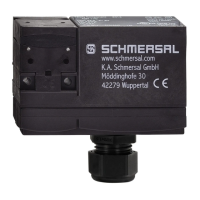
Describes the intended use for monitoring position and locking movable safety guards.
Lists detailed technical specifications including standards, electrical, and mechanical data.
Covers safety aspects like PL, SIL, control category, and mission time.
Provides general instructions for mounting the solenoid interlock and actuator.
Explains how to use the manual release mechanism for unlocking.
Shows the physical dimensions of the solenoid interlock in millimeters.
Mentions a retrofit kit for subsequent functional expansion.
Gives general information for electrical connections by authorized personnel.
Specifies details about the cable entry, type, and length used for connection.
Explains how the magnet is controlled in power-to-unlock and power-to-lock versions.
Describes the behavior of safety outputs when the guard is opened or closed.
Details the process of teaching or detecting the actuator for coded versions.
Explains the function of the three colored diagnostic LEDs on the device.
Describes the use of the conventional diagnostic output for visualization or control.
Explains serial diagnostics using SD function for data transmission via serial cable.
Outlines the steps for performing functional tests on safety components.
Recommends regular visual inspections and functional tests.
Specifies that disassembly must be done in a de-energised condition only.
Advises on proper disposal according to national prescriptions and legislations.
Shows application examples for series-wiring of safety switchgear.
Details wiring configurations, pin assignments, and available accessories.
 General
| Series | AZM201 |
|---|---|
| Operating voltage | 24V DC |
| Rated Voltage | 24V DC |
| Rated Current | 0.5A |
| Locking Force | 1, 200 N |
| Protection Rating | IP67 |
| Mechanical Life | 1, 000, 000 cycles |
| Electrical Life | 100, 000 cycles |
| Connection type | Terminal connection |
| Actuation Type | Key |
| Contact Configuration | 2NC/1NO |
| Operating Temperature | -25 ... +60 °C |
| Housing material | Zinc die-cast |
| Material | Zinc die-cast |
| Standards | EN ISO 13849-1 |
| Safety classification | Category 4 |

 To Next Page