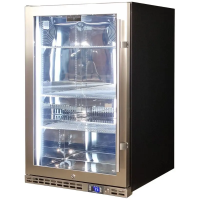
This document provides an operation manual for Schmick fridge models SK90, SK92, SK116, SK126, SK141, SK146, SK156, SK206, SK245, SK246, and SK386. These appliances are intended for use in household and similar applications, including commercial settings.
Function Description:
The Schmick fridges are designed for chilling drinks and other items, capable of reaching temperatures around 0°C. They operate using a compressor-driven refrigeration system with R600a refrigerant gas. The units feature electronic thermostat control, with two versions of controllers detailed in the manual: Danfoss ECO Controller and Normal Digital Thermostat Controller. Depending on the model, some units include switches at the rear to control heated glass (on/off) and fan speed (high/low). The heated glass function helps prevent condensation, while the fan speed adjustment is beneficial for areas with ambient temperatures over 38°C. All shelving within the units is fully adjustable and heavy-duty.
Important Technical Specifications:
The manual provides a table of specifications for various models, including:
- Climate Class: T (Tropical) 43°C, indicating operation in maximum ambient temperatures of 43°C.
- Storage Temp: 0-10°C (Maximum Ambient 43°C).
- Anti Shock Protection Class: I.
- Gross Capacity (litres): Ranges from 90 litres (SK90) to 399 litres (SK386).
- Voltage / Frequency: All models operate on 220/240V / 50Hz.
- Input Power (Watts): Ranges from 116W (SK90) to 275W (SK386).
- LED Light (Watts): Ranges from 8W (SK90) to 16.9W (SK386).
- Refrigerant R600A (g): Ranges from 20g (SK90) to 115g (SK386).
- Weight (Kg) - Black: Ranges from 36kg (SK90) to 128kg (SK386).
- Weight (Kg) - S/Steel: Ranges from 37.5kg (SK90) to 131kg (SK386).
The refrigeration system uses isobutane (R600a) as a refrigerant and cyclopentane as insulation blowing gas, both of which are flammable. The room for installing the appliance must be at least 1m³ per 8g of refrigerant.
Usage Features:
- Temperature Control: The electronic thermostat allows users to set the desired temperature. The Danfoss ECO Controller features a digital display showing the current temperature and allows adjustment of the set point using "up/down" buttons. The Normal Digital Thermostat Controller also displays the set temperature and allows modification using arrow buttons.
- ECO Function (Energy Saving): Both controller types include an ECO mode. The Danfoss controller indicates ECO mode with a green symbol. The Normal Digital Thermostat Controller allows activation/deactivation of ECO mode with a dedicated button.
- Light Control: The internal light can be switched on/off using a dedicated button.
- Defrosting: The units feature automatic defrost by turning off the compressor, or manual defrost can be initiated by holding a specific button for 6 seconds. The defrost LED illuminates during defrosting and flashes during the delay display after defrost.
- Heated Glass and Fan Speed: For models equipped, switches at the rear control the heated glass (on/off) and fan speed (high/low). The high fan speed setting is recommended for ambient temperatures above 38°C.
- Installation: The appliance is designed for both "built-in" cabinetry or freestanding use. Crucially, the front venting bottom grill must always be kept clear to ensure proper ventilation and prevent overheating. The unit should be installed on a sturdy, level floor, away from direct sunlight, heat sources, and excessive moisture. It is recommended to allow 30 minutes after positioning before turning the unit "ON."
- Storage: Drinks should be kept at least 1cm away from the internal walls to allow for better air circulation. The manual explicitly states that it is not recommended to store blood or special pharmaceuticals in the fridge, and the warranty does not cover "contents" in any circumstance.
- Safety: The manual emphasizes several safety precautions, including not damaging the refrigerant circuit, avoiding open flames near the appliance, ensuring proper electrical connection (no adaptors or extension cords), and supervising children.
Maintenance Features:
- Cleaning:
- Condenser: The condenser (located at the rear, bottom) should be cleaned every 6-12 months with a vacuum cleaner or brush to remove dust accumulation.
- Inside Cabinet: Clean with a clean damp cloth or neutral soap. Avoid abrasive or flammable cleaning products.
- Door Seal: Use eucalyptus oil twice a year with a clean cloth to wipe and clean the door seal.
- Frost Removal: Do not use sharp or metal instruments to remove frost; use a plastic scraper if necessary.
- Stainless Steel Models: For stainless steel models, a dedicated care guide is provided. It recommends applying a thin layer of olive oil with a lint-free cloth and buffing it off every 3-4 months to protect against corrosion and make cleaning easier. Abrasive cream cleaners should be avoided.
- Service: Any repairs, modifications, or replacements of parts should only be performed by a qualified technician. Contact the sales support line for assistance. In Queensland, an authorized service person MUST hold a Gas Work Authorisation for hydrocarbon refrigerants to carry out servicing or repairs involving the refrigeration piping system.
- Troubleshooting: The manual includes a troubleshooting section for common issues like noise (e.g., loose screws, compressor level, noisy fan) and not cooling (e.g., compressor not running, thermostat settings, door seal, fan operation).
- Disposal: At the end of its life, the appliance should not be disposed of with household rubbish due to flammable refrigerants and insulation blowing gases. Local municipal authorities should be contacted for advice on recycling and recovery. When discarding, the door should be removed, and shelves/racks left in place to prevent child entrapment.
The product complies with electrical and safety standards AS/NZS 60335.1 and AS/NZS 60335.2.24 and is registered under section 43 of the Greenhouse Minimum Energy Standards ACT, using ISO23953-2 Testing Standard (GEMS). The RCM Mark indicates compliance with ACMA guidelines and government requirements for electrical device safety. All units come with an Australia-wide 24-month comprehensive warranty.

 Need help?
 General

 To Next Page