Copyright © 2020 Axxiom Manufacturing, Inc. 13
1.17. AVOID DANGEROUS ENVIRONMENTS.
Do Not operate this equipment in elevated areas without using fall protection equipment. Certain
applications of this equipment may require the use of scaffolding. Use of scaffolding creates
hazardous situations such as tripping and fall hazards which can result in serious injury or death to
operating personnel. Consult OSHA 29 CFR 1910 Subpart D.
1.18. AVOID DANGEROUS ENVIRONMENTS.
Do Not blast objects that are not properly secured. The blast operation can cause the blasted object
to shift or move. Extremely large objects to be blasted can create a crush hazard to operating
personnel which can result in serious injury or death. Properly secure the object to be blasted.
1.19. AVOID DANGEROUS ENVIRONMENTS.
Do Not blast objects used to store flammable materials. The blast operation can cause sparks which
can ignite fumes or residual flammable materials inside enclosed containers which can explode
resulting in serious injury or death to operating personnel.
1.20. AVOID DANGEROUS ENVIORNMENTS
It has been determined that blast abrasives approved for use in blast equipment are not ignitable nor
do they present a dust explosion hazard in environments approved for use. However, airborne
substances that make up the items and substrates being blasted can be ignitable when mixed with
airborne dust from the blast abrasive. To mitigate risk of dust explosion avoid blasting in confined
spaces without proper ventilation. Consult plant authorities, OSHA 29 CFR 1910.146 and 1910.94.
Explosion Hazard. Do Not operate blast equipment in confined spaces without proper ventilation.
Consult plant authorities, OSHA 29 CFR 1910.146 and 1910.94.
1.21. ELECTRICALLY GROUND EQUIPMENT.
Static electricity is generated by the abrasive flow through the blast hose and/or vacuum hose. To
minimize chance of static electrical shock to operating personnel only use anti-static blast hose
and/or vacuum hose, properly electrically bond the blast nozzle, blast hose couplings, and the
equipment, and properly install an earth ground to the abrasive blaster. See Section 5.12.
1.22. MAINTAIN VESSEL INTEGRITY.
Do Not operate this equipment with the pressure vessel damaged, or with any part of it worn or
damaged. Do Not operate this equipment in a condition that may cause failure of the pressure
vessel. See Rules 1.23 through 1.33 below.
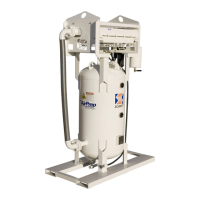
An AirPrep System is a Pressurized Vessel. Alterations, damage, or misuse of the pressure vessel
can result in rupturing. Damaged or incorrect components used on the AirPrep System can result in
rupturing. The compressed air inside a pressurized vessel contains a dangerously high level of
energy which can propel objects and cause serious injury or death.
1.23. NEVER OPERATE OVER MAXIMUM WORKING PRESSURE.
Do Not operate this equipment above maximum allowable working pressure (MAWP) at maximum
operating temperature (°F) shown on the ASME nameplate attached to the vessel. See Sections 2.2
and 8.1.
1.24. INSTALL PRESSURE RELIEF DEVICE.
Do Not operate this equipment without a pressure relief device in place. The ASME Code requires
that all vessels be equipped with pressure relief devices prior to installation. The pressure relief
device must be set at the maximum allowable working pressure of the abrasive blaster. See the
ASME nameplate attached to the vessel. See Section 3.11 for information regarding the pressure
relief valve.


 To Next Page
 Loading...