GB
Front
Hooking position for top H=40mm Back
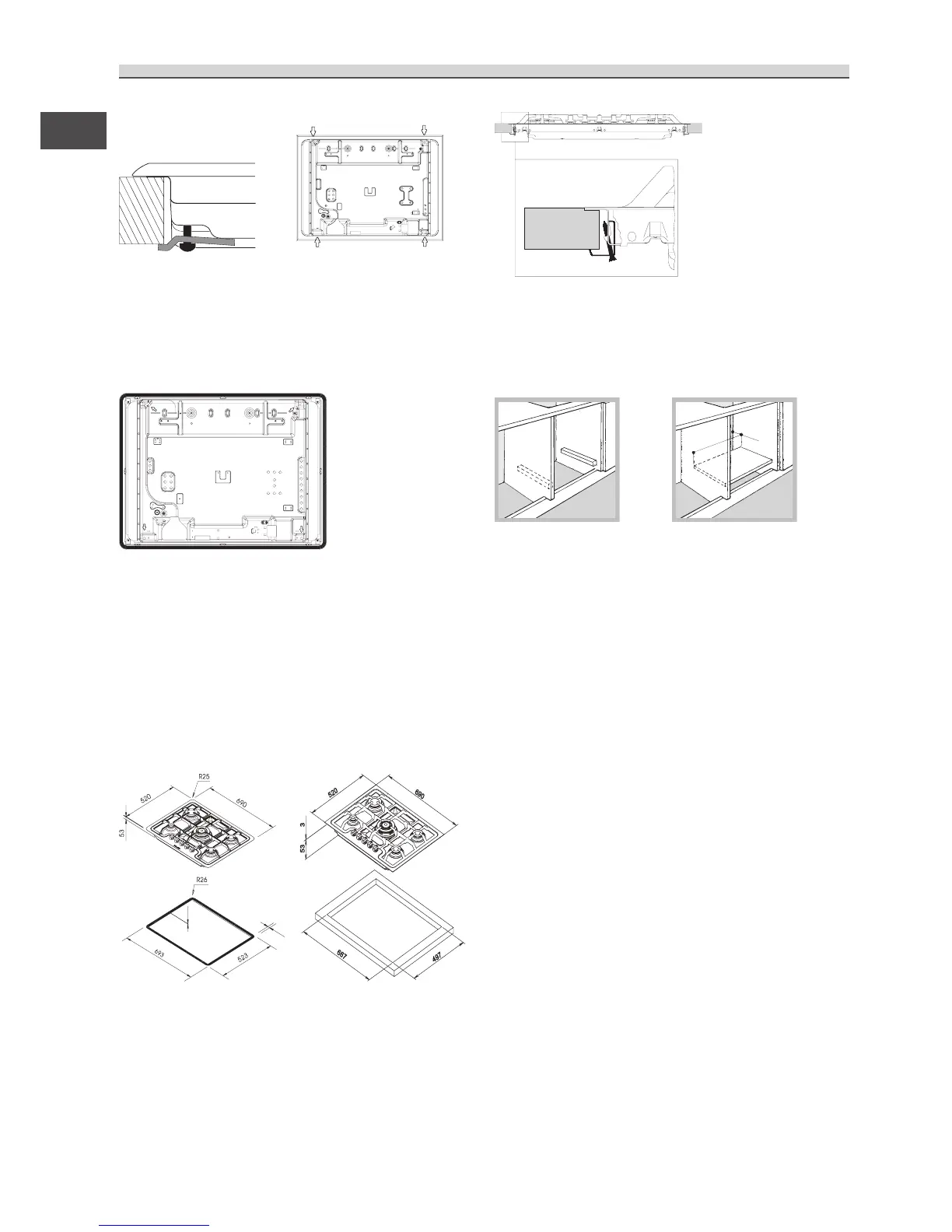
! Use the hooks contained in the “accessory pack”.
Hobs installation (mod. PPF... - PP..SF)
Before fastening the cooktop in place, position the seal (supplied) along the
perimeter of the countertop,as shown in the gure 3.
Fig.3
An insulating wooden panel should be tted beneath the hob, positioned at
a minimum of 20 mm from the hob underside. This wooden panel must be
removable in order to allow for any maintenance operations beneath the hob.
Installing ush-tted hobs (mod. PPF...)
To slot in the hob ush with the worktop, it is necessary to lower the area just
outside the cut-out for the hob as illustrated in gure 4.
Installing semi-ush hobs (mod. PP..SF)
To create the recess necessary for semi-ush hobs, drill into the top as
illustrated in gure 5.
2.5
13*
6
9
0
5
2
0
4
9
7
6
6
7
Fig.4 Fig.5
To x hobs to the cabinet, some brackets have been provided to t on as
illustrated in gure.
Ventilation
To ensure adequate ventilation, the back panel of the cabinet must be
removed. It is advisable to install the oven so that it rests on two strips of
wood, or on a completely at surface with an opening of at least 45 x 560
mm (see diagrams).
560 mm.
45 mm.
! The hob can only be installed above built-in ovens with a cooling ventilation
system.
Electrical connection
Hobs equipped with a three-pole power supply cable are designed to operate
with alternating current at the voltage and frequency indicated on the data
plate (this is located on the lower part of the appliance). The earth wire in the
cable has a green and yellow cover. If the appliance is to be installed above
a built-in electric oven, the electrical connection of the hob and the oven must
be carried out separately, both for electrical safety purposes and to make
extracting the oven easier.
Connecting the supply cable to the mains
Install a standardised plug corresponding to the load indicated on the data
plate.
The appliance must be directly connected to the mains using an omnipolar
circuit-breaker with a minimum contact opening of 3 mm installed between
the appliance and the mains.
The circuit-breaker must be suitable for the charge indicated and must comply
with current electrical regulations (the earthing wire must not be interrupted
by the circuit-breaker). The supply cable must not come into contact with
surfaces with temperatures higher than 50°C.
! The installer must ensure that the correct electrical connection has been
made and that it is compliant with safety regulations.
Before connecting to the power supply, make sure that:
• the appliance is earthed and the plug is compliant with the law.
• the socket can withstand the maximum power of the appliance, which is
indicated on the data plate.
• the voltage is in the range between the values indicated on the data plate.
• the socket is compatible with the plug of the appliance. If the socket is
incompatible with the plug, ask an authorised technician to replace it. Do
not use extension cords or multiple sockets.
! Once the appliance has been installed, the power supply cable and the
electrical socket must be easily accessible.



 To Next Page