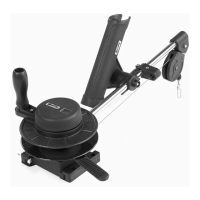
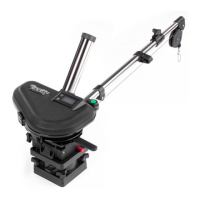
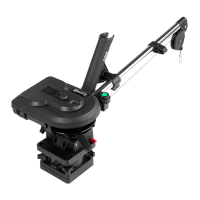
The Scotty Models No. 1085 and No. 1090 are designed for use on wide beam
boats of 16 ft. long and up. Installation on smaller boats is not recommended.
All sports have some physical hazards connected with them and fishing with a
Downrigger calls for some common sense and precaution. There are natural
physical forces associated with long armed downriggers. The load or strain at
the mounting point of a downrigger is proportional to the length of the arm.
With a 30 inch arm and 150 lb. breaking strain trolling wire, this pulling force
and the arm leverage can exert a force of approximately
1
100 lbs. on the gunnel
of your boat. It is obvious that this force could overcome a weak mounting
point on the boat. In the case of a small boat, it could cause the boat to
submerge or overturn if the wire is caught on the
bottom in a strong tide or in a heavy wind.
HERE ARE SOME SAFETY TIPS THAT
SHOULD BE OBSERVED WHEN YOU ARE
DOWNRIGGER FISHING, PARTICULARLY
IN OCEAN OR TIDAL CONDITIONS.
Care must always be exercised to avoid tangling
your downrigger wire in your boat prop. The best
way to avoid this risk is to mount the downrigger
near the stern of the boat so that the wire never
gets under the boat in a turn. Sharp turns should
be avoided and you should never back up with the
downrigger wire out.
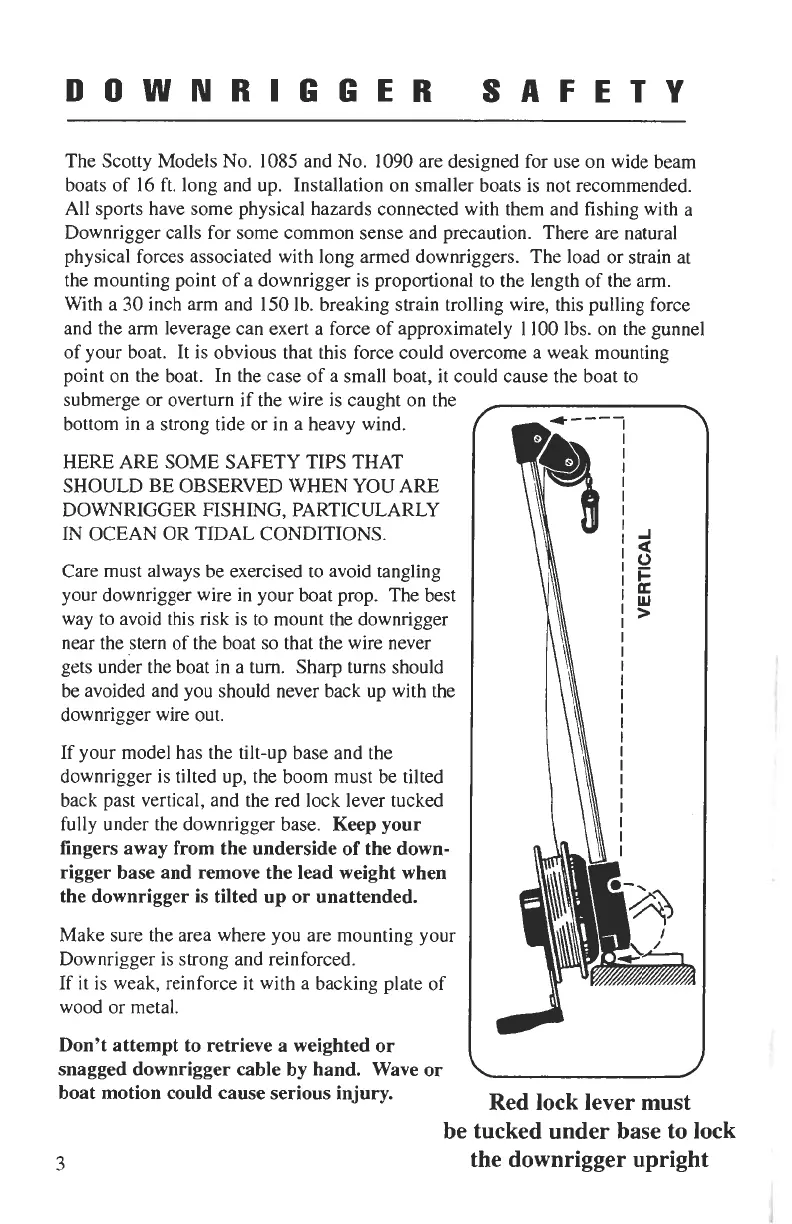
If your model has the tilt-up base and the
downrigger is tilted up, the boom must be tilted
back past vertical, and the red lock lever tucked
fully under the downrigger base.
Keep your
fingers away from the underside of the down-
rigger base and remove the lead weight when
the downrigger is tilted up or unattended.
Make sure the area where you are mounting your
Downrigger is strong and reinforced.
If
it
is weak, reinforce it with a backing plate of
wood or metal.
Don't attempt to retrieve a weighted or
snagged downrigger cable by hand. Wave or
boat motion could cause serious injury.
Red lock lever must
be tucked under base to lock
the downrigger upright


 To Next Page
 Loading...