5
How to use your Line Puller
Receptacle Installation & Wiring
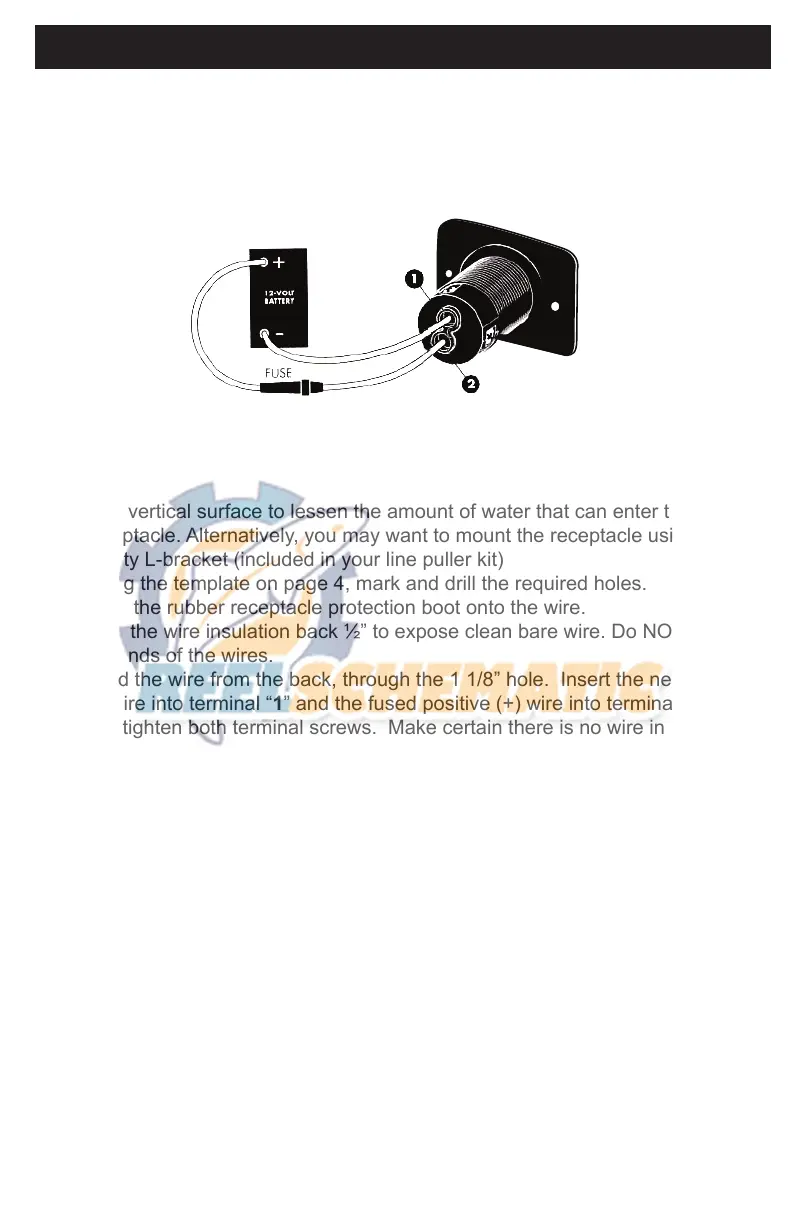
It is important that the receptacle is wired to match how the plug is wired. The
terminals marked “1” and “2” on the receptacle mate with the corresponding
terminals marked “1” and “2” on the plug.
1. Mounting the receptacle requires a 1 1/8” hole to be drilled. Select a
location where the boats structure will not be weakened. Also, mount
on a vertical surface to lessen the amount of water that can enter the
receptacle. Alternatively, you may want to mount the receptacle using the
Scotty L-bracket (included in your line puller kit)
2. Using the template on page 4, mark and drill the required holes.
3. Slide the rubber receptacle protection boot onto the wire.
4. Strip the wire insulation back ½” to expose clean bare wire. Do NOT solder
the ends of the wires.
5. Feed the wire from the back, through the 1 1/8” hole. Insert the negative
(-) wire into terminal “1” and the fused positive (+) wire into terminal “2”
and tighten both terminal screws. Make certain there is no wire insulation
inside the terminals and that there are no stray wire strands outside the
terminals. Do not overtighten!
6. Mount the receptacle. Ensure the drain hole is facing down.
7. Push the rubber receptacle protection boot onto the receptacle from the
backside.
Circuit Breaker
Your Scotty line puller is equipped with an automatic circuit breaker to protect
the motor from overload. If you attempt to lift a snagged trap or a trap that is
too heavy for the line puller, the circuit breaker will probably trip. Wait 5 to 10
seconds for it to automatically reset and you will have power again. However,
do not repeatedly attempt to lift a load too heavy for the line puller motor. If
possible, the snagged trap must rst be freed from the obstruction.
Note: It is also possible to trip the circuit breaker by lifting a snagged or fully
loaded trap from extreme depth. The circuit breaker is designed to trip at about
25 amps. If this happens, allow the circuit breaker to cool several seconds
before resuming lifting.
12 Volt Battery
In-Line 30 amp Fuse



 To Next Page