EasyManua.ls Logo

SCT SIDEWINDER ESC - User Manual

SCT SIDEWINDER ESC
2 pages
Print Icon
To Next Page IconTo Next Page
Loading...
QUICK START GUIDE
QUICK START GUIDE
1. Solder a high quality battery connector to the ESC.
2. Mount the ESC and motor into the car.
3. Connect the 3 motor wires in to the ESC.
4. Connect the ESC Rx lead to CH2 on your receiver.
5. Make sure the ESC’s switch is off.
6. Connect a battery.
7. Calibrate your ESC to your radio by holding full throttle on
your transmitter then turn the switch ON.
8. After a few seconds you’ll hear multiple tones and the red
LED will come on.
9. Now hold full brake and after a few seconds you’ll hear
multiple tones and the yellow LED will come on.
10. Now relax to neutral and after a few seconds you’ll hear
multiple tones and ALL the LEDs will light up.
11. A few seconds later the ESC will arm with a double tone and
you’re ready to go!
Revised 03/2017
Copyright 2017 © Castle Creations, Inc.
PKG: 057-0206-03
Question and Answer IconNeed help?

Do you have a question about the SCT SIDEWINDER ESC and is the answer not in the manual?

Summary

Quick Start Guide

Initial Setup Steps

Steps for soldering a connector, mounting components, and connecting wires.

ESC Calibration Process

Procedure to calibrate the ESC with the radio transmitter for throttle and brake.

Arming the ESC

Steps to arm the ESC, indicated by tones and LEDs, signifying readiness.

Sidewinder ESC and Neu-Castle 1410 3800 KV Motor Vital Information

Recommended Applications

Specifies suitable vehicle types and weight limits for the Sidewinder SCT.

Battery Choice Guidelines

Details on compatible battery types, cell counts, and discharge requirements.

Other Motor Compatibility

Information on using different motors with the ESC, focusing on Kv rating.

Gearing Recommendations

Advice on initial gearing and adjusting for motor temperature.

Programming Options

Methods for programming the ESC via transmitter or PC software.

Waterproof Operation

Guidelines for using the ESC in wet conditions and post-operation care.

Overview

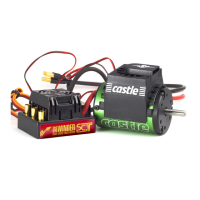
The Castle Sidewinder SCT is a 1:10 scale waterproof electronic speed control (ESC) designed for remote-controlled (RC) vehicles. It is part of a high-performance system, often paired with the Neu-Castle 1410 3800 KV motor, and is intended for use in short course truck (SCT) applications.

Function Description:

The Sidewinder SCT ESC controls the speed and direction of an RC vehicle's motor. It acts as an interface between the vehicle's receiver and the motor, translating commands from the transmitter into motor actions. This ESC is capable of running in both brushed and brushless motor modes, offering versatility for different motor types. It is designed to provide "overpowering RC" performance, indicating a focus on high power output and responsiveness.

Important Technical Specifications:

  • Scale: 1:10 scale.
  • Waterproof Rating: The unit is described as "waterproof," meaning it is suitable for operation in wet conditions. However, it is explicitly stated that it is "not intended for operation while submerged in liquid."
  • Recommended Applications: Specifically recommended for all SCT 2WD and 4WD applications that weigh less than 6.5 lbs (3kg). It is advised not to use this motor or controller in heavier vehicles.
  • Battery Compatibility (SCT Application):
    • Maximum cells: 2s LiPo (8.4 volts) or 7 cell NiCad/NiMh.
    • Requires high discharge cells due to its high-performance nature.
  • Battery Compatibility (Lighter Vehicles with 1410 3800 KV Motor):
    • Can be run on up to 3S (12.6 volts).
    • Requires careful monitoring of motor, battery, and controller temperatures.
  • Motor Compatibility (Other Motors in SCT Application):
    • The motor must have a Kv (RPMs per volt) that is the same or lower than 3800 kv.
    • The motor must be run within its manufacturer's specifications.
    • Requires careful monitoring of motor, battery, and controller temperatures.
  • Temperature Limits:
    • Motor temperature should "never get above 200°F." A practical test is provided: "If you can't touch the motor for 2 seconds, it's too hot."
    • This temperature limit applies to both the motor itself and when considering gearing changes or higher cell counts (e.g., 3S LiPo).

Usage Features:

  • Quick Start Guide: A detailed 11-step quick start guide is provided for initial setup and calibration.
    1. Solder a high-quality battery connector to the ESC.
    2. Mount the ESC and motor into the car.
    3. Connect the 3 motor wires to the ESC.
    4. Connect the ESC Rx lead to CH2 on the receiver.
    5. Ensure the ESC's switch is off.
    6. Connect a battery.
    7. Calibrate the ESC to the radio by holding full throttle on the transmitter, then turning the switch ON.
    8. After a few seconds, multiple tones will be heard, and the red LED will come on.
    9. Hold full brake; after a few seconds, multiple tones will be heard, and the yellow LED will come on.
    10. Relax to neutral; after a few seconds, multiple tones will be heard, and all LEDs will light up.
    11. A few seconds later, the ESC will arm with a double tone, indicating it's ready to go.
  • Gearing Recommendations:
    • Always start with the stock gearing.
    • When changing gearing, motor, or battery, frequently check motor temperature on the first run.
    • If the motor gets too hot, solutions include reducing pinion size, increasing spur size, or reducing pack voltage.
  • Programming Options:
    • Transmitter Programming: The ESC is programmable via the transmitter for basic adjustments.
    • Castle Link USB Adapter: More advanced programmable features can be accessed using a Windows PC and a Castle Link USB adapter (not included). This allows for fine-tuning and access to the latest features.
    • Field Link Card: A Field Link card (not included) also provides access to programmable features without a PC.
    • Users are directed to the "Drivers' Ed Guide" for more details on programming.
  • Motor Modes: The Sidewinder SCT can operate in both brushed and brushless motor modes. The manual should be consulted for specific wiring details required for brushed modes.

Maintenance Features:

  • Wet Conditions Care: If the unit is operated in wet conditions, it should be rinsed with fresh water to remove dirt or corrosives, and then fully dried. This prevents long-term damage from contaminants.
  • Temperature Monitoring: Regular monitoring of motor, battery, and controller temperatures is crucial, especially when using higher cell counts (e.g., 3S LiPo) or non-stock gearing/motors. Adhering to the 200°F motor temperature limit is a key maintenance practice to ensure longevity and prevent damage.

SCT SIDEWINDER ESC Specifications

General IconGeneral
BrandSCT
ModelSIDEWINDER ESC
CategoryComputer Hardware
LanguageEnglish