Need help?
Do you have a question about the Sea-Fire 131-450 and is the answer not in the manual?
Lists key features of the Engine Shutdown Restart System, including automatic shutdown and override modes.
Details recommended locations for installing the ESRS unit, emphasizing ventilation and avoiding heat exposure.
Instructions for physically mounting the ESRS unit using screw holes and connecting the display panel.
Guidance on wiring the ESRS unit, including wire gauge, terminal block connections, and specific inputs/outputs.
Overview of terminal block connections for system inputs and outputs.
Details on connecting the PS1 pressure switch to terminals 1 and 2.
Details on connecting the PS2 pressure switch to terminals 3 and 4, including jumper usage.
Instructions for connecting main, backup, and generator power sources to the ESRS unit.
Guidance on connecting the Display Panel to the ESRS unit using the RJ45 port and CAT-5 cable.
Instructions for connecting multiple cylinder supervisory pressure switches in series to PS1.
Reference for connecting engines or machinery to the ESRS unit relays based on OEM manuals.
Details the specifications for the relays used in the ESRS unit, including contact type, current, and voltage ratings.
Describes the state of the relays when the ESRS unit is operational and in standby mode.
Describes the state of the relays when the ESRS unit is in the shutdown state.
Information on the optional automatic reset timer function for the relays.
Procedural steps to verify the correct installation and operation of the ESRS unit after power application.
Guide to identifying and resolving common problems encountered with the ESRS unit, including power, alarm, and reset issues.
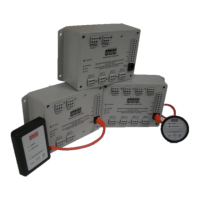
The document describes the Sea-Fire Engine Shutdown Restart System (ESRS), a low-voltage microcontroller unit designed to integrate with Sea-Fire automatic and manual fire suppression systems. Its primary function is to shut down engines, blowers, generators, dampers, and other machinery in a protected space if a fire or extreme overheating causes the fire suppression system to discharge. This ensures that the fire suppression agent remains in the enclosed compartment at the proper concentration and is not ingested or reduced by running machinery.
The ESRS operates by monitoring pressure switches connected to the fire suppression system. Upon agent discharge, the PS1 (Pressure Switch 1) closed-loop circuit opens, activating an alarm and de-energizing all connected relays. This change in relay state shuts down all machinery connected to the ESRS unit. Visual and audible indications (PS1 LED on the unit, DISCHARGE LED on the Display Panel, and an 85 dB buzzer) alert users to the discharge. The alarm can be silenced by pressing the SILENCE button on either the ESRS unit or the connected Display Panel.
In the event of a discharge or loss of cylinder pressure (indicated by an open PS1 loop), the system can be put into an "override" mode by simultaneously pressing the SILENCE and "Dimmer" buttons. This allows connected machinery to restart. However, the ESRS can only be properly reset to standby mode after the discharged agent cylinder has been refilled/replaced and the SHUTDOWN RESET buttons are pressed. In standby mode, only the green POWER LED on the ESRS and Display Panel remains on.
The ESRS also monitors a second pressure switch, PS2, which can be connected to a High-Temperature, Low-Pressure, or Auxiliary Discharge sensor switch. If the PS2 sensor switch opens, an alarm activates, and both the PS2 LED on the unit and the Second Zone LED on the Display Panel illuminate. Importantly, the relays' state does not change in this scenario, meaning machinery continues to operate. This PS2 circuit alarm can also be silenced with the SILENCE button. The unit is reset after the PS2 circuit condition is remedied by pressing the SHUTDOWN RESET buttons.
 General
| Brand | Sea-Fire |
|---|---|
| Model | 131-450 |
| Category | Control Systems |
| Language | English |


 To Next Page