
 Need help?
Do you have a question about the Sealey AK3984 and is the answer not in the manual?
Adhere to health & safety regulations, keep work area clean & lit, and secure workpieces.
Familiarize with limitations, maintain equipment, use genuine parts, keep clean, check alignment.
Do not operate if damaged/missing or for unintended purposes. Store safely when not in use.
Always wear approved eye or face protection when operating the riveter.
Suitable for rivet nuts in aluminium, steel, stainless steel. Short arms for restricted spaces, long arms for accuracy.
Adjust stroke by rotating sheath, retighten lock ring, screw nut onto mandrel, insert riveter, close handles, rotate thumbwheel.
Use tool to remove nut, sheath, washer. Use spanner to hold tube and undo mandrel anticlockwise. Screw in new mandrel.
If mandrel cannot be removed easily, use a bar and spanner to rotate anticlockwise to release.
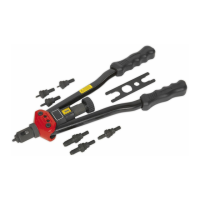
The Sealey Long/Short Arm Threaded Nut Riveter, models AK3984 and AK3985, is a robust tool designed for setting rivet nuts in various materials, including aluminium, steel, and stainless steel. This device is engineered to provide efficient and reliable performance for a range of fastening applications.
The primary function of the riveter is to install threaded rivet nuts, which create a strong, load-bearing thread in thin materials that are too delicate to tap or where access is limited to one side. The tool operates by deforming the rivet nut from the blind side of the workpiece, securing it in place and providing a threaded insert for subsequent fastening.
The riveter features a mechanism that allows for precise control over the working stroke. By rotating the sheath, the user can adjust the length of the stroke, effectively controlling the compression applied to the rivet nut. Rotating the sheath anticlockwise lengthens the stroke, while rotating it clockwise shortens it. This adjustability is crucial for achieving optimal compression and ensuring a secure installation without over-stressing the rivet nut or the material. Model AK3985, specifically, includes a stroke scale that helps gauge the optimum compression, indicating when the scale shows 6mm or less for proper operation.
Once the working stroke is set, a rivet nut is screwed onto the mandrel until it is flush with the end of the nut. The riveter is then inserted into a pre-drilled hole in the workpiece. By closing the handles of the riveter, the tool pulls the mandrel, causing the rivet nut to deform and secure itself to the material. The rivet needs to shorten by approximately 6mm during this process. After the rivet nut is set, the mandrel is removed by rotating the thumbwheel anticlockwise, releasing it from the newly installed rivet nut.
The design incorporates both short arms (AK3984) and long arms (AK3985) to cater to different access requirements. The short-arm version is ideal for working in restricted or confined spaces where maneuverability is limited, offering effortless functionality in tight spots. The long-arm version, on the other hand, provides increased leverage, making it easier to set larger or tougher rivet nuts with less physical effort, and its adjustable stroke scale further enhances accuracy for critical applications.
Operating the Sealey riveter requires adherence to specific procedures to ensure both safety and effective results. Before use, it is essential to familiarise oneself with the tool's application, limitations, and potential hazards. The work area should always be kept clean, uncluttered, and adequately lit to prevent accidents.
When inserting rivet nuts, the first step involves adjusting the working stroke. For model AK3985, the stroke scale should be monitored to ensure the compression is within the optimal range (6mm or below). After setting the stroke, the knurled lock ring must be retightened to secure the adjustment. A rivet nut is then screwed onto the mandrel until it is level with the end of the nut. The riveter is then inserted into the pre-drilled hole in the workpiece, and the handles are closed to set the rivet nut. Finally, the thumbwheel is rotated anticlockwise to remove the mandrel from the set rivet nut.
Changing the mandrel is a straightforward process but requires specific tools. The mandrel nut, sheath, and its washer must first be removed. A 12mm cut-out spanner is used to hold the tube, engaging and holding the hex nut. A suitable sized bar is then inserted through the hole in the mandrel and rotated anticlockwise to undo it. Once the old mandrel is removed, the new mandrel is screwed in, and the sheath, its washer, and the mandrel nut are refitted, ensuring all components are tight before use. This process ensures the tool is correctly configured for different rivet nut sizes.
It is crucial to never hold the workpiece by hand during operation. Instead, it should be secured with a clamp, vice, or other adequate holding device to prevent movement and ensure a stable installation. The riveter should only be used for its intended purpose, which is setting rivet nuts. Any attempt to use it for other tasks could lead to damage or personal injury.
Proper maintenance is essential to ensure the longevity and reliable performance of the Sealey riveter. The tool should be kept in good condition, and any damaged or missing parts must be replaced immediately with genuine Sealey parts. Using unauthorised parts can be dangerous and will invalidate the warranty. Regular checks of moving parts for alignment are also recommended to prevent wear and tear and ensure smooth operation.
The riveter should be kept clean for best and safest performance. After use, it should be stored in a safe, dry, and childproof location to protect it from environmental damage and unauthorised access.
In case of troubleshooting, if the mandrel cannot be easily removed from a rivet nut, it is important not to force it, as this could cause damage to the riveter. Instead, a bar and spanner should be used to rotate the mandrel anticlockwise to release it from the rivet nut gently. This approach prevents potential damage to the tool's internal mechanisms.
Always wearing approved eye or face protection when operating the riveter is a critical safety measure that should never be overlooked. Adhering to health and safety regulations, local authority guidelines, and general workshop practices is paramount for safe and effective use of this equipment.
 General
| Nose Pieces | 4 |
|---|---|
| Working Pressure | 90psi |
| Air Consumption | 4cfm |
| Weight | 1.5kg |
| Type | Air Riveter |
| Rivet Capacity | 2.4mm, 3.2mm, 4.0mm, 4.8mm |

 To Next Page