LRX 2239 ELECTRONIC PANEL
12/24*VDC low voltage electronic control unit, for the
automation of swinging and rolling gates with incorporated
receiver and battery charger.
- Mod. LG 2239 : without radio receiver
- Mod. LRS 2239 : 433.92 Mhz
- Mod. LRS 2239 SET : 433.92 Mhz “narrow band”
- Mod. LRH 2239 : 868.3 Mhz “narrow band”
TECHNICAL DATA:
- Transformer power supply: 230 Vac 50/60Hz 120W max.
- Control unit power supply: 12 Vac /20*Vac 50/60Hz 120W
max.
- Flashing light output : 12/24* Vdc 4 W max.
- Emergency battery input : 12 Vdc 7A/h max.
- Motor outputs : 12/24*Vdc 2 x 50 W max.
- Electric lock output : 12/24* Vdc 12W max.
- Power supply to photocells : 12/24* Vdc 3 W max.
- Indicator light output : 12 Vdc 3 W max.
- Working temperature : -10 - 55 °C
- Radio receiver : refer to type
- Op. transmitters : 12-18 Bit or Rolling Code
- TX max codes in memory : 120 (CODE or CODE PED)
- Dimensions of container : 240x190x110 mm.
- Protection degree : IP 56
* If using 24Vdc motors, replace the transformer provided
with a 230/20 Vac transformer the power of which is suited
to the type of motor used (120W max; the outputs for the
flashing light, electric lock and photocell power supply will
adapt to the voltage of 24Vdc, but it is only ever possible
to connect a 12Vdc battery, even when using 24Vdc
motors).
TERMINAL BOARD CONNECTIONS:
CN1 :
1 : Power supply input 12 / 20* Vac 120W max.
2 : Power supply input 12 / 20* Vac 120W max..
3 : Input + Emergency battery 12Vdc 1.2 / 7 Ah max.
4 : Input – Emergency battery 12Vdc 1,2 / 7 Ah max.
5 : Input + Solar panel
6 : Output + Flashing light 12/24*Vdc 4W max.
7 : Output - Flashing light 12/24*Vdc 4W max.
8 : Output + Motor 1.
9 : Output - Motor 1.
10 : Output + Motor 2.
11 : Output - Motor 2.
CN2 :
1 : Electric lock Output (+ 12/24*Vdc 12W).
2 : Electric lock Output (+ 12/24*Vdc 12W).
3 : Control and power supply to photocells (+ 12/24*Vdc 3W ).
4 : Control and power supply to photocells (+ 12/24*Vdc 3W ).
5 : Indicator light output (+ 12Vdc 3W ).
6 : Indicator light output (- 12Vdc 3W ).
7 : Open-Close/Open push button input (NO).
8 : Pedestrian / Close push button input (NO), DS AUX (NC).
9 : Common GND input.
10: Block input (NC).
11: Safety device input (NC).
12: Opening limit switch input for motor 1 (NC).
13: Closing limit switch input for motor 1 (NC).
14: Common GND input.
15: Opening limit switch input for motor 2 (NC).
16: Closing limit switch input for motor 2 (NC).
17: Aerial earth input.
18: Aerial hot pole input.
OPERATING CHARACTERISTICS:
Automatic:
Using either the radio control (CODE led lit) or the low tension
button panel (PUL) to operate the gates, commands will have
the following effect: the first command impulse activates the
opening mechanism either for the pre-set motor operating
interval or until the activation of the opening limit switch. The
second command impulse closes the gate. If a command
impulse is received before the activation of the limit switch the
direction of movement of the mechanism will be reversed
whether engaged in opening or closing operations.
Step-by-step:
Using either the radio control (CODE led lit) or the low tension
button panel (PUL) to operate the gates, commands will have
the following effect: the first command impulse activates the
opening mechanism either for the pre-set motor operating
interval or until the activation of the opening limit switch. The
second command impulse closes the gate. If a command
impulse is received before the activation of the limit switch the
movement of the mechanism will be stopped. A further
command impulse will reactivate the mechanism in the
opposite direction.
Automatic closing:
The mechanism may be set up to automatically close the gate
without sending additional commands.
The set-up procedure is described in the instructions for setting
the delay period.
Pedestrian access:
Using the radio command (the CODE PED. led is on) or the
button panel (PED), you can activate just motor 1 for the
programmed length of time (T.MOT.PED. led).
Block input:
The control board allows for the connection of a blocking button
(NC). Commands from the button during any phase will
immediately stop the movement of the gate. A further command
will only be executed if the blocking mechanism is deactivated,
and in any case normal automatic opening will work.
If not used the terminals must be jumped.
Safety device:
The control board allows for the connection and control of
photocells in accordance with directive EN 12453.
Commands from the device during the opening phase will be
ignored, and when the gate is closing they will reverse the
direction of movement.
The control board needs the photocells to be connected to their
respective dedicated inputs, otherwise it will not work.
AUX 1 safety device (PED input):
The control unit, when configured, can be fitted with an
Auxiliary 1 safety device together with the Pedestrian Input
(NC).
Commands from the device during the opening phase will stop
the gate temporarily; when reactivated, the control unit
continues the opening phase. Commands whilst the gate is
closing will reverse the direction of movement.
AUX 2 safety device (PED input):
The control unit, when configured, can be fitted with an
Auxiliary 2 safety device together with the Pedestrian Input
(NC).
Commands from the device during an opening or closing phase
temporarily reverse and then stop the movement.
Opening and closing limit switch:
The control unit permits the connection of an Opening and
Closing limit switch for each Motor (NC). Commands from the
limit switches during the respective work phases stop the
respective motors immediately.
Warning: Connect the limit switches, if available;
otherwise do not jump the FA1, FC1, FA2 or FC2 inputs
on the terminal board.
1 Rev. 1.0 08/10/2010
GB

 Need help?
 General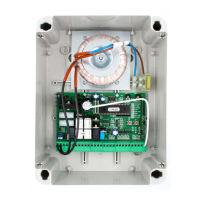

 To Next Page
