This document is a Service Manual for a KRUPS automatic coffee machine, specifically covering models EA8200, EA8240, EA8245, EA8271, EA8255, EA8250, EA8251, EA8258, EA8268, EA8260, EA8261, EA826E, and EA828E. It provides detailed instructions for dismantling, maintenance, and troubleshooting, primarily intended for service technicians.
Function Description:
The KRUPS coffee machine is an automatic espresso and coffee maker designed for home use. It features an integrated grinder, a thermoblock heating system, and a hydraulic distribution system to prepare various coffee beverages. The machine automates the process from grinding coffee beans to brewing and dispensing the final drink. It offers options for different coffee strengths and lengths, including Espresso, Strong Espresso, Coffee, and Long Coffee, as indicated on the display. The machine also includes functions for hot water and steam, suggesting capabilities for milk-based drinks. A key component is the brewing unit, which compacts ground coffee into a "cake" for brewing and then ejects it into a dedicated cake tank.
Important Technical Specifications (Reference Values):
- Espresso Temperature (50ml – strong coffee) 1st coffee: 68°C minimum. This indicates the target temperature for the first espresso shot, ensuring optimal extraction and taste.
- Temperature Increase by Steam with 125ml of water after 45s: 42°C. This specification relates to the steam function, likely for frothing milk, and indicates the heating efficiency of the steam system.
- Cake Thickness: 12-14mm. This refers to the thickness of the compacted coffee puck after brewing, which is an important parameter for consistent brewing quality and proper ejection.
Usage Features:
The machine is operated via a user interface that includes a display and an "OK" button, which also functions as a rotary selector for navigation. The display shows the current time (e.g., 12:02) and available drink options. Users can select different coffee types and potentially customize strength or volume. The presence of a "grinding fineness setting button" suggests that users can adjust the coarseness of the coffee grind to suit their preference or coffee type. The machine also has a water reservoir and a coffee bean container, which are user-accessible for refilling. A "cake tank" collects used coffee grounds, requiring regular emptying.
Maintenance Features:
The manual outlines several maintenance procedures, primarily for service technicians, but some aspects relate to general machine care:
- Dismantling: Detailed steps are provided for disassembling the machine, including removing the grinding fineness setting button, screws from the coffee bean container, top cover, front cover, and various internal components. This is crucial for accessing internal parts for repair or replacement.
- Grinder Maintenance/Replacement: Instructions cover removing the grinder's protection, crown, and the grinder itself. A critical note emphasizes ensuring the brewing unit's spring is in the correct position during grinder replacement. It also highlights checking the "little ball" in the green line and the axis for coffee grinding adjustment when reassembling the grinder crown, ensuring proper calibration.
- Subassembly Switch Ejection Maintenance/Replacement: This section details how to access and replace the ejection switch, which is vital for the proper functioning of the brewing unit's cake ejection mechanism. It involves removing the thermoblock screws and tipping it back, then unscrewing and sliding up the switch. Calibration is required after replacement.
- Troubleshooting (ASS Modes and Defect Description): The manual describes two "ASS Modes" (likely "After Sales Service" or "Assistance Service" modes) for diagnostic purposes:
- ASS Mode 1: Accessed by removing the cake tank, putting the tray and water tank in place, pressing "OK," and plugging in the appliance. This mode provides access to "Informations," "Heating," "Autotest," "Grinder," and "Calibration" functions.
- Informations: This sub-mode provides a comprehensive list of data points (Pages 1-44), including IHM (Human-Machine Interface) and Power board versions, last recorded defects (up to 3), and counts of various defects (e.g., NDDISPOS, NDPRIMIN, NDFLMET, NDLEAKA, NDOBSTAC, NDCOFCIR, NDNTC, NDHEATIN, NDEJECTB, NDEJECT, NDWCAL, NDCAKEM, NDWCOFBM, NDPCBCOM). It also tracks total recipe numbers (NCTOTALR) and counts for specific coffee types (NCESP, NCESPS, NCCOF, NCLCOF), hot water (NCWATER), steam (NCVAPOR), cleaning cycles (NCCLEAN), and descaling cycles (NCDESCAL). Other parameters like auto-off/on settings (VAAUTOFF, VAAUTOON), hardware versions (VAHARDWA), contrast settings (VACONTRAST), filter status (DFILTER), and switch status (NDSWITCH) are also listed. Many parameters are noted as "No used in ASS," indicating they might be for internal development or future features.
- Heating: Allows checking the heating phase for steam or hot water.
- Grinder: Initiates an 8-second grinder test.
- Autotest: Launches an automatic test sequence.
- Calibration: Initiates the calibration procedure, emphasizing the need to place the cake gauge, coffee beans in the tank, and water in the water tank. This is crucial for ensuring accurate brewing and cake ejection.
- ASS Mode 2: Accessed by simultaneously pressing the "Hot water" and "Prog" buttons. This mode only provides access to the "information" page, likely a simplified diagnostic view.
- ASS Defect Description: This section provides a table linking defect codes (e.g., 1, 4, 5, 6, 7, 8, 9, 12, 13, 14, 15, 16, 0A-10, 0C-0D-0E) to their descriptions, priority levels, and parts to be checked. Examples include:
- Defect 1 (Distributor position issue): Distributor movement done, but no action from distributor. Priority 1. Check Distributor.
- Defect 4 (Priming issue): Pump running for 5 seconds, volume < 10ml. Priority 1. Check Claris filter, Flow meter.
- Defect 5 (Flow meter defect): Pump running, but no flow. Priority 1. Check Flow meter, Pump, Pipes disconnected.
- Defect 6 (Leakage in water circuit): Flow > 50ml/min, volume measured > 80ml during cylinder descent. Priority 2. Check Thermoblock, Pump valve, Hole on the pipe.
- Defect 7 (Actuator obstruction defect): Flow < 50ml/min, volume measured < 25ml. Priority 1. Check Claris Filter, Flow meter.
- Defect 8 (Coffee circuit blocked): Flow < 80ml/min after 5 seconds of disposal. Priority 1. Check Thermoblock, Crimped pipe, Grinder (grinds too fine).
- Defect 9 (CTN defect): Temperature too high or too low regarding heating time. Priority 1. Check Thermoblock, Compaction head gasket (missing or defective), Fuse KO.
- Defect 12 (Ejection issue): 4 times defect 13. Priority 1. Check Thermoblock.
- Defect 13 (Cake ejection defect): No ejection switch impulse during cylinder upward. Priority 1. Check Thermoblock.
- Defect 14 (Calibration defect): Lack of gauge or switch issue. Priority 1. Check No cake gauge, Cake height switch.
- Defect 15 (Calibration defect): Wrong flow meter impulse number or calibration switch issue with empty tank or on second coffee test. Priority 1. Check Flow meter, Cake height switch.
- Defect 16 (Calibration defect): Value measured with empty tank not between 6mm and 9.6mm. Priority 1. Check Cake height switch.
- Defect 0A-10 (Heating resistor issue): Heating actuated, but temperature not changed. Priority 1. Check Thermoblock, Fuse wires red and/or blue.
- Defect 0C-0D-0E (Communication issues): Communication issues between Display and power boards. Priority 1. Check if both boards are compatible.
The manual uses visual aids (pictures with arrows and circles) to guide technicians through the dismantling and reassembly processes, highlighting critical points like screw locations, clips, and proper component positioning. The emphasis on using specific tools (Torx screwdrivers T15 and T10) ensures proper handling and prevents damage. The "BE CAREFUL" notes serve as important warnings for delicate steps, such as ensuring the brewing unit spring is correctly positioned or the switch wire is in the right place.

 Need help?
 General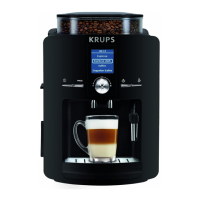

 To Next Page