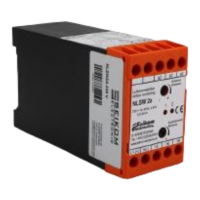
The NLSW®45-3 series of calorimetric flow monitors from SEIKOM ELECTRONIC offers an economical solution for monitoring gaseous media. These devices operate on the calorimetric principle, detecting flow by measuring the heat dissipation from a heated temperature-sensitive resistor. A second, unheated precision resistor provides temperature compensation, ensuring accurate measurements despite variations in media temperature. When flow is present and exceeds a pre-selected threshold, the device's relay output is energized, and a yellow "Airflow" LED illuminates. Conversely, when flow falls below the threshold, the relay output is de-energized, and the yellow LED turns off.
Function Description:
The core function of the NLSW®45-3 is to monitor the flow speed of gaseous media and provide a switching output when a user-defined threshold is met. The calorimetric principle relies on the fact that flowing media dissipates heat from a heated resistor. The change in the resistor's temperature and thus its resistance value is evaluated by the unit. To account for the influence of media temperature on heat dissipation, a second, unheated resistor is used for temperature compensation. The device's switching point, which determines the flow speed at which the output changes state, is adjustable via an integrated potentiometer. This allows for flexible adaptation to various application requirements. The device is designed for simple and quick installation using either a flange mount for channel installations or a PG7 threaded connector.
Important Technical Specifications:
- Type: NLSW®45-3
- Article Numbers: 77029 (for 24 V AC/DC), 63377 (for 230 V AC)
- Operating Voltage:
- 24 V AC/DC ± 5% (Article-No. 77029)
- 230 V AC 50/60 Hz ± 6% (Article-No. 63377)
- Power Consumption:
- 3 VA (for 24 V AC/DC)
- 4.5 VA (for 230 V AC)
- Ambient Temperature: -20 to 50°C
- Switching Output: 1 change-over contact relay
- Switching Function at Flow: Relay engages
- Relay Output: 250 V AC, 8 A, 2 kVA
- Minimum Switching Load: 10 mA / 5 V DC
- Signal Lamp Airflow: Yellow LED (turns on when flow ≥ threshold, shuts off when flow < threshold)
- Start-up Delay: Adjustable, approximately 5 to 60 seconds
- Media Temperature Range: -25 to 120°C
- Switching Point Adjustment: With potentiometer
- Airflow Range: 0.1 to 30.0 m/s
- Sensor: Available separately (F2.x, F3.x recommended, F4.x made of PTFE)
- Immersion Depth (depending on sensor): Approximately 50 mm, 130 mm, 165 mm, 300 mm, 400 mm, 500 mm
- Process Connection: PG7, flange
- Sensor Material: MS58, nickel-plated, optional stainless steel
- Pressure Resistance: 10 bar
- Electrical Connection: 10 terminals, 2.5 mm²
- Protection Category, Housing: IP40
- Protection Category, Terminals: IP20
- Pollution Class: 2
- Housing Dimensions (L x W x H): 120 mm x 45 mm x 73 mm
- Type Certification: Type examination TÜV Nord according to DIN EN 61010-1:2011-07
- EU Declaration of Conformity: Complies with 2014/30/EU (EMV-Richtlinie), 2014/35/EU (Niederspannungsrichtlinie), 2011/65/EU (Beschränkung gefährlicher Stoffe), and 2015/863/EU (Ergänzung RoHS 3). Applied standards include DIN EN IEC 63000:2019-05, DIN EN IEC 61000-6-2:2019-11, and DIN EN IEC 61000-6-3:2021-03.
Usage Features:
- Simple Installation: The sensor can be easily and quickly installed using a flange mount for channels or a PG7 threaded connector.
- Adjustable Switching Point: The integrated potentiometer allows users to precisely set the flow threshold, making the device adaptable to various monitoring needs.
- Visual Indication: A yellow LED provides clear visual feedback on the flow status (on for flow ≥ threshold, off for flow < threshold).
- Relay Output: The device provides a reliable relay output (1 change-over contact) for integration into control systems, signaling the presence or absence of sufficient flow.
- Start-up Delay: An adjustable start-up delay (5-60 seconds) prevents false triggers during system startup or transient flow conditions.
- Versatile Applications: Suitable for monitoring gaseous media in chillers (water shortage), boiler and sprinkler systems, pumps, and cooling/lubricant circuits.
- Robust Design: The device housing has an IP40 protection category, and the terminals have IP20, suitable for mounting in a housing or control cabinet.
- Installation Guidelines:
- The sensor tip should be positioned as close as possible to the center of the pipe, with the traverse hole within the full gaseous medium.
- A small notch at the end of the sensor indicates the direction from which the current should be coming, serving as a mounting aid.
- For vertical pipes, especially with small airflows (up to 1 m/s), the flow direction should be upwards to avoid thermal influences.
- The sensor requires at least 5 times the pipe diameter (5 x D) of free inlet and 3 times the pipe diameter (3 x D) of outlet path to prevent turbulence-induced measurement errors.
- The device operates independently of its installation position.
- Sensor connections must follow the provided diagram; incorrect wiring can lead to malfunctions or damage.
- Shielding the sensor line is recommended if laid alongside other current-carrying lines (e.g., motors, solenoid valves) to prevent malfunctions.
- Sensor cable extensions should have a cross-section of at least 1.5 mm² and a maximum length of 50 m.
- Commissioning Procedure:
- Install and connect the flow controller according to instructions.
- Align the sensor mark with the air stream.
- Set the start-up delay jumper if needed.
- Set the "Sensitivity" trimmer to minimum (left limit stop).
- Connect main voltage; the green LED will light up. The start-up delay will expire (if jumper is set).
- The yellow LED will briefly light up and then go out (or remain on until delay expires if maximum delay is set).
- Set the nominal flow rate.
- Slowly turn the "Sensitivity" trimmer clockwise until the yellow LED lights up and the signal output switches. Turn slightly beyond the switching point to prevent faulty switching from minor flow changes.
- Reduce or stop the flow to check functionality; the yellow LED should go off.
Maintenance Features:
- Regular Cleaning: The flow sensor should be serviced at regular intervals, especially when used in heavily contaminated media.
- Cleaning Procedure:
- Dismantle the flow monitor.
- Soak the flow monitor carefully in lukewarm soapy water for approximately 10 minutes (duration depends on the degree of soiling).
- Rinse the flow monitor carefully with lukewarm water.
- Install the flow monitor.
- Put the flow monitor back into operation and, if necessary, perform a new calibration with the evaluation electronics.
- Important Cleaning Precaution: Do not clean the sensor tip with sharp or abrasive tools like screwdrivers or wire brushes, as this carries a high risk of damage.
Error Messages and Solutions:
- Problem: Device does not work at all.
- Potential Cause: Missing or wrong supply voltage.
- Solution: Check supply voltage and connection.
- Problem: Device does not detect a flow.
- Potential Cause: Sensor is not installed properly.
- Solution: Review if the sensor was installed with its marking positioned towards the airflow source and close to the duct's center.
- Potential Cause: Flow is outside of the measurement range.
- Solution: Adjust the tube's diameter to increase or decrease the flow.
- Problem: Device detects flow when no flow is present.
- Potential Cause: Flow is present even at standstill (e.g., due to ventilation flaps allowing air from outside).
- Solution: Adjust the sensor's switching point.
- Problem: Device shows delayed reaction behavior.
- Potential Cause: Sensor tip is polluted.
- Solution: Carefully clean the sensor with water.
- Problem: Device switches in the event of a rapid media temperature increase.
- Potential Cause: Temperature gradient is outside of technical specifications.
- Solution: Turn the "Sensitivity" potentiometer a little further clockwise. Set switching point in hot media environment.
The NLSW®45-3 series provides a reliable and adaptable solution for flow monitoring, backed by clear installation, commissioning, and maintenance guidelines to ensure optimal performance and longevity.

 Need help?
 General

 To Next Page