
 Need help?
Do you have a question about the Selco Genesis 200 CLS and is the answer not in the manual?
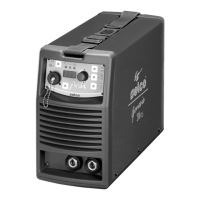
The Selco Genesis 200 CLS is a versatile welding power source designed for both MMA (Manual Metal Arc) and TIG (Tungsten Inert Gas) welding processes. This manual provides comprehensive instructions for its operation, maintenance, and safety.
The Genesis 200 CLS is a generator capable of performing MMA and TIG welding with excellent results. It features a front control panel (FP134) and a rear control panel for user interaction. The front panel includes a display (D1) for showing welding current, selected parameters, alarm messages, and real-time voltage/current readings. An encoder (E1) allows continuous adjustment of welding current and setup values. Push buttons are provided for selecting the current adjusting system (S1), welding process (S2), electrode type (S3 – standard or cellulosic), and displaying measurements (S4). The machine stores the last welding state and presents it upon restart.
For MMA welding, the machine incorporates HOT-START and ARC-FORCE features to facilitate arc ignition and maintain stability. The HOT-START feature provides an initial current increment, while ARC-FORCE temporarily increases current to prevent the electrode from sticking during short circuits. An "antisticking" function reduces current to a minimum if the electrode sticks, allowing for easy removal without damage.
For TIG welding, the Genesis 200 CLS supports continuous arc operation. It utilizes a high-frequency (H.F.) spark for non-contact arc ignition, preventing tungsten inclusions in the weld. A "lift-arc" start option is also available, which involves a low-current short circuit followed by arc ignition upon lifting the electrode, reducing tungsten inclusions. The machine maintains a stable and uniform output current, unaffected by supply voltage variations, ensuring high-quality welds.
The Genesis 200 CLS operates on a 3x400V power supply with a tolerance of +10% to -10%. Key electrical specifications include:
These specifications are valid at an ambient temperature of 40°C.
Safety and Installation: Before any operation, users must read and understand the manual. Modifications and unprescribed maintenance are prohibited. The machine should be installed in compliance with local safety regulations, ensuring adequate power supply and earthing. The earth cable must be connected as close as possible to the welding area. The generator should not be placed in confined spaces or on surfaces with an inclination exceeding 15° from the horizontal plane. Protection against direct sunlight and heavy rain is advised.
Personal Protection: Operators must wear appropriate personal protective equipment, including fire-retardant clothing, a welding helmet with side guards and an adequate filter (at least NR10), safety goggles, and hearing protection if noise levels are high. Contact lenses should not be worn. A first aid kit should be readily available.
Fire/Explosion Prevention: The welding process can cause fires or explosions. Flammable materials must be cleared from the work area. Compressed gas cylinders should be protected from direct sunlight, flames, and extreme temperatures, and secured to prevent falling. Welding on closed containers or in explosive atmospheres is strictly forbidden.
Fume and Gas Protection: Adequate ventilation (natural or forced) is crucial to protect against harmful fumes and gases. In confined spaces, operator supervision by a colleague is recommended. Gas cylinders should be positioned outdoors or in well-ventilated areas.
Electromagnetic Compatibility (EMC): The Genesis 200 CLS complies with EN50199. It is designed for professional industrial use. Users are responsible for evaluating potential electromagnetic problems in the surrounding area, especially concerning individuals with pacemakers or hearing aids. Measures like mains power filtering or shielding of cables may be necessary to reduce interference. Welding cables should be kept as short as possible, positioned close to each other, and at ground level. All metal components in the welding installation should be equipotentially connected to earth, but the operator must be insulated from these components to prevent electric shock.
Welding Process (MMA): Edge preparation varies based on joint type, material thickness, and welding position. Clean surfaces, free from rust or contaminants, are essential for good welds. Electrode selection depends on material thickness and joint type; smaller diameter electrodes are preferred for "position" welding or initial passes in "V" preparations. The current range for electrodes is specified by the manufacturer. Arc ignition is achieved by striking the electrode on the workpiece and quickly retracting it to the normal welding distance. Slag removal after each pass is critical for impurity-free joints.
Welding Process (TIG): TIG welding is highly effective for carbon and alloy steels, especially for high-quality joints without reverse rewelding. It is also suitable for copper due to its high heat concentration capacity. Pure argon (99.99%) is the recommended protective gas, with flow rates varying based on current. Thorium-tungsten electrodes (2% thorium-red) are recommended, with specific diameters and tip angles depending on the welding current. Filler rods should have mechanical properties comparable to the base material.
Routine Maintenance: Regular maintenance is essential to ensure the longevity and proper functioning of the device.
The machine should not be modified in any way. All access and service doors, and covers, must be closed and secured when the equipment is in operation. If any electrical faults or incorrect power output occur, troubleshooting steps are provided, including checking the power supply, fuses, selector switch positions, and for overheating. For persistent issues, contacting an authorized Selco technical service center is recommended.

 To Next Page
 General