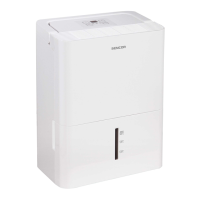
This document describes the SENCOR SDH 1020WH dehumidifier, a device designed to reduce humidity in indoor environments.
Function Description:
The SENCOR SDH 1020WH is a dehumidifier primarily used for drying out areas with increased moisture, such as flooded basements or damp rooms. It operates by drawing in humid air, passing it over a cooling coil where moisture condenses, and then releasing drier air back into the room. The collected condensate is stored in a tank or can be continuously drained via a hose. The appliance features an automatic defrost mode that activates when frost forms on the vaporizer coil, ensuring continuous operation and efficiency. It is equipped with an automatic restart function (AUTO-RESTART) that preserves settings in case of a power outage.
Important Technical Specifications:
- Power supply: 220-240 V ~ 50 Hz
- Dehumidification capacity: 10 liters per 24 hours
- Rated input power: 340 W
- Rated current: 1.9 A
- Energy factor EEV: 1.81 kWh
- Starting current: 5.5 A
- Fuse type and current value: T3.15A
- Condensate tank capacity: 2.1 liters
- Refrigerant type and weight: R290 / 45 g
- GWP (global warming potential): 3
- Equivalent CO₂: 0.000135 tonnes
- Air flow volume: 107 m³/h (high)
- Noise level: 54 dB (A)
- Dimensions: 320 x 215 x 420 mm
- Weight net / gross: 11.3 / 12 kg
- Operating temperature: 5-32 °C
- Recommended room area: 16-31 m²
The appliance uses R290, a flammable refrigerant gas, and should be operated in rooms with an area greater than 4 m².
Usage Features:
The dehumidifier is controlled via a panel (A1) with several buttons and a digital display (B6).
- On/Off (B4): Powers the appliance on or off. An indicator light (B3) signals the power status.
- Humidity Setting (B5, B7): Allows users to set the desired humidity level between 35% and 85% RH (relative humidity) in 5% increments. The set humidity is shown on the display (B6).
- Continuous Dehumidification (B8): Activates continuous dehumidification, indicated by light B1. In this mode, the appliance runs until the condensate tank is full, without a specific humidity target.
- Condensate Tank (A3): Collects condensed water. A viewing window (A4) allows checking the water level. When the tank is full, the indicator light (B2) illuminates, and the appliance stops operating. The tank must be emptied and correctly reinstalled for the appliance to resume.
- Continuous Draining (A9): For continuous operation without manual tank emptying, a drain hose can be connected to outlet A9. The hose must be positioned to allow free flow of condensate to a lower container.
- Automatic Defrosting: The appliance automatically enters defrost mode when frost builds up on the vaporizer coil, with the compressor cycling on and off and the fan running continuously.
- Placement: The appliance should be placed on an even, dry, stable surface, at least 20 cm away from walls or other objects to ensure proper air circulation. It should not be used outdoors or in rooms where the temperature falls below 5 °C, as this can reduce efficiency.
Maintenance Features:
Regular maintenance is crucial for the appliance's longevity and efficient operation.
- Cleaning the Condensate Tank (A3): The tank should be emptied and wiped clean after each use. To prevent bacteria and mold, it should be cleaned monthly with lukewarm water and neutral detergent, then rinsed and dried. Do not wash the tank in a dishwasher.
- Cleaning the Air Filter (A8): The air filter, located behind the protective grille (A7), should be checked and cleaned at least every two weeks, or more frequently with daily use. To clean, remove the grille, wash the filter in warm water with a small amount of kitchen detergent, rinse thoroughly, and allow it to dry naturally before reinstallation. Do not use the appliance without a properly installed filter, and do not wash the filter in a dishwasher.
- Cleaning the Outer Cover and Air Outlet Grilles (A2, A7): These parts can be cleaned with a wiping cloth lightly dampened in lukewarm water with a neutral detergent. For dusty grilles, a vacuum cleaner can be used. Ensure no water enters the vents.
- Storage: For extended periods of non-use, disconnect the power plug, clean the appliance and condensate tank, wind the power cord around its holder, and store the appliance in a dry, clean, well-ventilated location away from extreme temperatures and out of reach of children.
- Troubleshooting: The manual provides a detailed troubleshooting guide for common issues like the dehumidifier not turning on, not removing humidity, excessive noise, frost formation, or water on the floor, along with corresponding solutions. Error messages (AS, ES, P2) displayed on the screen also have specific solutions, often involving power cycling or contacting an authorized service center.
The manual emphasizes several safety precautions, including:
- Always read and store the user's manual.
- Ensure proper supervision for children and inexperienced individuals.
- Do not use the appliance with a damaged power cord.
- Store the appliance to prevent mechanical damage in a well-ventilated room larger than 4 m², away from open flames or heat sources.
- Connect to a properly grounded, easily accessible power socket.
- Do not use extension cords or power adapters unless specifically authorized for dehumidifiers.
- Do not touch the appliance with wet hands.
- Do not expose the appliance to dripping or spraying water.
- Ensure at least 30 cm of clear space around the appliance for air circulation.
- Always turn off and disconnect the appliance before moving, disassembling, or cleaning.
- Do not attempt to repair or modify the appliance yourself; contact an authorized service center.
- The appliance contains flammable refrigerant R290. Follow specific warnings regarding its use, storage, and servicing to prevent fire or explosion hazards.
- Do not drink the collected condensate.


 To Next Page
 General