
 Need help?
Do you have a question about the SereneLife SLIGEN2200 and is the answer not in the manual?
Explains safety alert symbols (DANGER, WARNING, CAUTION) and general operational safety.
Warns about carbon monoxide from exhaust fumes and the need for ventilation.
Describes the risk of rapid starter cord retraction causing injury.
Warns about sparks igniting flammable materials and requirements for spark arresters.
Alerts to burn risks from hot engine parts and exhaust gases.
Warns about the flammability of gasoline and explosion risks.
Advises checking for loose/damaged parts, leaks, and safety label condition.
Warns about severe injury from moving parts and entanglement risks.
Details risks of electrocution from generator voltage and proper grounding.
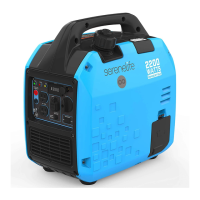
Identifies key external features like carrying handle, fuel cap, and recoil starter.
Explains the function of each control on the generator's panel.
Describes the meaning and function of running, overload, and oil alarm indicators.
Explains the operation of the choke lever, energy-saving switch, grounding terminal, and ON/RUN switch.
Details the circuit breaker, parallel terminal, fuel cap, and ventilation knob functions.
Details operating location, high altitude considerations, and pre-operation checks.
Step-by-step guide on how to check the engine oil level using the dipstick.
Instructions on checking fuel level, using correct gasoline, and avoiding mixing oil.
Guides on connecting devices, grounding, and device readiness.
Explains the necessity and method of grounding the generator for safety.
Detailed steps for manual recoil starting, including choke usage and kickback warnings.
Addresses starting failures, battery issues, and choke lever adjustments.
Provides steps for connecting, starting, and disconnecting electrical devices.
Explains how to avoid overloading, calculate power needs, and manage connected devices.
Details the procedure for safely shutting down the generator.
Instructions for connecting multiple generators for increased power output.
Emphasizes operator responsibility for timely maintenance and following recommendations.
Presents a chart detailing the recommended service intervals for various components.
Provides instructions for cleaning the generator's exterior, air vents, and cooling slots.
Specifies the correct type of engine oil and its capacity.
Detailed, step-by-step instructions for safely changing the engine oil.
Step-by-step guide for removing, cleaning, and reinstalling the air filter element.
Instructions for cleaning, inspecting, gapping, and reinstalling the spark plug.
Procedures for cleaning the spark arrester screen to remove carbon deposits.
Lists common starting failures and their potential solutions.
Addresses issues like breaker trips and inadequate cords causing no output.
Instructions for periodic use and preparation for long-term storage.
Safety precautions and methods for transporting the generator.
Illustrates the electrical connections for the recoil start model.
Illustrates the electrical connections for the electric start model.
Lists key features and items included in the generator package.
Details engine model, displacement, type, speed, and run times.
Lists surge/running wattage, noise levels, fuel capacity, and dimensions.
 General
| Peak Power | 2200W |
|---|---|
| Rated Watts | 1800W |
| Starting Watts | 2200W |
| Fuel Type | Gasoline |
| Starting System | Recoil Start |
| Weight | 46.3 lbs |
| Dimensions | 20.9 x 12.6 x 19.3 inches |
| Run Time at 25% load | 9 hours |
| Frequency | 60Hz |
| Cooling | Forced Air |
| Noise Level | 59 dB |
| AC Output | 120V |
| DC Output | 12V, 8.3A |
| Engine Type | 4-stroke |
| Protection Features | Overload Protection |
| Power Output | 1800W Rated, 2200W Peak |

 To Next Page