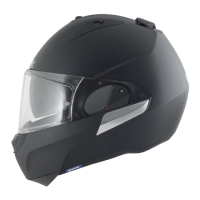
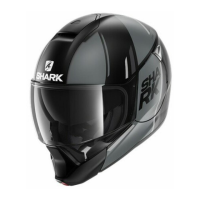
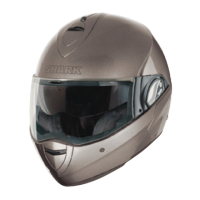
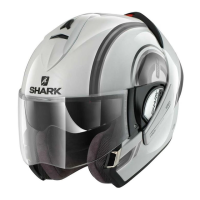
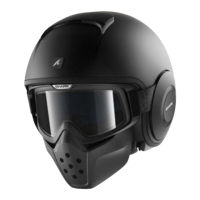
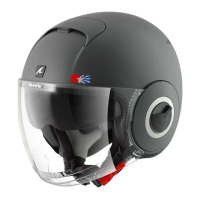
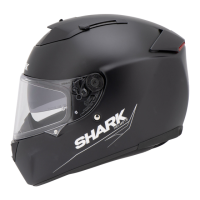
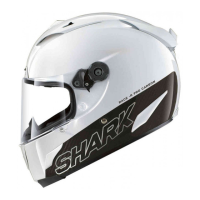
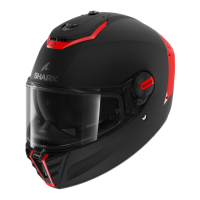
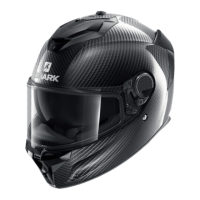
This document is the owner's manual for the SHARK EVO-ONE 2 helmet, a top-quality helmet designed for both urban and extra-urban use on two-wheeled motorised vehicles. The manual provides comprehensive instructions for the helmet's proper use, fitting, maintenance, and safety, emphasising that adherence to these guidelines is crucial for the helmet to provide adequate protection in an accident. Failure to follow the warnings and instructions can lead to severe head injury or death.
Function Description
The SHARK EVO-ONE 2 is a versatile modular helmet that can transform between a full-face and an open-face configuration while remaining on the rider's head. This adaptability allows the rider to choose between the comprehensive protection of a full-face helmet, complete with a waterproof visor, and the open feel of a jet helmet. The chin section is designed to integrate perfectly with the helmet's profile in the jet position, ensuring no aerodynamic problems or weight instability. The helmet has passed all approval tests in the jet position, including rotating acceleration tests.
The helmet is equipped with a visor and an integral sun shield with external controls. The visor provides clear visibility, and its removal and replacement are designed to be straightforward. The sun shield is intended for use only in bright glare conditions and should be kept in the high position in situations of reduced visibility to avoid impairing vision.
Ventilation systems are integrated into the helmet to ensure rider comfort. Upper air intakes facilitate air circulation over the head, while a lower ventilation system directs fresh air over the interior surface of the visor to prevent misting. An additional air vent around the chin complements the defogging ventilation.
The helmet's chin strap system, available in either a "Precise Lock" rapid buckle or a double-D ring, is critical for securing the helmet. Proper adjustment and fastening of the chin strap are paramount for the helmet's performance.
Usage Features
- Choosing the Correct Size: The manual stresses the importance of a proper fit. Riders should measure their head circumference and try on the helmet to ensure it feels snug around the head and tight on the cheek pads. The helmet should not move excessively from side to side or up and down when the chin strap is fastened. The skin of the head and face should feel pulled when moving the helmet. If the helmet is too big, a smaller size should be selected. These tests should be repeated throughout the helmet's life as comfort padding can wear over time.
- Chin Strap Fastening:
- Precise Lock: This system offers precise adjustment due to its notched section. Riders must adapt the strap length using the adjusting buckle upon purchase. To fasten, the tongue is threaded into the buckle until tension is perfect, locking automatically. To release, a lever is pulled, and the tongue is removed. Frequent checks of strap length adjustment are recommended.
- Double-D Ring: The long part of the chin strap is slid through both D-rings, with the comfort pad positioned correctly. The end of the strap is then brought back through the lower D-ring. The strap is pulled until resistance is felt, ensuring it is held in place under the chin without being too tight or impeding breathing. The free end of the strap is then slid into the plastic strap loop on the comfort padding to prevent fluttering.
- Warning: Never ride with a loose or insufficiently tightened chin strap, as the helmet may come off in a fall.
- Transforming Helmet Configuration:
- Full Face to Open Face: While wearing the helmet, press the red button on the chin protection. The screen will automatically rise slightly (AUTO-UP). Push the chin protection forward and lift it up. If guided correctly, the chin protection will push the screen to its top position and move to the back of the helmet. Lower the screen to achieve an open-face helmet with a protection screen.
- Open Face to Full Face: The visor screen can be in either a low or high position and will automatically rise slightly (AUTO-DOWN). Grab the chin bar, placing the left thumb as shown in the manual, and tilt it forward while drawing it aside slightly. Once the chin section is in the low position, two "clicks" should be heard, indicating complete locking. The visor screen can then be closed.
- Warning: This transformation should only be performed when stationary. Never move the chin guard to change configuration while in motion, as this can lead to loss of control and injury.
- Visor and Sun Shield Operation:
- Visor Removal: Move the visor to the high position. Apply pressure to the catches using a screwdriver or pointed instrument. Pivot the visor to detach it from its support.
- Visor Replacement: Both visor supports must be in the high position. Position the visor, starting with the upper fixing lug. Rotate the visor on its supports until a "click" is heard, blocking it on both sides. Check that it is properly in place and functioning before use.
- Sun Shield Operation: The sun shield is operated using a button in the upper ventilation. To lower it, the button is in a forward position; to raise it, move the button toward the back.
- Warning: Never ride with an open visor at highway speeds, or try to open it while riding, as it could dislodge. Tinted or dark visors should not be used at night or in poor visibility conditions. If the visor no longer provides clear visibility, it must be replaced. The sun shield should only be used in bright glare and not in areas with sudden visibility changes (e.g., tunnels) or reduced visibility conditions. Never try to raise or lower the sun shield while riding.
- Ventilation Operation:
- Upper Air Intakes: The tongue is pushed backwards to open and forwards to close.
- Lower Ventilation: Press the button as indicated in the manual to open or close.
- Chin Air Vent: Move the tab one way or the other to open or close the aeration system.
- Warning: Do not open or close any vents or adjust the chin air vent while operating the motorcycle, as this can lead to loss of control.
Maintenance Features
- Textile Parts (Interior Padding):
- Removal: The interior padding should be removed with the helmet in the jet configuration. Turn the helmet over. Separate the chin strap parts. Detach the back part of the headgear from its casing. Disassemble the neck pad by releasing the hook on both sides. Unclip the front of the head section, starting with one side, and remove it. Unclip the two cheek pads and slide them along the chin straps to extract them.
- Replacement: Reposition the cheek pads by passing the chin straps through the slit in the foam and clipping all studs. Start by sliding the plastic tabs of the front of the head section into its housing, beginning with one side. Position the padding correctly inside the top of the helmet. Raise the cheek pad by inserting the back piece and then replacing the hooks on the side parts one after the other. Check that the headgear is in the correct direction.
- Warning: The interior padding is critical for maintaining the correct fit. If there is any doubt about removal or replacement, do not use the helmet and contact a retailer. Never use the helmet with any part of the interior padding removed. The polystyrene lining and interior padding are critical for proper fit. An improper fit can cause the helmet to dislodge in an accident.
- Cleaning: Interior textile parts are washable. Cheek pads and head section must be hand washed in warm, soapy water (around 30°C) using a product for delicate materials in low dilution or household soap. Textile and foam parts must be completely dry before use, dried at room temperature, and never ironed. For leather-appearance parts or textiles attached to safety elements, use a slightly damp sponge or cloth with household soap and rinse with clean water. Avoid excessive water contact with polystyrene parts.
- Warning: Ensure all interior parts are perfectly dry before using the helmet, as moisture can damage the battery feeding the LED and its electric cable.
- Visor and Sun Shield:
- The external surface of the sun shield has an anti-scratch treatment. To maintain and clean it, follow the same instructions as for the external surface of the visor.
- Warning: Do not use any solvent, petrol, abrasive paste, or similar products for cleaning the visor and coatings. Use a soft rag with cool water and mild soap.
- General Helmet Care:
- The helmet should not be subjected to any technical modification.
- Any helmet that has been subjected to a severe impact must be replaced.
- Do not apply any paint, stickers, petrol, or any other solvent to the helmet.
- Only SHARK VZ150 visors approved under No. E11 050543 must be used with this helmet.
The manual concludes by stating that it is not contractual, and SHARK reserves the right to improve production quality. All images in the document are SHARK's exclusive property, and reproduction is forbidden.

 Need help?
 General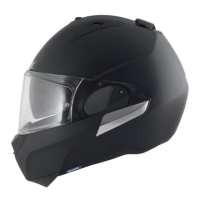

 To Next Page