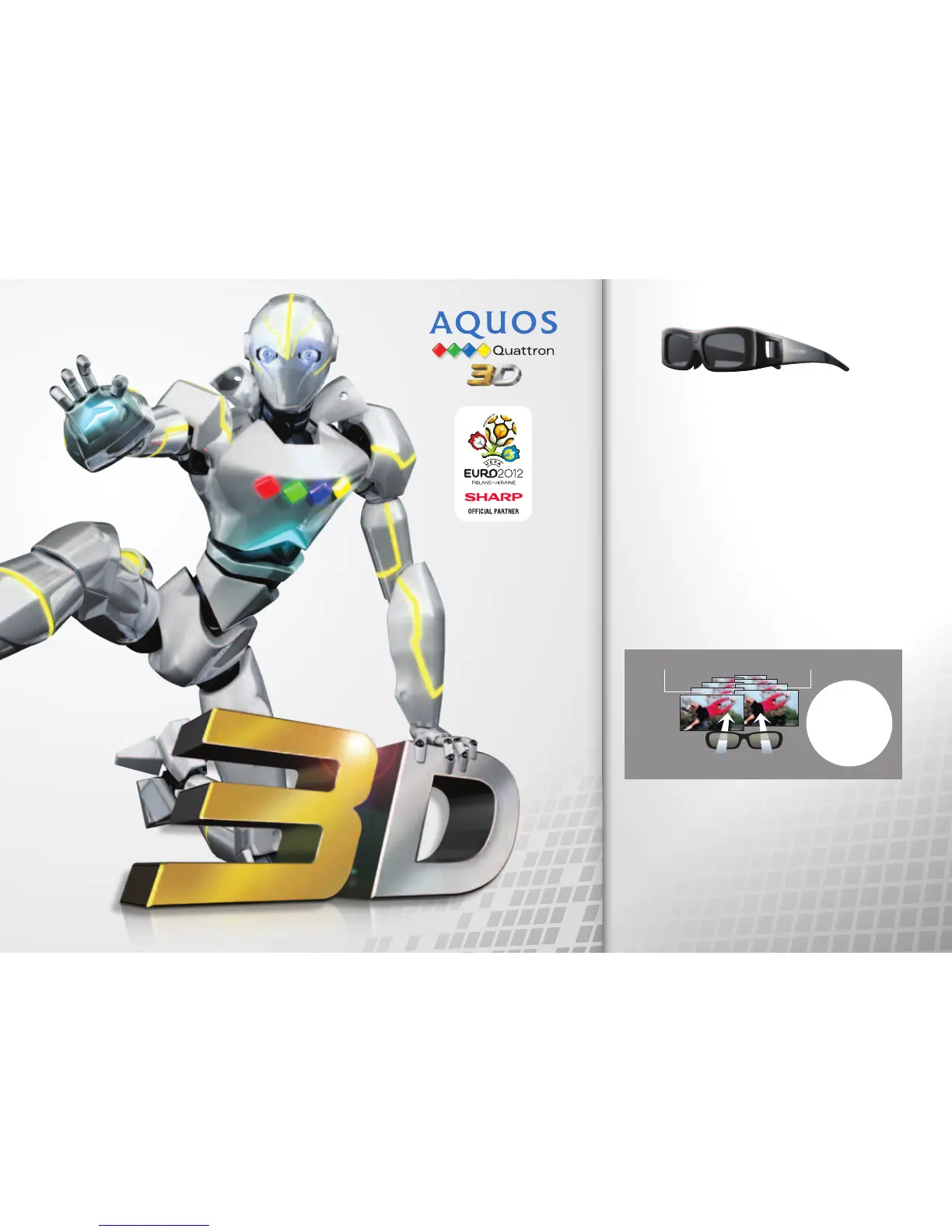
Image for left eye
Left eye Right eye
Image for right eye
High-
speed On/
Off switching of
LCD shutters in 3D
glasses uses parallax
to reproduce a
stereoscopic
image.
Precautions when viewing Stereoscopic 3D
• Do not view stereoscopic 3D if you are in poor health or feeling unwell.
• Immediatelystopviewingstereoscopic3Difyouexperiencediscomfort.
• Thesenseofthree-dimensionalitymayvaryfrompersontoperson.
• Anyonewhohasheartdisease,whoisillorpregnantorwhohasamedicalhistoryofphotosensitivity
should not view 3D TV.
• 3Dglassesshouldnotbeusedforapplicationsotherthanthosespecied.
• Childrenunder7yearsoldshouldnotview3DTVduetotheirdevelopingopticnerves.3DTVmaydamage
their optic nerves.
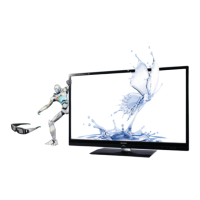
Principles of AQUOS Quattron 3D
When we view an object, our left eye and right eye each look from slightly
different angles. The difference in these viewing angles, i.e., parallax, enables
processing in the brain to produce one image with perception of the depth using
the images from the left eye and right eye. With a 3D image, perception of height,
width, and depth is achieved by separately projecting to the left eye an image
recorded at one angle for the left eye and projecting to the right eye and image
recorded for the right eye at another angle.
With Sharp’s active shutter system, lenses in special glasses turn on and off
in synchronization with an image recorded at one angle for the left eye and an
image recorded at another angle for the right eye. This system produces a high-
quality 3D image in full high-definition.
Note: The concept of four primary colours for 3D Quattron is based on
characteristics of liquid crystal display and differs from the general concept of
three primary colours in optics.
Note: Special 3D glasses (supplied or optional) are required for viewing 3D.
AN-3DG10-S or
AN-3DG20-B (USB Chargeable)



 To Next Page