EasyManua.ls Logo

Sharp FDD-412A - Page 32

Sharp FDD-412A
119 pages
Print Icon
To Next Page IconTo Next Page
To Previous Page IconTo Previous Page
Loading...
FDD412A/B
:
Correc-—
Input
Differences
between
ae
ee
tion
data
input
data
intervals!
difference
values
O@E886
©
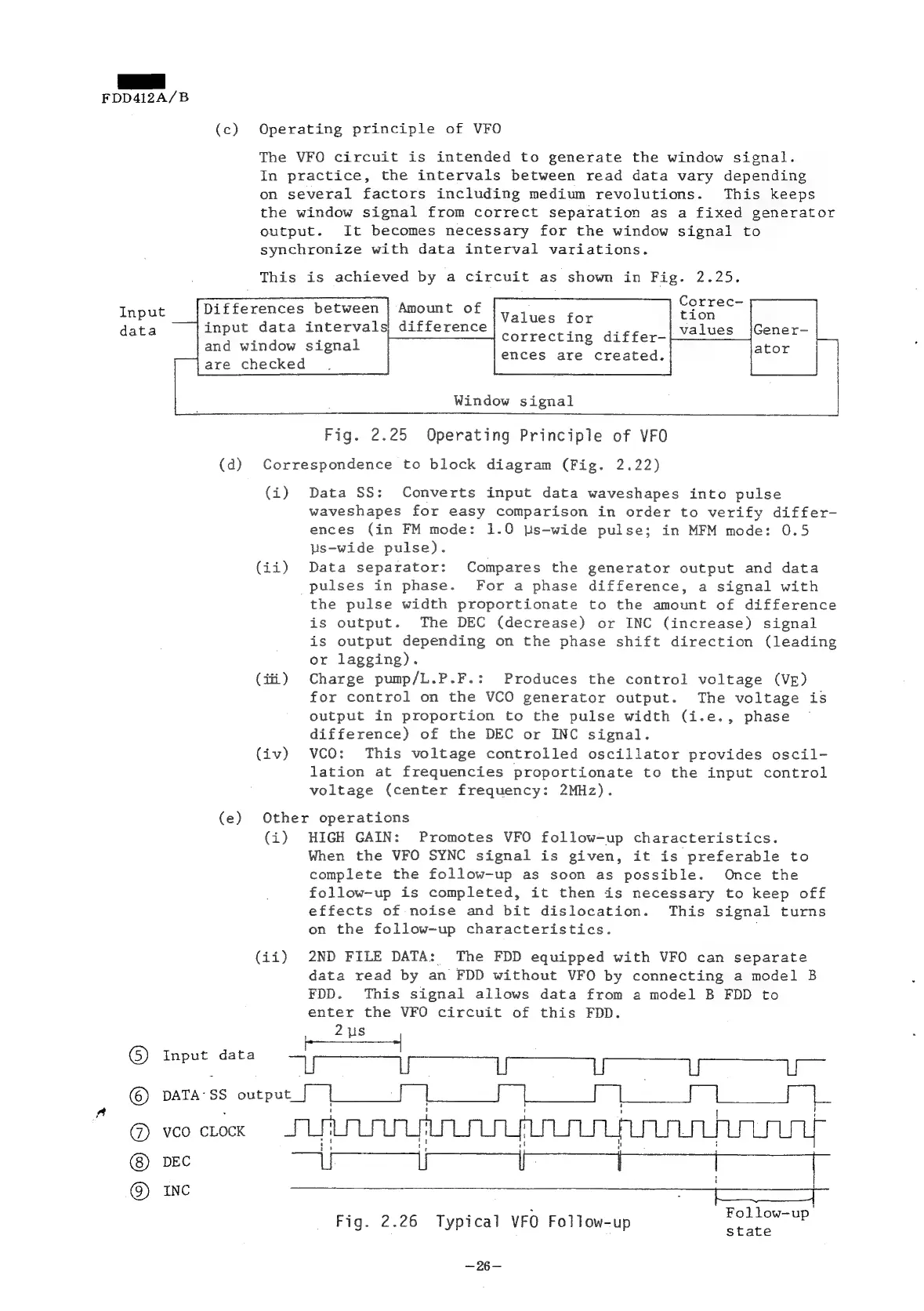
(c)
Operating principle
of
VFO
The
VFO
circuit
is
intended
to
generate
the
window
signal.
In
practice,
the
intervals
between
read
data
vary
depending
on
several
factors
including
medium
revolutions.
This
keeps
the
window
signal
from
correct
separation
as
a
fixed
generator
output.
It
becomes
necessary
for
the
window
signal
to
synchronize
with
data
interval
variations.
This
is
achieved
by
a
circuit
as
shown
in
Fig.
2.25.
correcting
differ-
and
window
signal
ences
are
created.
are
checked
Window
signal
Fig.
2.25
Operating
Principle
of
VFO
(d)
Correspondence
to
block
diagram
(Fig.
2.22)
(i)
Data
SS:
Converts
input
data
waveshapes
into
pulse
waveshapes
for
easy
comparison
in
order
to
verify
differ-
ences
(in
FM
mode:
1.0
Us-wide
pulse;
in
MFM
mode:
0.5
s-wide
pulse).
(ii)
Data
separator:
Compares
the
generator
output
and
data
pulses
in
phase.
For
a
phase
difference,
a
signal
with
the
pulse
width
proportionate
to
the
amount
of
difference
is
output.
The DEC
(decrease)
or
INC
(increase)
signal
is
output
depending
on
the
phase
shift
direction
(leading
or
lagging).
(iti)
Charge
pump/L.P.F.:
Produces
the
control
voltage
(VE)
for
control
on
the
VCO
generator
output.
The
voltage
is
output
in
proportion
to
the
pulse
width
(i.e.,
phase
difference)
of
the
DEC
or
INC
signal.
(iv)
vco:
This
voltage
controlled
oscillator
provides
oscil-
lation
at
frequencies
proportionate
to
the
input
control
voltage
(center
frequency:
2MHz).
(e)
Other
operations
(i)
HIGH
GAIN:
Promotes
VFO
follow-up
characteristics.
When
the
VFO
SYNC
signal
is
given,
it
is
preferable
to
complete
the
follow-up
as
soon
as
possible.
Once
the
follow-up
is
completed,
it
then
is
necessary
to
keep
off
effects
of
noise
and bit
dislocation.
This
signal
turns
on
the
follow-up
characteristics.
,
(ii)
2ND
FILE
DATA:
The
FDD
equipped
with
VFO
can
separate
data
read
by
an
FDD
without
VFO
by
connecting
a
model
B
FDD.
This
signal
allows
data
from
a
model
B
FDD
to
enter
the
VFO
circuit
of
this
FDD.
2us
Input
data
A
DATAYSSoutpatel
(LSP
te
ee
:
;
yoo
ctock
UCP
LUE
ep
i
:
if
\,
;
DEC
L
Lf
]
|
|
INC
aa
aaa
a
EE
Fig.
2.26
Typical
VFO
Follow-up
Bereewron
state