EasyManua.ls Logo

Sharp FDD-412A - Page 81

Sharp FDD-412A
119 pages
Print Icon
To Next Page IconTo Next Page
To Previous Page IconTo Previous Page
Loading...
FDD412A/B
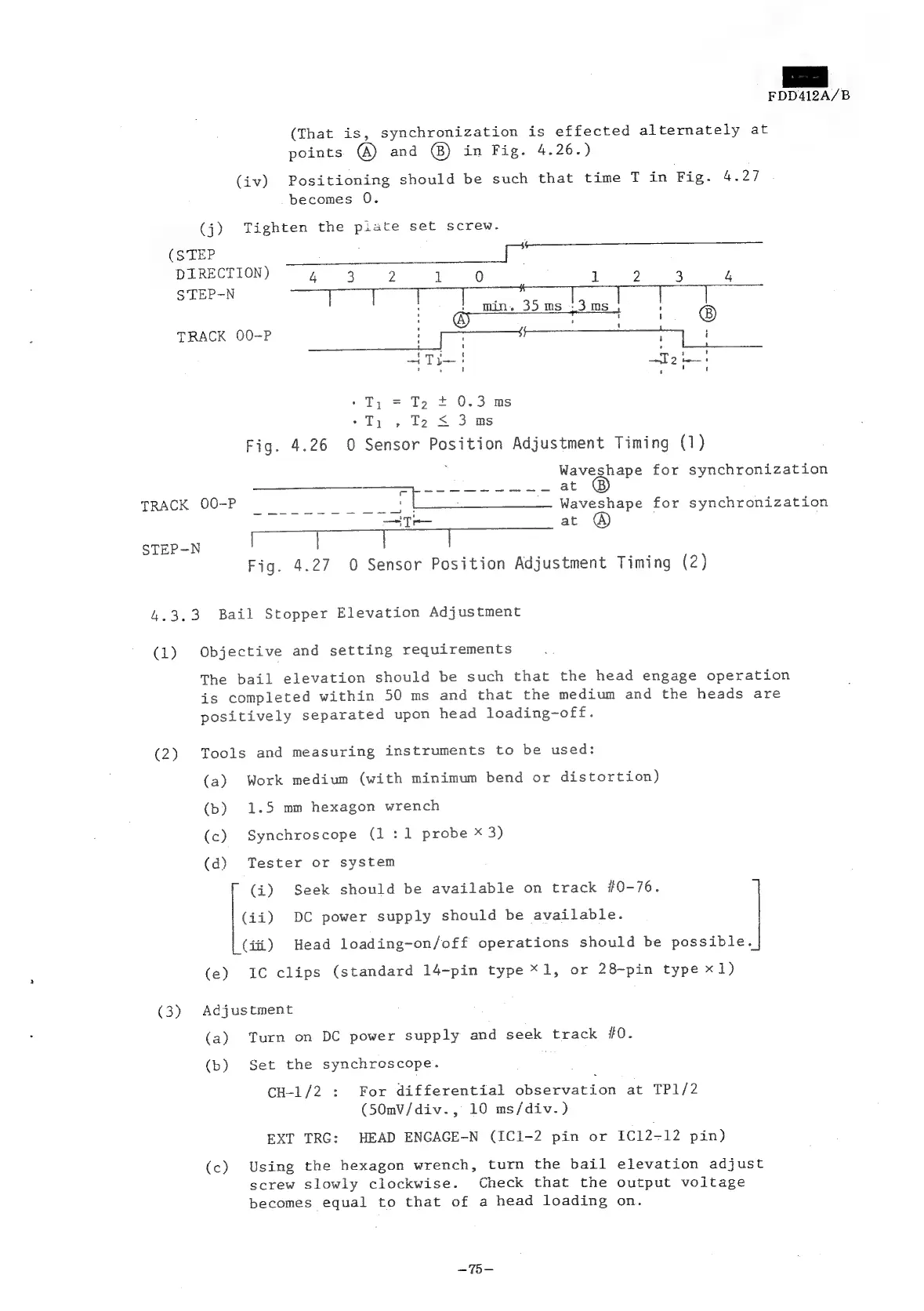
(That
is,
synchronization
is
effected
alternately
at
points
(A)
and
in
Fig.
4.26.)
(iv)
Positioning
should
be
such
that
time
T
in
Fig.
4.27
becomes
0.
(j)
Tighten
the
piate
set
screw.
(STEP
ee
DIRECTION)
4
3
STEP-N
TO
“(ada
TRACK
00-P
2
ST
-
T,
=
To
+
0.3
ms
-T,
,
T2
S$
3
ms
Fig.
4.26
0
Sensor
Position
Adjustment
Timing
(1)
Waveshape
for
synchronization
at
Waveshape
for
synchronization
at
TRACK
0OO-P
STEP~N
|
¥.
d
Fig.
4.27
0
Sensor
Position
Adjustment
Timing
(2)
4.3.3
Bail
Stopper
Elevation
Adjustment
(1)
Objective
and
setting
requirements
The
bail
elevation
should
be
such
that
the
head
engage
operation
is
completed
within
50
ms
and
that
the
medium
and
the
heads
are
positively
separated
upon
head
loading-off.
(2)
Tools
and
measuring
instruments
to
be
used:
(a)
Work
medium
(with
minimum
bend
or
distortion)
(b)
1.5
mm
hexagon
wrench
(c)
Synchroscope
(1:1
probe
x
3)
(d)
Tester
or
system
(i)
Seek
should
be
available
on
track
#0-76.
(ii)
DC
power
supply
should
be
available.
(iti)
Head
loading-on/off
operations
should
be
possible.
(e)
IC
clips
(standard
14-pin
type
x1,
or
28-pin
type
x1)
(3)
Adjustment
(a)
Turn
on
DC
power
supply
and
seek
track
#0.
(b)
Set
the
synchrescope.
CH-1/2
:
For
differential
enseiuacion
at
TP1/2
(50mV/div.,
10
ms/div.)
EXT
TRG:
HEAD
ENGAGE-N
(IC1-2
pin
or
1C12-12
pin)
(c)
Using
the
hexagon
wrench,
turn
the
bail
elevation
adjust
screw
slowly
clockwise.
Check
that
the
output
voltage
becomes
equal
to
that
of
a
head
loading
on.
~75—