WARNING
Safety
• Safety glasses
don't
fog as easily
as
goggles and can
be
worn all the
time. Regular glasses normally have
only impact resistant lenses. They
are not safety glasses.
• A face shield protects your entire
face, not
just
your eyes. And you can
flip it up out
of
the way when you
don't
need it. A face shield can
be
used with regular glasses.
Ear Protection
Prolonged exposure
to
high intensity
noise from high speed power tools
can damage your hearing.
• Hearing protectors screen out noise
levels that can damage ears. Wear
hearing protectors when you're ex-
posed
to
high intensity power tool
noise for prolonged periods
of
time.
Sawdust and Chips
Sawdust and chips can
be
fire hazards
and breathing sawdust can
be
a health
hazard. Sawdust may cause you phys-
ical discomfort, especially
if
you have
emphysema, asthma, or
an
allergic
reaction. The sawdust from some
woods can also
be
toxic.
• Wear a close-fitting
dust
mask if a
significant
amount
of
dust is
re-
leased into the air. Clean or replace
the filters in the mask regularly .
• Open a window or use a fan
to
venti-
late your shop.
Guarding for Turning
Most shop accidents happen to wood-
workers who believe they are
too
experienced to use the guards and
safety devices. Although proper use
of
guards and safety devices usually
requires a small amount
of
additional
setup, the security
that
you and your
family obtain from them is well worth
the effort. Don't take shortcuts. It
doesn't pay.
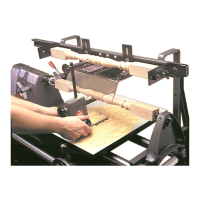
• Keep the guard in place during
duplicator
operations. Also use the
guard when doing conventional
lathe turning on the Mark
V.
Dress
Loose hair and
clothing
which could
be
entangled
in
rotating workpieces
are very hazardous.
• Tuck long hair under a hat or tie it
up.
Do
not wear ties, gloves, loose
clothing
or
jewelry. Roll sleeves up
above your etbows.
General Safety Rules
for Power Tools
• Know your power tool. Read the
owners manual carefully. Learn
its
application and
limitations
as well as
the specific potential hazards pecul-
iar to the tool.
• Ground all tools (unless double
insulated). If tool is equipped with an
approved 3-conductor cord and a
3-prong grounding type
plug to fit the
proper grounding type receptacle,
the green conductor in the cord is
the grounding wire. Never connect
the green wire to a
live terminal.
• Wear proper eye and ear protec-
tion_
Also, wear a dust mask.
• Keep guards in
place.
Always
keep guards
in
working order and in
proper alignment and adjustment.
Most injuries
occur
on unguarded
power tools.
• Remove
adjusting
keys and
wrenches.
Form habit
of
checking to
see
that
keys
and
adjusting
wrenches are removed from tool
be-
fore turning it on.
• Wear proper apparel.
Do
not wear
loose clothing, ties, gloves, or jew-
elry. Roll sleeves up above your el-
bows, wear nonslip footwear, and
tucUong
hair under a hat.
•
Do
not operate power tools if
you
are fatigued, taking medication, or
under the influence of alcohol or
drugs.
•
Avoid
dangerous environments.
Don't use power tools in damp, wet
or
explosive atmospheres.
• Keep work areas well lit, clean,
and free from clutter.
•
Do
not force the tool. It will do the
job
better and safer at the rate for
which it was designed.
• Use the right tool. Don't force a
tool or accessory
to
do a
job
for
which it was not designed.
• Direction of feed. Feed the work-
piece into the
cutter
against the
ro-
tation
of
the
cutter
ONLY.
• Check damaged parts. A dam-
aged guard
or
part should
be
prop-
erly
repaired
or
replaced
before
further use. If a strange noise or vi-
bration develops, immediately turn
off
the power, unplug the machine
and correct the problem.
• Secure work pieces. Use clamps,
fixtures, and other devices
to
hold
workpieces when practical. It's safer
than using your hands and it frees
your hands
to
operate the tool.
•
Do
not overreach. Keep proper
footing and balance at all times.
•
Turn
off the tool and wait until it
comes to a complete stop
before
re-
moving workpieces and scraps.
•
Do
not try to stop the tool
by
grab-
bing
the workpiece or any part
of
the
tool. Turn
off
the tool and let it come
to
a complete stop by itself.
•
Do
not leave tool running unat-
tended.
Turn power off. Don't leave
tool until it comes to a complete
stop.
• Avoid
unintentional
starting.
Make sure the switch is
in
the
"off"
position before plugging in or
un-
plugging the tool.
• Disconnect tools. T'I'rn
off
and un-
plug tools before changing acces-
sories
and
setups,
making
ad-
justments, and performing mainte-
nance and repair.
•
Do
not stand or lean
on
the tool.
You
could fall onto the tool or it could
tip over injuring you and/or damaging
the tool.
• Maintain tools. Keep parts and
tools
sharp, clean and maintained
according to the Owners Manual.
• Make workshop childproof. Use
padlocks, master switches or remove
starter keys.
• Keep children away. All visitors
should stay a safe distance from
power tools, and wear eye and ear
protection.
• Use recommended accessories.
Consult the owners manual for rec-
ommended accessories.
3


 To Next Page
 Loading...