www.sitech.se
1. Optimal Buoyancy Control
Before early 70´s, drysuits was mainly used in commercial and military
diving activities. To avoid discomfort created by squeeze at greater depth,
overpressure valves were installed in the ankles, wrists and neck in order to
remove excessive air inflated through the face mask.
The inflation of gas also increased the undergarments insulation ability. This type of
drysuit was named constant volume drysuit. The wetsuit was a great improvement
and started to be popular in the early 50´s and drysuits in general became out aged.
Stig Insulán made his military service as a mine clearance diver. Stig was early invol-
ved in wetsuit and general diving gear manufacturing, which he started in 1962.
With his dedication to diving and interest in design he tested the ideas during com-
mercial diving operations. During long dives under ice in cold water Stig required
something better.
Stig´s invention of the variable volume drysuit valve, opened up for a new era of
underwater comfort. From extensive diving experience and expertise in regards to
diving physiology a number of criterias was set up:
1. It must act as an automatic overpressure valve, also at maximum setting.
2. It must have feature for manual dumping of insulation gas with occupied hands.
3. It must have a sensitive regulation of internal suit pressure.
4. It must at a given setting maintain internal gas for buoyancy control.
5. It must maintain insulation and flotation gas for prolonged surface time.
6. It must be placed on a location allowing easy gas dumping without
inadvertently deflation. E.G Rising hands for alert call.
7. It must have adequate flow rate to enable easy ascent speed control.
8. It must be removable for checking and service.
9. It must be attached in a Valve Port, preventing leakage if material is compressed.
Also to avoid rip out if tangled.
The result of Stig´s and SI TECH´s efforts is known worldwide and has
evolved modern drysuit diving to what it is today!
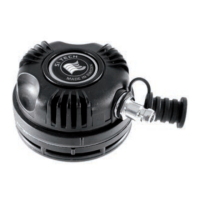
SI TECH Valves are designed to make your dives pleasant and easy
avoiding dangerous pressure gradients between the suits inner
and outer pressure with a maximum resistance of 25 mbar.
The focus of the valves is the pressure precision that make the SI TECH
valve superior. This also assures to prevent leakage of insulating gas
when set to maximum pressure for extended surface buoyancy and
warmth. The location of the Exhaust Valve at the upper arm ensure
an easy access of internal gas venting when controlling ascent
speed and fine adjustment of buoyancy during the dive. At minimum
setting 2 mbar the suit can be evacuated to a minimum of free
gas (not gas inherent in the underwear).
For secure attachment the valve is preferably attached with SI TECH
Valve Ports. This allows you to make service an easy task.
Basic diving physiology helps you to understand
buoyancy control!
To easier determine your buoyancy, reduce number of gas filled compart-
ments. The gas in the suit is the main compartment for a good insulation.
By utilizing the valve in an optimal way you also control your buoyancy with
the amount of gas in the suit. In a stressed situation it can be difficult to
determine which compartment to manouver if the BCD* is simultaneously
used. Also consider buoyancy change in a thick neoprene drysuit. Gas volu-
me changes in regards to depth. The weight of gas in your cylinder changes
during the dive and must be considered when determining your weighting
for a optimal buoyancy control at the end of dive. A weight loss of roughly
3 kg (6 lbs) has to be considered from start to end of dive.
*BCD = Buoyancy Control Device


 To Next Page
 Loading...