Need help?
Do you have a question about the Siamp Monaco OPTIMA 49 and is the answer not in the manual?
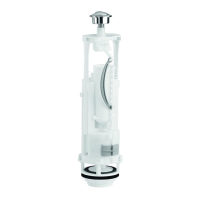
This document describes the SIAMP Optima 49 flushing mechanism, designed for Monaco cisterns. It provides detailed instructions for installation, setup, and maintenance.
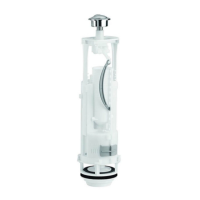
The SIAMP Optima 49 is a dual-flush toilet flushing mechanism. It features a button (a) for initiating flushes, offering both a "Spłukiwanie krótkie" (short flush) and a "Spłukiwanie długie" (long flush). The mechanism includes a lift rod (c) that connects to the button and actuates the flush. A key component is the overflow tube (l), which also serves as a guide for the stirrup (m). The stirrup's position, indicated by a visible notch number, determines the overflow tube's height and, consequently, the water level for flushing. The device also incorporates a residual sliding valve (d) for adjusting the "martwej wody" (residual water) level, which impacts the cleaning efficiency of the bowl.
The mechanism is designed for cisterns with specific dimensions. The height (H) of the cistern, measured from the top of the lid to the inside base, and the diameter (D) of the hole in the lid (38-44mm) are critical for proper setup. The overflow tube (l) can be cut to adjust its height based on the cistern's H dimension. A table is provided to correlate the cistern height (H) with the appropriate stirrup notch number and, if necessary, the cut on the overflow tube. For instance, a cistern height of 448-435mm corresponds to stirrup notch 11, while 314-300mm corresponds to "Mini". The maximum water level in the cistern should be 20mm below the overflow tube.
Installation and Setup:
Valve Gasket Replacement:
The document provides a visual breakdown of the components, including the stirrup (m), overflow tube (l), stirrup catch clips (k), lift rod (c), residual sliding valve (d), strainer nut (f), valve gasket (i), and strainer gasket (h). It also includes contact information for SIAMP for support.
 General
| Brand | Siamp |
|---|---|
| Model | Monaco OPTIMA 49 |
| Category | Plumbing Product |
| Language | English |

 To Next Page