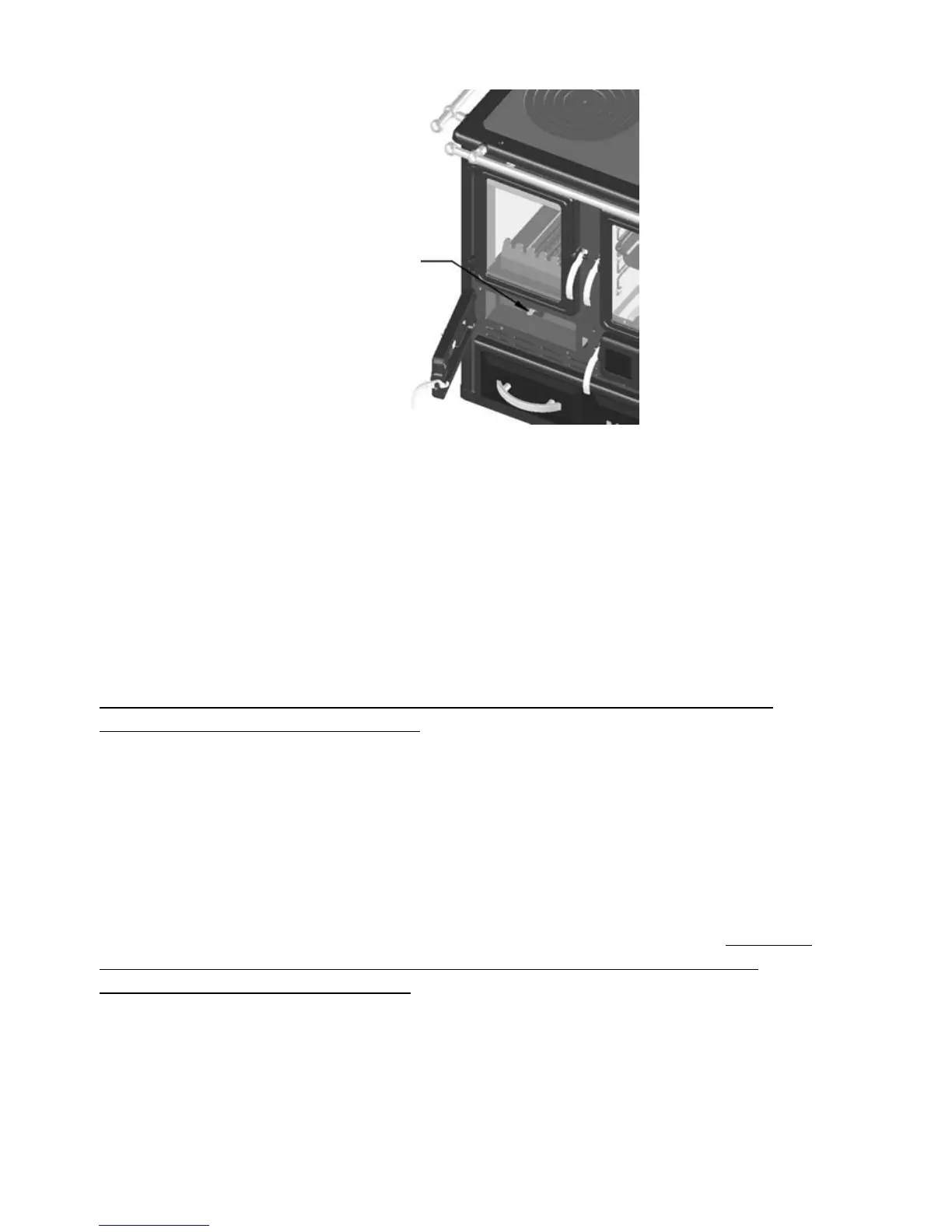
FIG. A
Grate shaker
The firebox has a panoramic door with ceramic glass that withstands high
temperatures (700°C). With this solution, we wanted to offer the visual appeal of
flames inside the firebox without any danger of sparks or smoke escaping into the
heated room. The firebox door and the ash pan door are air tight. Fuel is loaded by
opening the firebox door from R to L. It is opened by releasing the HANDLE to the R
of the firebox door.
When loading wood, we recommend you are very careful with the refractory
bricks in the firebox (in the versions with the firebox made of refractory bricks) as
they could break if knocked hard. Remember that improper use of the stove (too
much fuel, etc) will wear out the stove more quickly so use the amount of fuel
appropriate to the heating capacity of the appliance.
We advise always taking great care and using the protective glove provided when
loading fuel and inspecting the ash pan.
Heating is obtained by convection, through the air passages situated between the body
of the stove and the ceramic side panels and through the openings at the front and the
back of the stove, and by irradiation using the heat from the glass door, the external
ceramic walls and the cast iron parts.
Both versions of the stove have the same dual air intake control system with a
primary air valve and a secondary air valve.
The primary air valve (FIG. B and FIG. C) is in the centre of the ash pan door. This
valve allows air to come in from below, through the ash pan area, the grate holder and
the grate towards the fuel. The primary air (P.A.) is vital for combustion.
Therefore,
avoid overfilling the ash pan placed immediately under the grate, as the ash can
obstruct the entry of the primary air.
The intake is controlled by moving the controls in the middle of the ash pan door
from right to left or vice versa.
The position for maximum intake of primary air is when the top control is completely
at the right (FIG. B), whereas, on the other hand, the valve is closed when the top
control is completely at the left (FIG. C).
4


 To Next Page