Need help?
Do you have a question about the Sierra Wireless AirPrime EM8805 and is the answer not in the manual?
Precautions for operating the wireless module in hazardous environments or aircraft.
Explains sources of RF interference and sensitivity degradation.
Techniques to reduce the effect of device-generated RF interference on Rx performance.
Requirements for host radiated spurious emissions testing with the module.
Methods for testing receiver performance desensitization due to host noise.
Lists conditions under which the EM8805 module should not be operated.
Details FCC/IC regulations for mobile applications, including separation distances and antenna gain limits.
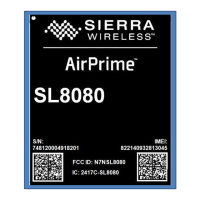
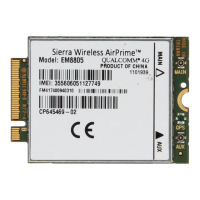
The Sierra Wireless EM8805 Embedded Module is an M.2 wireless module designed to provide extensive connectivity for a range of portable computing devices, including notebooks, ultrabooks, and tablets. Its primary function is to enable high-speed wireless communication, supporting various radio frequency bands and technologies such as DC-HSPA+, HSPA+, HSDPA, HSUPA, WCDMA, GSM, GPRS, EDGE, and GNSS. This broad compatibility ensures that the device can operate across different cellular networks and provide global navigation satellite system capabilities. The module is engineered to meet specific industry and carrier certifications, including AT&T carrier certification, Android compliance, and Windows 8 Mobile Broadband Interface Model (MBIM) compliance, ensuring its integration into diverse ecosystems.
For development and evaluation, a hardware development kit is available, which includes essential components like a development board, cables, antennas, and other accessories. This kit facilitates the integration process for OEMs and developers. The module requires specific connectors for integration into a host device, including M.2-spec compatible RF cable connectors (two jacks) and a 67-pin EDGE connector, which is Slot B compatible according to the PCI Express NGFF (M.2) Electromechanical Specification Revision 0.7. This EDGE connector is designed to mate with a generic 75-pin position connector on the motherboard, featuring a mechanical key for proper alignment. Manufacturers like LOTES, Kyocera, JAE, Tyco, and Longwell produce compatible connectors. Additionally, an industry-standard SIM connector is required for network access.
The EM8805 module operates through power supplied by the host device, relying on multiple power and ground pins. It does not possess an independent power supply or internal protection circuits, necessitating a safe and continuous power supply from the host, either via a battery or a regulated power supply. The module features five distinct power states: Normal (Default), Low Power ('Airplane mode'), Sleep, Off, and Disconnected. In the Normal state, the module is fully active, capable of placing/receiving calls and establishing data connections. This state is entered when VCC is applied, Full_Card_Power_Off# is deasserted (pulled high), and W_DISABLE#1 is deasserted. Current consumption in this state varies based on factors like radio band, transmit power, receive gain settings, and data rate. The Low Power state, or 'Airplane mode,' is entered either under host interface control (e.g., AT+CFUN=0 command or assertion of W_DISABLE#1 after AT!PCOFFEN=0) or automatically if critical temperature or voltage limits are reached. In this state, the module is active but with reduced power consumption. The Sleep state represents a normal idle mode between calls or data connections, where the module cycles between wake (polling the network) and sleep intervals as determined by the network provider. The Off state is maintained by the host asserting Full_Card_Power_Off# (pulled low or left floating), resulting in minimal current draw. Finally, the Disconnected state signifies that the host power source is entirely removed, and all associated voltages are at 0 V.
RF performance is a critical aspect of the EM8805. The module supports various WCDMA frequency bands (Band 1, 2, 5, 8) and GSM frequency bands (GSM 850, EGSM 900, GSM 1800, GSM 1900), as well as GNSS frequency bands for GPS (1575.42 MHz) and GLONASS (1602 MHz). When attaching antennas, it is crucial to use compatible 2x2 mm RF receptacle connectors from manufacturers like Foxconn, Longwell, Speedtech, Murata, or IPEX. Coaxial connections between the module and antenna must be matched to 50 Ω, and RF cable losses should be minimized, with a recommended maximum cable loss of 0.5 dB. For optimal thermal performance, grounding the device to a metal chassis via its mounting hole is advised. The module is fully shielded to protect against electromagnetic interference (EMI), and this shielding should not be removed.
Antenna selection and cabling are paramount for RF performance, requiring a careful match between antenna gain and cable loss. The antenna and its associated circuitry should have a nominal impedance of 50 Ω with a return loss better than 10 dB across all operating frequency bands. System gain directly impacts regulatory test results (FCC, IC, CE). For custom antenna designs, a skilled RF engineer is recommended to ensure performance. If both UMTS and CDMA modules are used in the same platform, separate antennas might be beneficial for maximum performance. Antenna placement is also critical; positioning antennas away from noise sources (e.g., switching power supplies, LCD assemblies) is essential, as high levels of broadband or spurious noise from an insufficiently shielded host device can degrade module performance. Connecting cables should maintain 50 Ω impedance to prevent RF performance reduction due to mismatch. The diversity antenna can be enabled or disabled using the AT command !RXDEN=1 or !RXDEN=0, respectively, to improve connection quality and reliability, particularly in environments with varying interference effects.
Proper ground connection is vital to prevent noise leakage into the RF system. A strong ground connection should be established through the host connector and the module's mounting hole. Minimizing ground noise leakage is especially important for host board designs with signals running along the module's length or circuitry operating at both ends of the interconnects. The module's RF performance can be affected by interference, known as RF desense, originating from power supply noise, device-generated RF, or other wireless devices within the host. To mitigate desense, antennas should be placed as far as possible from interference sources. Shielding the host device's components with high RF emissions (like the main processor and parallel bus) is often necessary, as the module itself is well-shielded but its antenna cannot be. Filtering unwanted high-order harmonic energy on low-frequency lines and forming shielding layers around high-speed clock traces on multi-layer PCBs are also effective strategies. Routing antenna cables away from noise sources is crucial.
Radiated Spurious Emissions (RSE) compliance is a key consideration for antenna design. The host device with the EM8805 module must meet RSE test cases outlined in CE/ETSI EN 301 908 (WCDMA) and CE/ETSI EN 301 511 (GSM) standards. Antenna impedance influences radiated emissions, which are compared against the module's 50-ohm conducted emissions baseline. GSM spurious emissions are particularly prone to RSE issues, but all models with user-designed antennas must meet RSE requirements. Radiated sensitivity measurement, or over-the-air (OTA) testing, is necessary to determine receiver performance desensitization caused by self-generated noise from the host device. This testing can be performed by Sierra Wireless or in-house using an OTA test chamber. The EM8805 is based on ZIF (Zero Intermediate Frequency) technologies, meaning there are no IF components to consider during EMC tests.
Regulatory compliance and industry certifications are paramount. The module is designed to meet requirements from regulatory bodies such as the Federal Communications Commission (FCC) of the United States, the National Communications Commission (NCC) of Taiwan, and the Radio Equipment and Telecommunications Terminal Equipment (R&TTE) Directive of the European Union. Industry certifications like GCF-CC and Full GCF are also obtained. OEMs are responsible for additional testing and certification for their end products. Sierra Wireless offers professional services to assist OEMs with this process.
Important safety and hazard notices emphasize that due to the nature of wireless communications, data transmission and reception cannot be guaranteed, and delays or losses are possible. The module should not be used in situations where data failure could lead to damage, injury, or loss of property. Sierra Wireless disclaims liability for such damages. The module must not be operated in areas with blasting, explosive atmospheres, or near medical/life support equipment where radio interference could occur. In aircraft, the module must be powered off to prevent interference with onboard systems, although some airlines may permit cellular phone use on the ground with the door open. Operating communication devices while driving is prohibited in some jurisdictions.
For North American users, the EM8805 has modular approval for mobile applications, allowing integrators to use it without additional FCC certification if certain conditions are met. A minimum separation distance of 20 cm between the antenna and the user's body must be maintained. To comply with FCC/IC regulations, the maximum antenna gain, including cable loss, must not exceed 6.5 dBi in the Cellular band and 3 dBi in the PCS band for mobile-only exposure. If the EM8805 transmits simultaneously with other collocated radio transmitters in a host device, each collocated transmitter must be FCC certified for mobile application, and a 20 cm separation distance between all collocated antennas and the user's body must be maintained. The output power and antenna gain must adhere to stipulated limits for UMTS (23.5 dBm conducted power, 3 dBi antenna gain), GSM (33 dBm for 850, 30 dBm for 1900, 3 dBi antenna gain), WLAN (29 dBm, 5.0 dBi), WiMAX (29 dBm, 5.0 dBi), and BT (15 dBm, 5.0 dBi). A label with "This device contains FCC ID: N7NEM8805" must be affixed to the end product, and the user manual must clearly state operating requirements for FCC/IC RF exposure compliance. The end product may also need to pass FCC Part 15 unintentional emission testing. For portable devices, separate SAR approval is required.
 General
| Manufacturer | Sierra Wireless |
|---|---|
| Model | AirPrime EM8805 |
| Form Factor | M.2 |
| Operating Temperature | -40°C to +85°C |
| Operating Voltage | 3.3V |
| Category | Wireless module |
| Technology | LTE |
| Interface | PCIe, USB |
| GNSS | GPS, GLONASS |
| Certifications | FCC, IC, CE, GCF |

 To Next Page