od)
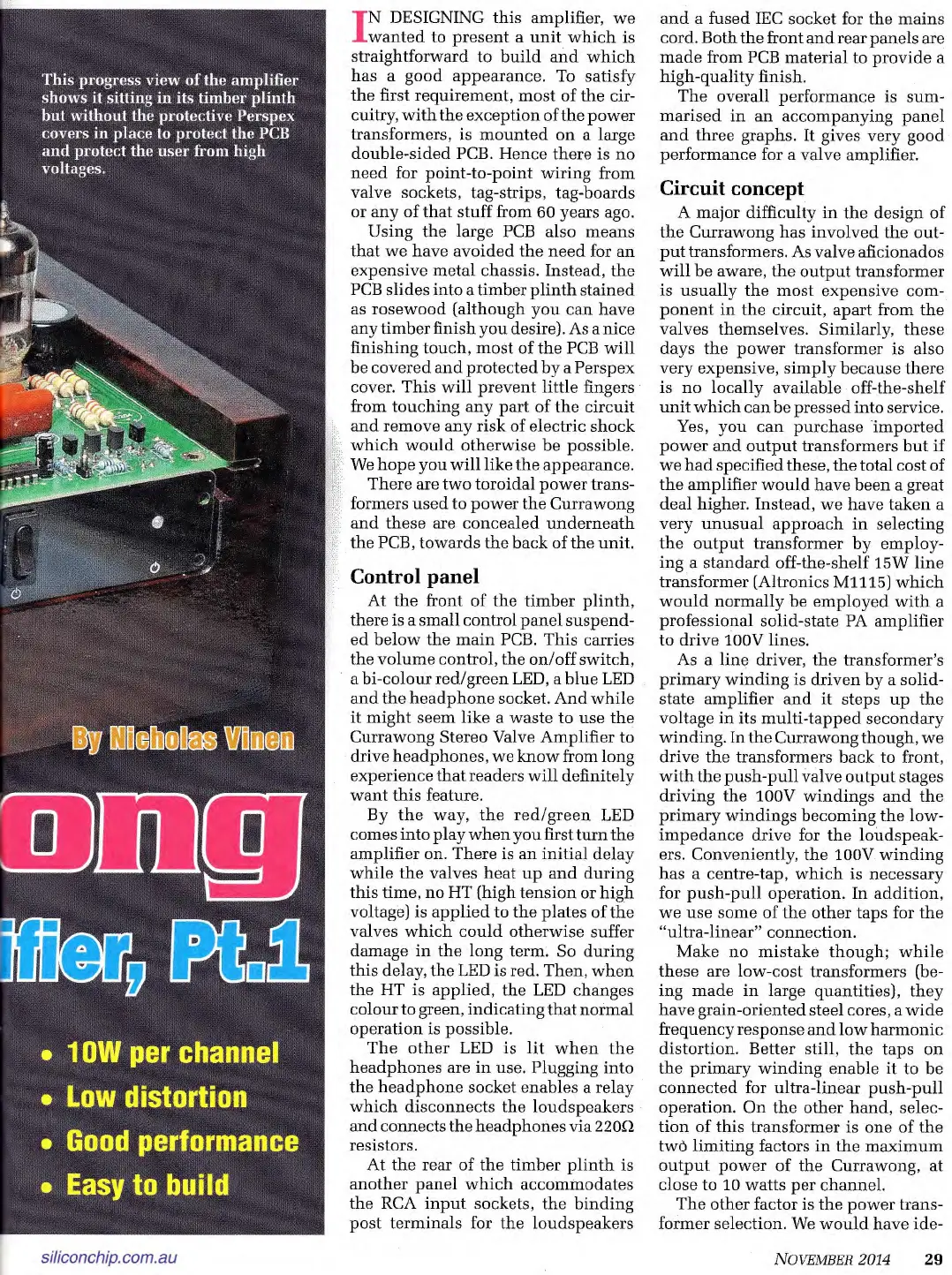
This progress view of the amplifier
shows it sitting in its timber plinth
but without the protective Perspex
covers in place to protect the PCB
and protect the user from high
voltages.
e-
•
10W per channel
•
Low distortion
•
Good performance
•
Easy to build
I
N DESIGNING this amplifier, we
wanted to present a unit which is
straightforward to build and which
has a good appearance. To satisfy
the first requirement, most of the cir-
cuitry, with the exception of the power
transformers, is mounted on a large
double-sided PCB. Hence there is no
need for point-to-point wiring from
valve sockets, tag-strips, tag-boards
or any of that stuff from 60 years ago.
Using the large PCB also means
that we have avoided the need for an
expensive metal chassis. Instead, the
PCB slides into a timber plinth stained
as rosewood (although you can have
any timber finish you desire). As a nice
finishing touch, most of the PCB will
be covered and protected by a Perspex
cover. This will prevent little fingers
from touching any part of the circuit
and remove any risk of electric shock
which would otherwise be possible.
We hope you will like the appearance.
There are two toroidal power trans-
formers used to power the Currawong
and these are concealed underneath
the PCB, towards the back of the unit.
Control panel
At the front of the timber plinth,
there is a small control panel suspend-
ed below the main PCB. This carries
the volume control, the on/off switch,
a bi-colour red/green LED, a blue LED
and the headphone socket. And while
it might seem like a waste to use the
Currawong Stereo Valve Amplifier to
drive headphones, we know from long
experience that readers will definitely
want this feature.
By the way, the red/green LED
comes into play when you first turn the
amplifier on. There is an initial delay
while the valves heat up and during
this time, no HT (high tension or high
voltage) is applied to the plates of the
valves which could otherwise suffer
damage in the long term. So during
this delay, the LED is red. Then, when
the HT is applied, the LED changes
colour to green, indicating that normal
operation is possible.
The other LED is lit when the
headphones are in use. Plugging into
the headphone socket enables a relay
which disconnects the loudspeakers
and connects the headphones via 22052
resistors.
At the rear of the timber plinth is
another panel which accommodates
the RCA input sockets, the binding
post terminals for the loudspeakers
and a fused IEC socket for the mains
cord. Both the front and rear panels are
made from PCB material to provide a
high-quality finish.
The overall performance is sum-
marised in an accompanying panel
and three graphs.
It
gives very good
performance for a valve amplifier.
Circuit concept
A major difficulty in the design of
the Currawong has involved the out-
put transformers. As valve aficionados
will be aware, the output transformer
is usually the most expensive com-
ponent in the circuit, apart from the
valves themselves. Similarly, these
days the power transformer is also
very expensive, simply because there
is no locally available off-the-shelf
unit which can be pressed into service.
Yes, you can purchase imported
power and output transformers but if
we had specified these, the total cost of
the amplifier would have been a great
deal higher. Instead, we have taken a
very unusual approach in selecting
the output transformer by employ-
ing a standard off-the-shelf 15W line
transformer (Altronics M1115) which
would normally be employed with a
professional solid-state PA amplifier
to drive 100V lines.
As a line driver, the transformer's
primary winding is driven by a solid-
state amplifier and it steps up the
voltage in its multi-tapped secondary
winding. In the Currawong though, we
drive the transformers back to front,
with the push-pull valve output stages
driving the 100V windings and the
primary windings becoming the low-
impedance drive for the loudspeak-
ers. Conveniently, the 100V winding
has a centre-tap, which is necessary
for push-pull operation. In addition,
we use some of the other taps for the
"ultra-linear" connection.
Make no mistake though; while
these are low-cost transformers (be-
ing made in large quantities), they
have grain-oriented steel cores, a wide
frequency response and low harmonic
distortion. Better still, the taps on
the primary winding enable it to be
connected for ultra-linear push-pull
operation. On the other hand, selec-
tion of this transformer is one of the
twe limiting factors in the maximum
output power of the Currawong, at
close to 10 watts per channel.
The other factor is the power trans-
former selection. We would have ide-
siliconchip.com.au
NOVEMBER
2014
29


 To Next Page
 Loading...